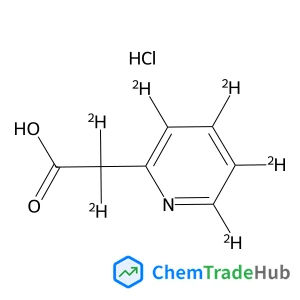
2,2-dideuterio-2-(3,4,5,6-tetradeuterio-2-pyridyl)acetic acid;hydrochloride
CAS Number:
1329799-67-8
Molecular Formula:
C7H2ClD6NO2
Erik M. Larsen, Chia-Fu Chang, Tomoyo Sakata-Kato, Joseph W. Arico, Vince M. Lombardo, Dyann F. Wirth, Richard E. Taylor
The synthesis of a 2-methyl-substituted analogue of the natural product, neopeltolide, is reported in an effort to analyze the importance of molecular conformation and ligand–target interactions in relation to biological activity. The methyl substitution was incorporated via highly diastereoselective ester enolate alkylation of a late-stage intermediate. Coupling of the oxazole sidechain provided 2-methyl-neopeltolide and synthetic neopeltolide via total synthesis. The substitution was shown to maintain the conformational preferences of its biologically active parent compound through computer modeling and NMR studies. Both compounds were shown to be potential antimalarial compounds through the inhibition of mitochondrial respiration in P. falciparum parasites.

Kinetics and Catalysis

Journal of Physics and Chemistry of Solids

Journal of Medicinal Chemistry

Proceedings of the National Academy of Sciences of the United States of America

Helvetica Chimica Acta

Journal of Organometallic Chemistry

Pure and Applied Chemistry

Planta Medica

Science Progress

Journal of Heterocyclic Chemistry
Wen-Jin Yin, Annabella Selloni, Li-Min Liu
DOI: 10.1039/C9CP05097C
Lu Wang, Michele Ceriotti, Thomas E. Markland
DOI: 10.1039/C9CP06483D
Kangli Wang, Beate Paulus
DOI: 10.1039/D0CP01239D
V. Esteso, L. G. MacDowell, D. F. Parsons, F. Spallek, H. Míguez, C. Persson, Stefan Yoshi Buhmann, I. Brevik
DOI: 10.1039/C9CP06836H
Eleonora Consiglieri, Kai-Hong Zhao, Wolfgang Gärtner, Aba Losi
DOI: 10.1039/D0CP02014A
Nandha Kumar, Nicola Seriani, Ralph Gebauer
DOI: 10.1039/C9CP06453B
Katherine McCullough, Travis Williams, Kathleen Mingle, Pooyan Jamshidi, Jochen Lauterbach
DOI: 10.1039/D0CP00972E
Pernille D. Pedersen, Kurt V. Mikkelsen, Matthew S. Johnson
DOI: 10.1039/D0CP00958J
Zhigang Li, Yan Qin, Liyuan Dong, Kai Li, Yang Qiao, Wei Li
DOI: 10.1039/D0CP01649G
Ruodi Cheng, Jonathan Martens, Travis D. Fridgen
DOI: 10.1039/D0CP00069H
4-Nitrophenyl phosphate disodium salt hexahydrate is primarily used as a substra...
2-(Trifluoromethyl)-1,3-oxazole-4-carboxylic Acid (CAS: 1060816-01-4) is widely ...
2-Fluoro-4-biphenylcarboxylic acid should be stored in a cool, dry place at room...
Prednisolone-21-Carboxylic Acid is primarily used in the pharmaceutical industry...
4-(Hydrazinomethyl)-1,2,3-benzenetriol (CAS: 3614-72-0) should be stored in a co...
4-Amino-1-methyl-1H-pyrazole-5-carboxylic acid hydrochloride (CAS: 92534-70-8) i...
Dehydropachymic acid (CAS: 77012-31-8) is regulated by various agencies. It fall...
The market and research trends for 6-[(2,2-Dimethylpropanoyl)amino]nicotinic aci...
1,10-Phenanthroline-2,9-dicarbaldehyde should be stored in a cool, dry place awa...
5-Carbamoyl-11-oxo-10,11-dihydro-5H-dibenzo[b,f]azepin-10-yl acetate can be synt...

Organic & Biomolecular Chemistry (OBC) publishes original and high impact research and reviews in organic chemistry. We welcome research that shows new or significantly improved protocols or methodologies in total synthesis, synthetic methodology or physical and theoretical organic chemistry as well as research that shows a significant advance in the organic chemistry or molecular design aspects of chemical biology, catalysis, supramolecular and macromolecular chemistry, theoretical chemistry, mechanism-oriented physical organic chemistry, medicinal chemistry or natural products. Articles published in the journal should report new work which makes a highly-significant impact in the field. Routine and incremental work is generally not suitable for publication in the journal. More details about key areas of our scope are below. In all cases authors should include in their article clear rationale for why their research has been carried out.
![(2E)-3-(3-Chlorophenyl)-N-{2-[4-(methylsulfonyl)-1-piperazinyl]-2-oxoethyl}acrylamide structure](https://static.chemtradehub.com/structs/250/2505001-54-5-c1e9.webp "(2E)-3-(3-Chlorophenyl)-N-{2-[4-(methylsulfonyl)-1-piperazinyl]-2-oxoethyl}acrylamide structure")