


Guanidine functionalized anthranilamides as effective antibacterials with biofilm disruption activity
Literature Information
Publication Date
2018-07-19
DOI
10.1039/C8OB01699B
Impact Factor
3.876
Authors
Rajesh Kuppusamy, Muhammad Yasir, Eugene Yee, Mark Willcox, David StC. Black, Naresh Kumar
View Original
Abstract
We describe a library of amphiphilic anthranilamide compounds as antimicrobial peptide (AMP) mimics. These contain a hydrophobic naphthoyl side chain and different hydrophilic cationic groups such as amino, quaternary ammonium and guanidino groups. These are prepared via the ring-opening of different isatoic anhydrides. The antibacterial activity against S. aureus and E. coli of compounds containing guanidino cationic groups was greater than that for amino and quaternary ammonium cationic groups. The fluoro-substituted guanidinium compound 9b showed a minimum inhibitory concentration (MIC) of 2.0 μM against S. aureus, and reduced established biofilms of S. aureus by 92% at 64 μM concentration. The bromo-substituted guanidinium compound 9d exhibited good MIC against S. aureus (3.9 μM) and E. coli (15.6 μM) and disrupted established biofilms of S. aureus by 83% at 62.4 μM concentration. Cytoplasmic membrane permeability studies suggested that depolarization and disruption of the bacterial cell membrane could be a possible mechanism for antibacterial activity and the in vitro toxicity studies against MRC-5 human lung fibroblast cells showed that the potent compounds are non-toxic against mammalian cells.
Recommended Journals

Pure and Applied Chemistry

Science Progress

Proceedings of the National Academy of Sciences of the United States of America

Journal of Heterocyclic Chemistry

Helvetica Chimica Acta

Planta Medica

Journal of Medicinal Chemistry

Journal of Physics and Chemistry of Solids

Molecular Pharmacology

Kinetics and Catalysis
Related Literature
Ionization energies in solution with the QM:QM approach
Zsuzsanna Tóth, Jakub Kubečka, Eva Muchová, Petr Slavíček
2020-01-22
Paper
DOI: 10.1039/C9CP06154A
Highly-excited state properties of cumulenone chlorides in the vacuum-ultraviolet
Quynh L. D. Nguyen, William K. Peters, Ryan C. Fortenberry
2020-05-09
Paper
DOI: 10.1039/D0CP01835J
Influence of alkaline-earth metal substitution on structure, electrical conductivity and oxygen transport properties of perovskite-type oxides La0.6A0.4FeO3−δ (A = Ca, Sr and Ba)
Jia Song, De Ning, Henny J. M. Bouwmeester
2020-05-07
Paper
DOI: 10.1039/D0CP00247J
Surface-orientation- and ligand-dependent quenching of the spin magnetic moment of Co porphyrins adsorbed on Cu substrates
Md. Ehesan Ali, Matthias Bernien, Nino Hatter, Fabian Nickel, Lalminthang Kipgen, Christian F. Hermanns, Timo Bißwanger, Philip Loche, Benjamin W. Heinrich, Katharina J. Franke, Peter M. Oppeneer, Wolfgang Kuch
2020-05-18
Paper
DOI: 10.1039/D0CP00854K
Water structures on a Pt(111) electrode from ab initio molecular dynamic simulations for a variety of electrochemical conditions
Sung Sakong, Axel Groß
2020-01-17
Paper
DOI: 10.1039/C9CP06584A
Wetting state transition of a liquid gallium drop at the nanoscale
Meng Yan, Tao Li, Peiru Zheng, Rubin Wei, Yanyan Jiang, Hui Li
2020-04-21
Paper
DOI: 10.1039/D0CP00985G
Bi-stimuli assisted engineering and control of magnetic phase in monolayer CrOCl
A. K. Nair, S. Rani, M. Venkata Kamalakar, S. J. Ray
2020-04-17
Paper
DOI: 10.1039/D0CP01204A
You might also like
Compound Q&A
What are the main uses of 4-Nitrophenyl phosphate disodium salt hexahydrate (CAS: 333338-18-4)?
4-Nitrophenyl phosphate disodium salt hexahydrate is primarily used as a substra...
333338-18-44-Nitrophenyl phosph...
Compound Q&A
What are the main uses of 2-(Trifluoromethyl)-1,3-oxazole-4-carboxylic Acid (CAS: 1060816-01-4)?
2-(Trifluoromethyl)-1,3-oxazole-4-carboxylic Acid (CAS: 1060816-01-4) is widely ...
1060816-01-42-(Trifluoromethyl)-...
Compound Q&A
How should 2-Fluoro-4-biphenylcarboxylic acid (CAS: 137045-30-8) be stored?
2-Fluoro-4-biphenylcarboxylic acid should be stored in a cool, dry place at room...
137045-30-82-Fluoro-4-biphenylc...
Compound Q&A
What industries use Prednisolone-21-Carboxylic Acid (CAS: 61549-70-0)?
Prednisolone-21-Carboxylic Acid is primarily used in the pharmaceutical industry...
61549-70-0Prednisolone-21-Carb...
Compound Q&A
How should 4-(Hydrazinomethyl)-1,2,3-benzenetriol (CAS: 3614-72-0) be stored?
4-(Hydrazinomethyl)-1,2,3-benzenetriol (CAS: 3614-72-0) should be stored in a co...
3614-72-04-(Hydrazinomethyl)-...
Compound Q&A
What industries use 4-Amino-1-methyl-1H-pyrazole-5-carboxylic acid hydrochloride (CAS: 92534-70-8)?
4-Amino-1-methyl-1H-pyrazole-5-carboxylic acid hydrochloride (CAS: 92534-70-8) i...
92534-70-84-Amino-1-methyl-1H-...
Compound Q&A
What regulatory guidelines apply to dehydropachymic acid (CAS: 77012-31-8)?
Dehydropachymic acid (CAS: 77012-31-8) is regulated by various agencies. It fall...
77012-31-8Dehydropachymic acid
Compound Q&A
What is the market or research trend for 6-[(2,2-Dimethylpropanoyl)amino]nicotinic acid (CAS: 898561-66-5)?
The market and research trends for 6-[(2,2-Dimethylpropanoyl)amino]nicotinic aci...
898561-66-56-[(2,2-Dimethylprop...
Compound Q&A
How should 1,10-Phenanthroline-2,9-dicarbaldehyde (CAS: 57709-62-3) be stored?
1,10-Phenanthroline-2,9-dicarbaldehyde should be stored in a cool, dry place awa...
57709-62-31,10-Phenanthroline-...
Compound Q&A
How is 5-Carbamoyl-11-oxo-10,11-dihydro-5H-dibenzo[b,f]azepin-10-yl acetate (CAS: 113952-21-9) typically synthesized?
5-Carbamoyl-11-oxo-10,11-dihydro-5H-dibenzo[b,f]azepin-10-yl acetate can be synt...
113952-21-95-Carbamoyl-11-oxo-1...
Source Journal
Organic & Biomolecular Chemistry

CiteScore:
3.4
Self-citation Rate:
10.3%
Articles per Year:
1041
Organic & Biomolecular Chemistry (OBC) publishes original and high impact research and reviews in organic chemistry. We welcome research that shows new or significantly improved protocols or methodologies in total synthesis, synthetic methodology or physical and theoretical organic chemistry as well as research that shows a significant advance in the organic chemistry or molecular design aspects of chemical biology, catalysis, supramolecular and macromolecular chemistry, theoretical chemistry, mechanism-oriented physical organic chemistry, medicinal chemistry or natural products. Articles published in the journal should report new work which makes a highly-significant impact in the field. Routine and incremental work is generally not suitable for publication in the journal. More details about key areas of our scope are below. In all cases authors should include in their article clear rationale for why their research has been carried out.
Recommended Compounds
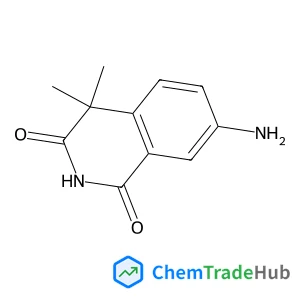
1,3(2H,4H)-Isoquinolinedione, 7-amino-4,4-dimethyl-
CAS Number:
14576-22-8
Molecular Formula:
C11H12N2O2

Recommended Suppliers






Disclaimer
This page provides academic journal information for reference and research purposes only. We are not affiliated with any journal publishers and do not handle publication submissions. For publication-related inquiries, please contact the respective journal publishers directly.
If you notice any inaccuracies in the information displayed, please contact us at support@chemtradehub.com. We will promptly review and address your concerns.