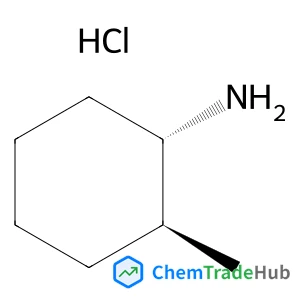
(1R,2R)-2-Methylcyclohexanamine hydrochloride (1:1)
CAS Number:
39558-31-1
Molecular Formula:
C7H16ClN
Susanne Lahdenperä, Anni Spangar, Anna-Maija Lempainen, Laura Joki, Tero Soukka
Switchable lanthanide luminescence is a binary probe technology that inherently enables a high signal modulation in separation-free detection of DNA targets. A luminescent lanthanide complex is formed only when the two probes hybridize adjacently to their target DNA. We have now further adapted this technology for the first time in the integration of a 2-plex polymerase chain reaction (PCR) amplification and hybridization-based solid-phase detection of the amplification products of the Staphylococcus aureus gyrB gene and an internal amplification control (IAC). The assay was performed in a sealed polypropylene PCR chip containing a flat-bottom reaction chamber with two immobilized capture probe spots. The surface of the reaction chamber was functionalized with NHS-PEG-azide and alkyne-modified capture probes for each amplicon, labeled with a light harvesting antenna ligand, and covalently attached as spots to the azide-modified reaction chamber using a copper(I)-catalyzed azide–alkyne cycloaddition. Asymmetric duplex-PCR was then performed with no template, one template or both templates present and with a europium ion carrier chelate labeled probe for each amplicon in the reaction. After amplification europium fluorescence was measured by scanning the reaction chamber as a 10 × 10 raster with 0.6 mm resolution in time-resolved mode. With this assay we were able to co-amplify and detect the amplification products of the gyrB target from 100, 1000 and 10 000 copies of isolated S. aureus DNA together with the amplification products from the initial 5000 copies of the synthetic IAC template in the same sealed reaction chamber. The addition of 10 000 copies of isolated non-target Escherichia coli DNA in the same reaction with 5000 copies of the synthetic IAC template did not interfere with the amplification or detection of the IAC. The dynamic range of the assay for the synthetic S. aureus gyrB target was three orders of magnitude and the limit of detection of 8 pM was obtained. This proof-of-concept study shows that the switchable lanthanide luminescent probes enable separation-free array-based multiplexed detection of the amplification products in a closed-tube PCR which can enable a higher degree of multiplexing than is currently feasible by using different spectrally separated fluorescent probes.
Shampa R. Samanta, Vasiliki Nikolaou, Shauni Keller, Michael J. Monteiro, Daniela A. Wilson, David M. Haddleton, Virgil Percec
DOI: 10.1039/C4PY01748J
Jian Hu, Jinlin He, Mingzu Zhang, Peihong Ni
DOI: 10.1039/C4PY01391C
Alaina J. McGrath, Weichao Shi, Christina G. Rodriguez, Nathaniel A. Lynd
DOI: 10.1039/C4PY01503G
Ali Demirci, Shunsuke Yamamoto, Jun Matsui, Tokuji Miyashita, Masaya Mitsuishi
DOI: 10.1039/C5PY00018A
Gang Qi, Yunhai Yu, Junpo He
DOI: 10.1039/C5PY01674F
M. Andersson, J. Engström, P. Restorp
DOI: 10.1039/C5PY01935D
Guillaume Chollet
DOI: 10.1039/C5PY01964H
Ze-Huan Hei, Mu-Hua Huang, Yunjun Luo, Yingxiong Wang
DOI: 10.1039/C5PY01682G
Fangyi Cao, Tongcun Huang, Yifei Wang, Fei Liu, Lumin Chen, Jun Ling, Jihong Sun
DOI: 10.1039/C5PY01011J
2-(2-Chloroacetamido)-3-phenylpropanoic acid (CAS: 7765-11-9) is generally consi...
2-(Benzyloxy)-5-bromobenzoic acid can be handled safely if appropriate precautio...
(4-Methyl-1,2,5-oxadiazol-3-yl)methanamine hydrochloride is a chemical compound ...
2-(5-Hexylthiophen-2-yl)-4,4,5,5-tetramethyl-1,3,2-dioxaborolane (CAS: 917985-54...
While 4-(8-Methyl-9H-1,3-dioxolo[4,5-h][2,3]benzodiazepin-5-yl)benzenamine (CAS:...
The market for tert-butyl 3-hydroxy-4,5,7,8-tetrahydro-2H-pyrazolo[3,4-d]azepine...
Waste containing 3,5-Diamino-1H-pyrazole-4-carbonitrile (CAS: 6844-58-2) should ...
(6-Fluoro-3-pyridinyl)boronic acid can be synthesized through the reaction of 6-...
Dibenzyl carbonimidoylbiscarbamate (CAS: 10065-79-9) finds applications in vario...
The market for (beta,beta,2,3,4,5,6-~2~H_7_)Phenylalanine (CAS: 74228-83-4) is g...

Analyst publishes analytical and bioanalytical research that reports premier fundamental discoveries and inventions, and the applications of those discoveries, unconfined by traditional discipline barriers.
![N-[2,6-Di(9-anthryl)-4-oxido-8,9,10,11,12,13,14,15-octahydrodinaphtho[2,1-d:1',2'-f][1,3,2]dioxaphosphepin-4-yl]-1,1,1-trifluoromethanesulfonamide structure](https://static.chemtradehub.com/structs/122/1227374-64-2-cdb5.webp "N-[2,6-Di(9-anthryl)-4-oxido-8,9,10,11,12,13,14,15-octahydrodinaphtho[2,1-d:1',2'-f][1,3,2]dioxaphosphepin-4-yl]-1,1,1-trifluoromethanesulfonamide structure")
![2-(5-Bromo-1H-pyrrolo[2,3-B]pyridin-3-YL)acetic acid structure](https://static.chemtradehub.com/structs/106/1060795-03-0-0589.webp "2-(5-Bromo-1H-pyrrolo[2,3-B]pyridin-3-YL)acetic acid structure")