












Activated lipidic cyclic carbonates for non-isocyanate polyurethane synthesis
Literature Information
Publication Date
2016-01-11
DOI
10.1039/C5PY01964H
Impact Factor
5.582
Authors
Guillaume Chollet
View Original
Abstract
Activated 5-membered cyclic carbonates were prepared from glycerol and fatty acid derivatives. Ester and ether moieties were introduced in the β position to the cyclic carbonate, in order to enhance its reactivity towards amines. 1H NMR kinetic investigation of the aminolysis of these cyclic carbonates demonstrated a higher reactivity compared to the one of alkyl substituted cyclic carbonates. In the case of ester-activated carbonates, a reactivity similar to the one of 6-membered ring cyclic carbonates was observed. Moreover, these carbonates exhibited amidation side-reactions with amines that could be however prevented by decreasing the temperature to room temperature. Poly(hydroxyurethane)s (PHUs) were then synthesized from these activated 5-membered ring cyclic carbonates at 70 °C in DMF (1 mol L−1) and exhibited molar masses up to 13 700 g mol−1 with Tg in the range −26 to −10 °C.
Recommended Journals
Related Literature
Prospects for plasmonic hot spots in single molecule SERS towards the chemical imaging of live cells
Darya Radziuk, Helmuth Moehwald
2015-01-08
Perspective
DOI: 10.1039/C4CP04946B
Polypeptide A9K at nanoscale carbon: a simulation study
Vitaly V. Chaban, Andre Arruda, Eudes Eterno Fileti
2015-09-08
Paper
DOI: 10.1039/C5CP04565G
The catalyzed hydrogen sorption mechanism in alkali alanates
Züleyha Özlem Kocabas Atakli, Shin-Ichi Orimo
2015-07-13
Paper
DOI: 10.1039/C5CP01684C
Trends in non-metal doping of the SrTiO3 surface: a hybrid density functional study
Yating Guo, Xiaowei Qiu, Hao Dong, Xin Zhou
2015-07-09
Paper
DOI: 10.1039/C5CP03005F
In situ Raman and surface-enhanced Raman spectroscopy on working electrodes: spectroelectrochemical characterization of water oxidation electrocatalysts
Xavier Sala
2015-02-09
Perspective
DOI: 10.1039/C4CP05053C
New data on photochemistry of the interstellar molecule: HNCS. Identification of the S⋯HCN complex
Justyna Krupa, Iwona Kosendiak, Maria Wierzejewska
2015-07-27
Paper
DOI: 10.1039/C5CP03663A
Plasmonic properties of regiospecific core–satellite assemblies of gold nanostars and nanospheres
A. Swarnapali D. S. Indrasekara, Roney Thomas
2014-10-31
Paper
DOI: 10.1039/C4CP04517C
Nonlinear optical imaging of single plasmonic nanoparticles with 30 nm resolution
Anke Horneber, Kai Braun, Jan Rogalski, Paul Leiderer, Alfred J. Meixner, Dai Zhang
2015-01-23
Paper
DOI: 10.1039/C4CP05342G
Exploring the charged nature of supramolecular micelles based on p-sulfonatocalix[6]arene and dodecyltrimethylammonium bromide
Nuno Basílio, Daniel Alfonso Spudeit, Juliana Bastos, Leandro Scorsin, Haidi D. Fiedler, Faruk Nome, Luis García-Río
2015-09-09
Paper
DOI: 10.1039/C5CP03718B
You might also like
Compound Q&A
Is 2-(2-chloroacetamido)-3-phenylpropanoic acid (CAS: 7765-11-9) safe?
2-(2-Chloroacetamido)-3-phenylpropanoic acid (CAS: 7765-11-9) is generally consi...
7765-11-92-(2-chloroacetamido...
Compound Q&A
Is 2-(Benzyloxy)-5-bromobenzoic acid (CAS: 62176-31-2) safe?
2-(Benzyloxy)-5-bromobenzoic acid can be handled safely if appropriate precautio...
62176-31-22-(Benzyloxy)-5-brom...
Compound Q&A
What is (4-Methyl-1,2,5-oxadiazol-3-yl)methanamine hydrochloride (CAS: 1159825-48-5)?
(4-Methyl-1,2,5-oxadiazol-3-yl)methanamine hydrochloride is a chemical compound ...
1159825-48-5(4-Methyl-1,2,5-oxad...
Compound Q&A
What is 2-(5-Hexylthiophen-2-yl)-4,4,5,5-tetramethyl-1,3,2-dioxaborolane (CAS: 917985-54-7)?
2-(5-Hexylthiophen-2-yl)-4,4,5,5-tetramethyl-1,3,2-dioxaborolane (CAS: 917985-54...
917985-54-72-(5-Hexylthiophen-2...
Compound Q&A
Are there alternatives to 4-(8-Methyl-9H-1,3-dioxolo[4,5-h][2,3]benzodiazepin-5-yl)benzenamine (CAS: 102771-26-6) in synthesis?
While 4-(8-Methyl-9H-1,3-dioxolo[4,5-h][2,3]benzodiazepin-5-yl)benzenamine (CAS:...
102771-26-64-(8-Methyl-9H-1,3-d...
Compound Q&A
What is the market or research trend for tert-butyl 3-hydroxy-4,5,7,8-tetrahydro-2H-pyrazolo[3,4-d]azepine-6-carboxylate (CAS: 851376-80-2)?
The market for tert-butyl 3-hydroxy-4,5,7,8-tetrahydro-2H-pyrazolo[3,4-d]azepine...
851376-80-2tert-butyl 3-hydroxy...
Compound Q&A
How should waste containing 3,5-Diamino-1H-pyrazole-4-carbonitrile (CAS: 6844-58-2) be handled?
Waste containing 3,5-Diamino-1H-pyrazole-4-carbonitrile (CAS: 6844-58-2) should ...
6844-58-23,5-Diamino-1H-pyraz...
Compound Q&A
How is (6-Fluoro-3-pyridinyl)boronic acid (CAS: 351019-18-6) typically synthesized?
(6-Fluoro-3-pyridinyl)boronic acid can be synthesized through the reaction of 6-...
351019-18-6(6-Fluoro-3-pyridiny...
Compound Q&A
What industries use Dibenzyl carbonimidoylbiscarbamate (CAS: 10065-79-9)?
Dibenzyl carbonimidoylbiscarbamate (CAS: 10065-79-9) finds applications in vario...
10065-79-9Dibenzyl carbonimido...
Compound Q&A
What is the market or research trend for (beta,beta,2,3,4,5,6-~2~H_7_)Phenylalanine (CAS: 74228-83-4)?
The market for (beta,beta,2,3,4,5,6-~2~H_7_)Phenylalanine (CAS: 74228-83-4) is g...
74228-83-4(beta,beta,2,3,4,5,6...
Source Journal
Polymer Chemistry

CiteScore:
8.6
Self-citation Rate:
7.3%
Articles per Year:
457
Polymer Chemistry welcomes submissions in all areas of polymer science that have a strong focus on macromolecular chemistry. Manuscripts may cover a broad range of fields, yet no direct application focus is required.
Recommended Compounds
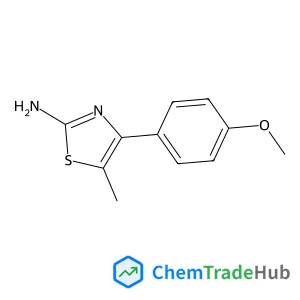
4-(4-Methoxyphenyl)-5-methyl-1,3-thiazol-2-amine
CAS Number:
105512-88-7
Molecular Formula:
C11H12N2OS
![2-Methyl-2-propanyl 4-oxo-3,9-diazabicyclo[4.2.1]nonane-9-carboxylate structure](https://static.chemtradehub.com/structs/131/1312456-05-5-9a15.webp "2-Methyl-2-propanyl 4-oxo-3,9-diazabicyclo[4.2.1]nonane-9-carboxylate structure")
2-Methyl-2-propanyl 4-oxo-3,9-diazabicyclo[4.2.1]nonane-9-carboxylate
CAS Number:
1312456-05-5
Molecular Formula:
C12H20N2O3
![(4-Methyl-1H-benzo[d]imidazol-2-yl)methanamine structure](https://static.chemtradehub.com/structs/933/933756-31-1-7b0b.webp "(4-Methyl-1H-benzo[d]imidazol-2-yl)methanamine structure")
Recommended Suppliers





Disclaimer
This page provides academic journal information for reference and research purposes only. We are not affiliated with any journal publishers and do not handle publication submissions. For publication-related inquiries, please contact the respective journal publishers directly.
If you notice any inaccuracies in the information displayed, please contact us at support@chemtradehub.com. We will promptly review and address your concerns.