












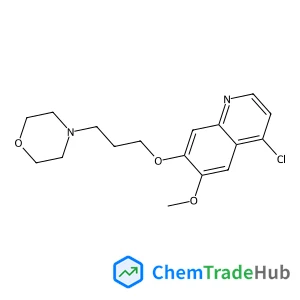
4-(3-((4-Chloro-6-methoxyquinolin-7-yl)oxy)propyl)morpholine
CAS Number:
205448-32-4
Molecular Formula:
C17H21ClN2O3
Jian Hu, Jinlin He, Mingzu Zhang, Peihong Ni
A series of well-defined three-armed star-block copolymers containing poly(ethylene glycol) monomethyl ether (mPEG) and poly(ε-caprolactone) (PCL) blocks linked with acid-cleavable acetal groups, designated as (mPEG-acetal-PCL-acetal-)3 or (mPEG-a-PCL-a-)3, have been prepared via a “coupling-onto” method based on ring-opening polymerization (ROP) and Cu(I)-catalyzed azide–alkyne cycloaddition (CuAAC) “Click” chemistry. The chemical compositions and structures, as well as the molecular weights and molecular weight distributions (PDIs) of these copolymers have been fully characterized by 1H NMR, FT-IR, and GPC measurements. Differential scanning calorimetry (DSC) and wide-angle X-ray diffraction (WAXD) analyses demonstrated that the thermal behaviors of the star-block copolymers strongly depended on the relative lengths of PEG and PCL blocks in the arms. The self-assembly behaviors of these amphiphilic star-block copolymers were investigated by a fluorescence probe method, dynamic light scattering (DLS) and transmission electron microscopy (TEM) analyses. The results showed that they could self-assemble into spherical micelles at low concentrations and mainly formed short rod-like micelles at high concentrations. Moreover, the acid-cleavable properties of these star-block copolymers were systematically studied by 1H NMR, GPC, and DLS measurements, and the results indicated that they were relatively stable in neutral pH media, but could be degraded under acidic conditions. The in vitro DOX release studies showed that DOX was released from drug-loaded micelles in a pH-sensitive manner. MTT assays demonstrated that these star-block copolymers possess low cytotoxicity against L929 cells and HeLa cells, and the DOX-loaded micelles exhibit a higher inhibition of the proliferation of HeLa cells in comparison with free DOX. Moreover, the results from the live cell imaging system and flow cytometry analysis revealed that these polymeric micelles could efficiently deliver and release DOX into the nuclei of HeLa cells. These pH-triggered shell-sheddable micelles are highly promising for the efficient intracellular delivery of hydrophobic anti-cancer drugs.
Nabin Kumar Pal, Carola Kryschi
DOI: 10.1039/C5CP01773D
Xavier Sala
DOI: 10.1039/C4CP05053C
Alexander Volk, Daniel Knez, Philipp Thaler, Andreas W. Hauser, Werner Grogger, Ferdinand Hofer, Wolfgang E. Ernst
DOI: 10.1039/C5CP04696C
Zhen Zhu, Jiamin Xiao, Haibin Sun, Yue Hu, Ronggen Cao, Yin Wang, Li Zhao, Jun Zhuang
DOI: 10.1039/C5CP02558C
K. P. Rajappan Nair, Michaela K. Jahn, Alberto Lesarri, Vadim V. Ilyushin, Jens-Uwe Grabow
DOI: 10.1039/C5CP03751D
Saravanan Kuppan, Hugues Duncan, Guoying Chen
DOI: 10.1039/C5CP04899K
Ryuji Matsushita, Manabu Kiguchi
DOI: 10.1039/C4CP04906C
Hsu-Sheng Tsai, Yu-Ze Chen, Henry Medina, Teng-Yu Su, Ta-Shun Chou, Yi-Hsuan Chen, Yu-Lun Chueh, Jenq-Horng Liang
DOI: 10.1039/C5CP02469B
Chiun-Yan Lin, Jhao-Ying Wu, Yih-Jon Ou, Yu-Huang Chiu, Ming-Fa Lin
DOI: 10.1039/C5CP05013H
Bo Wang, Songmei Li, Xiaoyu Wu, Bin Li, Jianhua Liu, Mei Yu
DOI: 10.1039/C5CP03042K
2-(2-Chloroacetamido)-3-phenylpropanoic acid (CAS: 7765-11-9) is generally consi...
2-(Benzyloxy)-5-bromobenzoic acid can be handled safely if appropriate precautio...
(4-Methyl-1,2,5-oxadiazol-3-yl)methanamine hydrochloride is a chemical compound ...
2-(5-Hexylthiophen-2-yl)-4,4,5,5-tetramethyl-1,3,2-dioxaborolane (CAS: 917985-54...
While 4-(8-Methyl-9H-1,3-dioxolo[4,5-h][2,3]benzodiazepin-5-yl)benzenamine (CAS:...
The market for tert-butyl 3-hydroxy-4,5,7,8-tetrahydro-2H-pyrazolo[3,4-d]azepine...
Waste containing 3,5-Diamino-1H-pyrazole-4-carbonitrile (CAS: 6844-58-2) should ...
(6-Fluoro-3-pyridinyl)boronic acid can be synthesized through the reaction of 6-...
Dibenzyl carbonimidoylbiscarbamate (CAS: 10065-79-9) finds applications in vario...
The market for (beta,beta,2,3,4,5,6-~2~H_7_)Phenylalanine (CAS: 74228-83-4) is g...

Polymer Chemistry welcomes submissions in all areas of polymer science that have a strong focus on macromolecular chemistry. Manuscripts may cover a broad range of fields, yet no direct application focus is required.
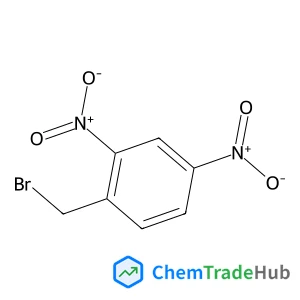
![2-Azaspiro[4.5]decane-3,8-dione structure](https://static.chemtradehub.com/structs/914/914780-96-4-e94b.webp "2-Azaspiro[4.5]decane-3,8-dione structure")
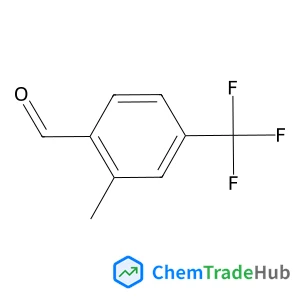
![N-[2,6-Di(9-anthryl)-4-oxido-8,9,10,11,12,13,14,15-octahydrodinaphtho[2,1-d:1',2'-f][1,3,2]dioxaphosphepin-4-yl]-1,1,1-trifluoromethanesulfonamide structure](https://static.chemtradehub.com/structs/122/1227374-64-2-cdb5.webp "N-[2,6-Di(9-anthryl)-4-oxido-8,9,10,11,12,13,14,15-octahydrodinaphtho[2,1-d:1',2'-f][1,3,2]dioxaphosphepin-4-yl]-1,1,1-trifluoromethanesulfonamide structure")




