












Stimuli responsive nanostructured porous network from triblock copolymer self-assemblies
Literature Information
Publication Date
2015-01-07
DOI
10.1039/C4PY01692K
Impact Factor
5.582
Authors
Zineb Mouline, Mona Semsarilar, Andre Deratani, Damien Quemener
View Original
Abstract
An ABA triblock amphiphilic copolymer is synthesized using RAFT chemistry. The self-assembled micelles of this copolymer are then used to prepare nano-organized porous films that could be used as filtration membranes. In this work a novel strategy is developed to build the nanostructures and perform their self-assembly using reversible and non-covalent interactions to create free volume between the micelles, thus giving tuneable porosity to the film. The self-assembly of poly(styrene)-b-poly(phenylboronic acid)-b-poly(styrene) block copolymer, occurs at high concentration through solvent evaporation, which induces a progressive decrease of the inter-micellar distance, and results in the formation of an in situ network of micelles and the final porous film. Subsequent permeability tests were conducted under different stimuli (pH and UV), generating cross-linking and chemical exchange reactions, to ensure the best balance between permeability and mechanical strength. This work highlights an original strategy for pore size control, and provides new insights towards the design of stimuli-responsive materials.
Recommended Journals
Related Literature
An in situ high-temperature scanning electron microscopy study of acanthite–argentite phase transformation in nanocrystalline silver sulfide powder
S. I. Sadovnikov, A. I. Gusev
2015-07-24
Communication
DOI: 10.1039/C5CP02499D
Controlling side reactions and self-discharge in high-voltage spinel cathodes: the critical role of surface crystallographic facets
Saravanan Kuppan, Hugues Duncan, Guoying Chen
2015-09-08
Paper
DOI: 10.1039/C5CP04899K
Dynamic interface tension of a smectic liquid crystal in anionic surfactant solutions
Kirsten Harth, Larissa M. Shepherd, James Honaker, Ralf Stannarius
2015-09-09
Paper
DOI: 10.1039/C5CP04193G
A detailed study of cholinium chloride and levulinic acid deep eutectic solvent system for CO2 capture via experimental and molecular simulation approaches
Ruh Ullah, Mert Atilhan, Baraa Anaya, Majeda Khraisheh, Gregorio García, Ahmed ElKhattat, Mohammad Tariq, Santiago Aparicio
2015-06-30
Paper
DOI: 10.1039/C5CP03364K
A novel conception for spontaneous transversions caused by homo-pyrimidine DNA mismatches: a QM/QTAIM highlight
2015-07-13
Communication
DOI: 10.1039/C5CP03211C
Tandem mass spectrometry and infrared spectroscopy as a tool to identify peptide oxidized residues
2015-08-10
Paper
DOI: 10.1039/C5CP03223G
Far- and near-field properties of gold nanoshells studied by photoacoustic and surface-enhanced Raman spectroscopies
V. Weber, A. Feis, C. Gellini, R. Pilot, P. R. Salvi, R. Signorini
2014-12-19
Paper
DOI: 10.1039/C4CP05054A
Improved Raman and photoluminescence sensitivity achieved using bifunctional Ag@SiO2 nanocubes
Nguyen Minh Kha, Ching-Hsiang Chen, Wei-Nien Su, John Rick
2015-01-13
Paper
DOI: 10.1039/C4CP05217J
The charge/discharge mechanism and electrochemical performance of CuV2O6 as a new anode material for Li-ion batteries
Jianjun Ma, Jicheng Zhang
2015-07-29
Paper
DOI: 10.1039/C5CP03435C
You might also like
Compound Q&A
Is 2-(2-chloroacetamido)-3-phenylpropanoic acid (CAS: 7765-11-9) safe?
2-(2-Chloroacetamido)-3-phenylpropanoic acid (CAS: 7765-11-9) is generally consi...
7765-11-92-(2-chloroacetamido...
Compound Q&A
Is 2-(Benzyloxy)-5-bromobenzoic acid (CAS: 62176-31-2) safe?
2-(Benzyloxy)-5-bromobenzoic acid can be handled safely if appropriate precautio...
62176-31-22-(Benzyloxy)-5-brom...
Compound Q&A
What is (4-Methyl-1,2,5-oxadiazol-3-yl)methanamine hydrochloride (CAS: 1159825-48-5)?
(4-Methyl-1,2,5-oxadiazol-3-yl)methanamine hydrochloride is a chemical compound ...
1159825-48-5(4-Methyl-1,2,5-oxad...
Compound Q&A
What is 2-(5-Hexylthiophen-2-yl)-4,4,5,5-tetramethyl-1,3,2-dioxaborolane (CAS: 917985-54-7)?
2-(5-Hexylthiophen-2-yl)-4,4,5,5-tetramethyl-1,3,2-dioxaborolane (CAS: 917985-54...
917985-54-72-(5-Hexylthiophen-2...
Compound Q&A
Are there alternatives to 4-(8-Methyl-9H-1,3-dioxolo[4,5-h][2,3]benzodiazepin-5-yl)benzenamine (CAS: 102771-26-6) in synthesis?
While 4-(8-Methyl-9H-1,3-dioxolo[4,5-h][2,3]benzodiazepin-5-yl)benzenamine (CAS:...
102771-26-64-(8-Methyl-9H-1,3-d...
Compound Q&A
What is the market or research trend for tert-butyl 3-hydroxy-4,5,7,8-tetrahydro-2H-pyrazolo[3,4-d]azepine-6-carboxylate (CAS: 851376-80-2)?
The market for tert-butyl 3-hydroxy-4,5,7,8-tetrahydro-2H-pyrazolo[3,4-d]azepine...
851376-80-2tert-butyl 3-hydroxy...
Compound Q&A
How should waste containing 3,5-Diamino-1H-pyrazole-4-carbonitrile (CAS: 6844-58-2) be handled?
Waste containing 3,5-Diamino-1H-pyrazole-4-carbonitrile (CAS: 6844-58-2) should ...
6844-58-23,5-Diamino-1H-pyraz...
Compound Q&A
How is (6-Fluoro-3-pyridinyl)boronic acid (CAS: 351019-18-6) typically synthesized?
(6-Fluoro-3-pyridinyl)boronic acid can be synthesized through the reaction of 6-...
351019-18-6(6-Fluoro-3-pyridiny...
Compound Q&A
What industries use Dibenzyl carbonimidoylbiscarbamate (CAS: 10065-79-9)?
Dibenzyl carbonimidoylbiscarbamate (CAS: 10065-79-9) finds applications in vario...
10065-79-9Dibenzyl carbonimido...
Compound Q&A
What is the market or research trend for (beta,beta,2,3,4,5,6-~2~H_7_)Phenylalanine (CAS: 74228-83-4)?
The market for (beta,beta,2,3,4,5,6-~2~H_7_)Phenylalanine (CAS: 74228-83-4) is g...
74228-83-4(beta,beta,2,3,4,5,6...
Source Journal
Polymer Chemistry

CiteScore:
8.6
Self-citation Rate:
7.3%
Articles per Year:
457
Polymer Chemistry welcomes submissions in all areas of polymer science that have a strong focus on macromolecular chemistry. Manuscripts may cover a broad range of fields, yet no direct application focus is required.
Recommended Compounds
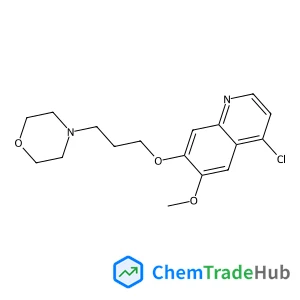
4-(3-((4-Chloro-6-methoxyquinolin-7-yl)oxy)propyl)morpholine
CAS Number:
205448-32-4
Molecular Formula:
C17H21ClN2O3
Recommended Suppliers





Disclaimer
This page provides academic journal information for reference and research purposes only. We are not affiliated with any journal publishers and do not handle publication submissions. For publication-related inquiries, please contact the respective journal publishers directly.
If you notice any inaccuracies in the information displayed, please contact us at support@chemtradehub.com. We will promptly review and address your concerns.