












![(4-Methyl-1H-benzo[d]imidazol-2-yl)methanamine structure](https://static.chemtradehub.com/structs/933/933756-31-1-7b0b.webp "(4-Methyl-1H-benzo[d]imidazol-2-yl)methanamine structure")
Dual role for alkali metal cations in enhancing the low-temperature radical polymerization of N,N-dimethylacrylamide
Literature Information
Publication Date
2015-01-07
DOI
10.1039/C4PY01662A
Impact Factor
5.582
Authors
Tomohiro Hirano, Tatsuya Saito, Yoshitaka Kurano, Yohei Miwa, Miyuki Oshimura, Koichi Ute
View Original
Abstract
The radical polymerization of N,N-dimethylacrylamide (DMAAm) has been investigated in the presence of several alkali metal salts, including lithium bis(trifluoromethanesulfonyl)imide (LiNTf2). The addition of an alkali metal salt led to a significant increase in the yield and molecular weight of the resulting polymer. NMR analysis of mixtures of DMAAm and LiNTf2 suggested that DMAAm was being activated by the coordination of Li+ to its CO group. Electron spin resonance analysis of the DMAAm polymerization in the presence of LiNTf2 suggested that the propagating radical was being stabilized by Li+ through a single-electron lithium bond, because a signal for the propagating radical of the acrylamide derivatives was observed for the first time in solution when LiNTf2 was added. Based on these results, we have proposed a mechanism for this polymerization, where the propagation steps occur between a lithium ion-stabilized propagating radical and a lithium ion-activated incoming monomer. Furthermore, polymers with a wide range of stereoregularities, such as isotactic, syndiotactic and heterotactic systems, were successfully prepared using this method by carefully selecting the appropriate combination of solvent and alkali metal salt.
Related Literature
Structure–thermodynamics relationship of schoepite from first-principles
Philippe F. Weck, Carlos F. Jové-Colón, Eunja Kim
2019-09-24
Paper
DOI: 10.1039/C9CP04117F
Structural peculiarities of keto-carotenoids in water-soluble proteins revealed by simulation of linear absorption
Roman Y. Pishchalnikov, Igor A. Yaroshevich, Tatiana A. Slastnikova, Aleksandr A. Ashikhmin, Alexey V. Stepanov, Ekaterina A. Slutskaya, Thomas Friedrich
2019-11-05
Paper
DOI: 10.1039/C9CP04508B
Pressure-induced metallicity and piezoreductive transition of metal-centres in conductive 2-dimensional metal–organic frameworks
Khoa N. Le, Christopher H. Hendon
2019-11-05
Paper
DOI: 10.1039/C9CP04797B
Non-quenching photoluminescence emission up to at least 865 K upon near-UV excitation in a single crystal of orange-red emitting SmPO4
Jan Beyer, Richard Gloaguen, Johannes Heitmann
2019-11-11
Paper
DOI: 10.1039/C9CP05663G
Hydrophobic functional liquids based on trioctylphosphine oxide (TOPO) and carboxylic acids
Emily L. Byrne, Ruairi O’Donnell, Mark Gilmore, Nancy Artioli, John D. Holbrey, Małgorzata Swadźba-Kwaśny
2020-10-06
Paper
DOI: 10.1039/D0CP02605K
Differentiation of peptide isomers by excited-state photodissociation and ion–molecule interactions
Brielle L. Van Orman, Hoi-Ting Wu, Ryan R. Julian
2020-10-07
Paper
DOI: 10.1039/D0CP04111D
Critical phenomenon in the room-temperature ferromagnet Ce0.65Mg0.35Co3 prepared by high-pressure annealing
Weizheng Guan, Youwei Du
2020-09-30
Paper
DOI: 10.1039/D0CP03973J
Mechanistic insights into the phenomena of increasing capacity with cycle number: using pulsed-laser deposited MoO2 thin film electrodes
Michael Fenech, Sean Lim, Jeffrey Cheung, Neeraj Sharma
2019-11-02
Paper
DOI: 10.1039/C9CP05718H
In situ7Li-NMR analysis of lithium metal surface deposits with varying electrolyte compositions and concentrations
Verena Küpers, Martin Kolek, Peter Bieker, Gunther Brunklaus
2019-11-20
Paper
DOI: 10.1039/C9CP05334D
On the transition from partial wetting to complete wetting of methanol on graphite
Luisa Prasetyo, Toshihide Horikawa, Naoki Takashima, D. D. Do, D. Nicholson
2019-11-18
Paper
DOI: 10.1039/C9CP05118J
You might also like
Compound Q&A
What are the main uses of (5-Sulfamoyl-3-pyridinyl)boronic acid (CAS: 951233-61-7)?
(5-Sulfamoyl-3-pyridinyl)boronic acid is primarily used in chemical synthesis, p...
951233-61-7(5-Sulfamoyl-3-pyrid...
Compound Q&A
How is Benzyl 2-methyl-2-(methylsulfonyl)-4-pentenoate (CAS: 1942858-50-5) typically synthesized?
Benzyl 2-methyl-2-(methylsulfonyl)-4-pentenoate is typically synthesized via est...
1942858-50-5Benzyl 2-methyl-2-(m...
Compound Q&A
What precautions should be taken when handling 8-Fluoroquinolin-6-ol (CAS: 209353-22-0)?
When handling 8-Fluoroquinolin-6-ol (CAS: 209353-22-0), it is important to use p...
209353-22-08-Fluoroquinolin-6-o...
Compound Q&A
What are the physical and chemical properties of 1,3-Dibromo-5-(2-methyl-2-propanyl)benzene (CAS: 129316-09-2)?
1,3-Dibromo-5-(2-methyl-2-propanyl)benzene (CAS: 129316-09-2) is a crystalline c...
129316-09-21,3-Dibromo-5-(2-met...
Compound Q&A
What industries use Ethyl 7-chloro-4-oxo-1-(1,3-thiazol-2-yl)-1,4-dihydro-1,8-naphthyridine-3-carboxylate (CAS: 174726-87-5)?
Ethyl 7-chloro-4-oxo-1-(1,3-thiazol-2-yl)-1,4-dihydro-1,8-naphthyridine-3-carbox...
174726-87-5Ethyl 7-chloro-4-oxo...
Compound Q&A
What precautions should be taken when handling Delta-7-Avenasterol (CAS: 23290-26-8)?
When handling Delta-7-Avenasterol (CAS: 23290-26-8), it is important to wear app...
23290-26-8Delta-7-Avenasterol
Compound Q&A
What precautions should be taken when handling N-({(5R)-3-[3-Fluoro-4-(4-morpholinyl)phenyl]-2-oxo-1,3-oxazolidin-5-yl}methyl)acetamide (CAS: 872992-20-6)?
Proper handling involves the use of personal protective equipment such as gloves...
872992-20-6N-({(5R)-3-[3-Fluoro...
Compound Q&A
What precautions should be taken when handling 2-Methyl-2-proanyl 4-[(2-aminophenyl)amino]-1-piperidinecarboxylate (CAS: 79099-00-6)?
When handling 2-Methyl-2-proanyl 4-[(2-aminophenyl)amino]-1-piperidinecarboxylat...
79099-00-62-Methyl-2-propanyl ...
Compound Q&A
What is N-Methyl-4-chlorobenzylamine hydrochloride (CAS: 65542-24-7)?
N-Methyl-4-chlorobenzylamine hydrochloride (CAS: 65542-24-7) is a organic compou...
65542-24-7N-Methyl-4-chloroben...
Compound Q&A
Is [2-(Dodecyloxy)ethoxy]acetic acid (CAS: 27306-90-7) safe?
[2-(Dodecyloxy)ethoxy]acetic acid (CAS: 27306-90-7) is generally considered safe...
27306-90-7[2-(Dodecyloxy)ethox...
Source Journal
Polymer Chemistry

CiteScore:
8.6
Self-citation Rate:
7.3%
Articles per Year:
457
Polymer Chemistry welcomes submissions in all areas of polymer science that have a strong focus on macromolecular chemistry. Manuscripts may cover a broad range of fields, yet no direct application focus is required.
Recommended Compounds
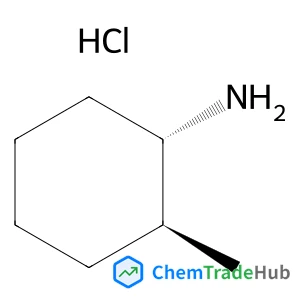
(1R,2R)-2-Methylcyclohexanamine hydrochloride (1:1)
CAS Number:
39558-31-1
Molecular Formula:
C7H16ClN
![2-Methyl-2-propanyl 4-oxo-3,9-diazabicyclo[4.2.1]nonane-9-carboxylate structure](https://static.chemtradehub.com/structs/131/1312456-05-5-9a15.webp "2-Methyl-2-propanyl 4-oxo-3,9-diazabicyclo[4.2.1]nonane-9-carboxylate structure")
2-Methyl-2-propanyl 4-oxo-3,9-diazabicyclo[4.2.1]nonane-9-carboxylate
CAS Number:
1312456-05-5
Molecular Formula:
C12H20N2O3
Recommended Suppliers






Disclaimer
This page provides academic journal information for reference and research purposes only. We are not affiliated with any journal publishers and do not handle publication submissions. For publication-related inquiries, please contact the respective journal publishers directly.
If you notice any inaccuracies in the information displayed, please contact us at support@chemtradehub.com. We will promptly review and address your concerns.