












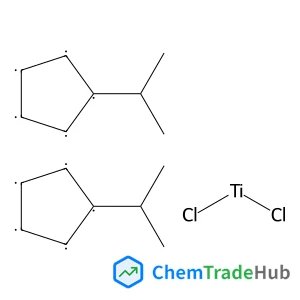
BIS(I-PROPYLCYCLOPENTADIENYL)TITANIUM DICHLORIDE
CAS Number:
12130-65-3
Molecular Formula:
C16H22Cl2Ti
J. Kozuch, N. Petrusch, U. Gernert, I. M. Weidinger
Polyhedron Ag nanostructures were created on top of a polished Au electrode via step-wise electrodeposition and tested as substrates for SERS spectroscopy. Average Raman enhancement factors were derived by combining SERS measurements with electrochemical impedance spectroscopy (EIS), which is able to determine the electroactive surface area of a randomly nanostructured surface. Depending on the deposition step an alternating increase and decrease of surface area was observed while the SERS intensity showed a clear maximum for the first deposition cycle. SEM pictures reveal the formation of Ag polyhedrons that are randomly dispersed on the Au surface. Furthermore the presence of a sub nanostructure on top of the polyhedron after the first deposition cycle is observed which becomes smoother after subsequent deposition cycles. Correlating the SEM pictures with SERS and EIS measurements it is concluded that the coral-like sub nanostructure is dominating the enhancement factor while the polyhedron structure itself only plays a minor role for electromagnetic field enhancement.
Luca Nodari, Ivana Angelini, Tiziana Boffa Ballaran
DOI: 10.1039/C7CP03446F
C. Paduani, Andrew M. Rappe
DOI: 10.1039/C7CP02091K
X. Liu, Y. Geng, A. Forni, E. Lucenti, S. Righetto, S. Decurtins, S.-X. Liu
DOI: 10.1039/C7CP04687A
Katrin Peckelsen, Jonathan Martens, Lisa Czympiel, Giel Berden, Dirk Gründemann, Anthony J. H. M. Meijer, Mathias Schäfer
DOI: 10.1039/C7CP03843G
Charusheela Ramanan, Marco Ferretti, Henny van Roon, Vladimir I. Novoderezhkin, Rienk van Grondelle
DOI: 10.1039/C7CP03038J
Vadym V. Kulish, Daniel Koch, Sergei Manzhos
DOI: 10.1039/C7CP04360K
Graeme J. Ackland
DOI: 10.1039/C7CP03729E
Alberto Figueroba, Albert Bruix, Gábor Kovács
DOI: 10.1039/C7CP02820B
H. T. Chin, C. H. Shih, C. C. Ting, J. N. Aoh, M. Hofmann
DOI: 10.1039/C7CP03207B
Jiaye Su, Yunzhen Zhao, Chang Fang, Syed Bilal Ahmed, Yue Shi
DOI: 10.1039/C7CP03351F
6-(3-Fluorophenyl)picolinic acid is generally considered safe for laboratory use...
(3R)-3-Pyrrolidinol is used in the pharmaceutical industry as a precursor for dr...
When handling (4R,5R)-4,5-Diethoxycarbonyl-2,2-dimethyldioxolane (CAS: 59779-75-...
1-(6-Chloroimidazo[1,2-b]pyridazin-3-yl)ethanone is often synthesized via a mult...
The market for N-Ethyl-3,4-dimethylbenzylamine (CAS: 39180-83-1) remains steady,...
Tert-butyl 3-(pyrrolidin-1-yl)azetidine-1-carboxylate is a chemical compound wit...
1-Bromo-3-chloro-2,4-dimethoxybenzene (CAS: 1228956-93-1) falls under the classi...
The safety of 8-Bromo-2-methyl-3,4-dihydroisoquinolin-1(2H)-one (CAS: 1368622-07...
Benzyl [(3S)-2,6-dioxo-3-piperidinyl]carbamate is generally safe when handled wi...
1-{[4-(4,4,5,5-Tetramethyl-1,3,2-dioxaborolan-2-yl)phenyl]sulfonyl}pyrrolidine s...

Physical Chemistry Chemical Physics (PCCP) is an international journal co-owned by 19 physical chemistry and physics societies from around the world. This journal publishes original, cutting-edge research in physical chemistry, chemical physics and biophysical chemistry. To be suitable for publication in PCCP, articles must include significant innovation and/or insight into physical chemistry; this is the most important criterion that reviewers and Editors will judge against when evaluating submissions. The journal has a broad scope and welcomes contributions spanning experiment, theory, computation and data science. Topical coverage includes spectroscopy, dynamics, kinetics, statistical mechanics, thermodynamics, electrochemistry, catalysis, surface science, quantum mechanics, quantum computing and machine learning. Interdisciplinary research areas such as polymers and soft matter, materials, nanoscience, energy, surfaces/interfaces, and biophysical chemistry are welcomed if they demonstrate significant innovation and/or insight into physical chemistry. Joined experimental/theoretical studies are particularly appreciated when complementary and based on up-to-date approaches.

![Methyl 2-[5-(3-Phenoxyphenyl)-2H-tetrazol-2-yl]acetate structure](https://static.chemtradehub.com/structs/130/1305320-60-8-84b4.webp "Methyl 2-[5-(3-Phenoxyphenyl)-2H-tetrazol-2-yl]acetate structure")
![3-[(3R,4R)-3-[(6-aminopyrimidin-4-yl)-methyl-amino]-4-methyl-1-piperidyl]-3-oxo-propanenitrile structure](https://static.chemtradehub.com/structs/164/1640971-60-3-83a4.webp "3-[(3R,4R)-3-[(6-aminopyrimidin-4-yl)-methyl-amino]-4-methyl-1-piperidyl]-3-oxo-propanenitrile structure")




