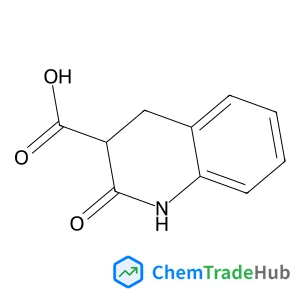
2-Oxo-1,2,3,4-tetrahydro-3-quinolinecarboxylic acid
CAS Number:
246867-17-4
Molecular Formula:
C10H9NO3
Kwonhyeok Yoon, Han Chang Kang, Li Li, Hana Cho, Mi-Kyoung Park, Eunji Lee, You Han Bae, Kang Moo Huh
In this study, a series of amphiphilic AB2-type 3-miktoarm copolymers consisting of hydrophilic poly(ethylene glycol) (PEG) as the A arm and hydrophobic poly(ε-caprolactone) (PCL) as the two B arms were synthesized through the ring-opening polymerization of ε-caprolactone (CL) using a PEG macroinitiator with a bi-arm structure. The self-assembly behavior, drug-loading capacities, and controlled drug release features of the PEG-PCL2 miktoarm copolymers were compared with those of their linear diblock counterparts (PEG-PCL). The PEG-PCL2 miktoarm copolymer with a relatively short PCL arm length (PEG volume fraction, fPEG = 0.55) self-assembled in aqueous solution to form a spherical micelle structure. However, cylindrical micelles were observed for the miktoarm copolymers with long PCL arms (fPEG = 0.15–0.32), whereas the corresponding linear counterparts consistently formed spherical micelle structures regardless of the PCL arm lengths. Drug-loading using doxorubicin (DOX) as the model drug indicated that the PEG-PCL2 cylindrical micelles possessed superior drug-loading capacities compared with the spherical micelles of the corresponding diblock copolymers. Furthermore, although the DOX-loaded cylindrical micelles exhibited a slower release rate than the DOX-loaded spherical micelles, the former exhibited higher cellular uptake and improved cytotoxic effects than the latter. These findings demonstrate the useful morphological versatility of the miktoarm-structured PEG-PCL block copolymers in comparison with the conventionally used linear diblock copolymers in the design of self-assembled nanocarriers for efficient drug delivery.
Zhenning Yu, Xinhua Wan, Hailiang Zhang, Xiaofang Chen, Qifeng Zhou
DOI: 10.1039/B212916G
Beth Rather, Michael J. Zaworotko
DOI: 10.1039/B301219K
Dong Kee Yi, Dong-Yu Kim
DOI: 10.1039/B300638G
Andrew J. Matthews, Punit K. Bhardwaj, Andrea Vasella
DOI: 10.1039/B300932G
Yong Cao, Jun-Cheng Hu, Ping Yang, Wei-Lin Dai, Kang-Nian Fan
DOI: 10.1039/B301375H
Laura Santagostini, Michele Gullotti, Roberto Pagliarin, Enrico Monzani, Luigi Casella
DOI: 10.1039/B307349A
Reiner Anwander, Michael G. Klimpel, H. Martin Dietrich, Dmitry J. Shorokhov, Wolfgang Scherer
DOI: 10.1039/B212754G
Alois Fürstner, Victor Mamane
DOI: 10.1039/B306880C
J. F. Denayer, A. R. Ocakoglu, W. Huybrechts, J. A. Martens, J. W. Thybaut, G. B. Marin, G. V. Baron
DOI: 10.1039/B304320G
Takaumi Kimura, Osamu Tochiyama, Zenko Yoshida
DOI: 10.1039/B300583F
When handling 2-Methyl-2-propanyl 5-amino-2-thiophenecarboxylate (CAS: 1498311-5...
5-Bromo-1,2-dichloro-3-fluorobenzene (CAS: 1000572-93-9) is a crystalline solid ...
(2R)-2-Amino-2-(4-bromophenyl)ethanol (CAS: 354153-64-3) should be stored in a c...
Methyl 4-(aminomethyl)tetrahydro-2H-pyran-4-carboxylate hydrochloride (CAS: 3627...
1,4-Dimethyl-1H-pyrazole-5-sulfonyl chloride is primarily used as an intermediat...
Dinaphtho[1,2-b:2',1'-d]furan is generally safe when handled with appropriate pe...
The market for 7-Methyl-7,9-dihydro-1H-purine-2,6,8(3H)-trione (CAS: 612-37-3) i...
2-(4-Chlorophenyl)malonaldehyde (CAS: 205676-17-1) is a colorless or light yello...
2-Methylchrysene (CAS: 3351-32-4) is typically synthesized via the reaction of c...
N-(6-aminopyrimidin-4-yl)acetamide (CAS: 89533-23-3) is generally considered saf...

Polymer Chemistry welcomes submissions in all areas of polymer science that have a strong focus on macromolecular chemistry. Manuscripts may cover a broad range of fields, yet no direct application focus is required.