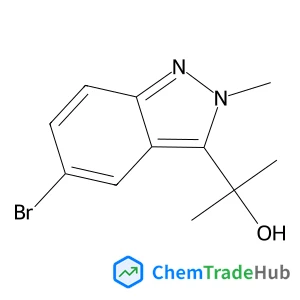
2-(5-Bromo-2-methyl-2H-indazol-3-yl)-2-propanol
CAS Number:
1823787-20-7
Molecular Formula:
C11H13BrN2O
Takaumi Kimura, Osamu Tochiyama, Zenko Yoshida
The luminescence spectrum of U4+ in aqueous solution was observed in the UV-Vis region with the lifetime < 20 ns at room temperature by excitation light corresponding to the 5f–5f electronic transition. All the luminescence peaks were assigned to individual electronic transitions.
Shaoxian Li, Fumiya Hamada, Ryosuke Nishikubo
DOI: 10.1039/D1SE01228B
Hao Zhang, Hang Xiang, Shahid Rasul, Alberto Roldan, Rebecca Taylor, Yujie Feng, Liam Banerji, Alexander Cowan, Jin Xuan
DOI: 10.1039/D1SE00861G
Ming Fang, Jishen Cao, Jianxiao Zou, Yating Song
DOI: 10.1039/D1SE01421H
Yulia Galagan, Hamid Ez-Zahraouy
DOI: 10.1039/D1SE00687H
Nilanka M. Keppetipola, Céline Olivier, Thierry Toupance, Ludmila Cojocaru
DOI: 10.1039/D1SE00954K
Zhe Sun, Zongxia Gao, Zhu Shan, Liangmao Xu
DOI: 10.1039/D1SE01729B
P. Arévalo-Cid, P. Dias, A. Mendes, J. Azevedo
DOI: 10.1039/D1SE00839K
Vijeth Hebri, Rabah Boukherroub, Ashokkumar Shankar Pawar, Vandana Molahalli, Devendrappa Hundekal
DOI: 10.1039/D1SE01391B
When handling 2-Methyl-2-propanyl 5-amino-2-thiophenecarboxylate (CAS: 1498311-5...
5-Bromo-1,2-dichloro-3-fluorobenzene (CAS: 1000572-93-9) is a crystalline solid ...
(2R)-2-Amino-2-(4-bromophenyl)ethanol (CAS: 354153-64-3) should be stored in a c...
Methyl 4-(aminomethyl)tetrahydro-2H-pyran-4-carboxylate hydrochloride (CAS: 3627...
1,4-Dimethyl-1H-pyrazole-5-sulfonyl chloride is primarily used as an intermediat...
Dinaphtho[1,2-b:2',1'-d]furan is generally safe when handled with appropriate pe...
The market for 7-Methyl-7,9-dihydro-1H-purine-2,6,8(3H)-trione (CAS: 612-37-3) i...
2-(4-Chlorophenyl)malonaldehyde (CAS: 205676-17-1) is a colorless or light yello...
2-Methylchrysene (CAS: 3351-32-4) is typically synthesized via the reaction of c...
N-(6-aminopyrimidin-4-yl)acetamide (CAS: 89533-23-3) is generally considered saf...

ChemComm publishes urgent research which is of outstanding significance and interest to experts in the field, while also appealing to the journal’s broad chemistry readership. Our communication format is ideally suited to short, urgent studies that are of such importance that they require accelerated publication. Our scope covers all topics in chemistry, and research at the interface of chemistry and other disciplines (such as materials science, nanoscience, physics, engineering and biology) where there is a significant novelty in the chemistry aspects. Major topic areas covered include: Analytical Chemistry Catalysis Chemical Biology and medicinal chemistry Computational Chemistry and Machine Learning Energy and sustainable chemistry Environmental Chemistry Green Chemistry Inorganic Chemistry Materials Chemistry Nanoscience Organic Chemistry Physical Chemistry Polymer Chemistry Supramolecular Chemistry
methyl]-N,2-dimethyl-2-propanesulfinamide structure](https://static.chemtradehub.com/structs/256/2565792-50-7-8a26.webp "N-[(R)-[3-(Benzyloxy)-2-(dicyclohexylphosphino)phenyl](phenyl)methyl]-N,2-dimethyl-2-propanesulfinamide structure")
![1-{[5-(4,4,5,5-Tetramethyl-1,3,2-dioxaborolan-2-yl)-2-thienyl]methyl}piperidine structure](https://static.chemtradehub.com/structs/121/1218790-44-3-baef.webp "1-{[5-(4,4,5,5-Tetramethyl-1,3,2-dioxaborolan-2-yl)-2-thienyl]methyl}piperidine structure")