












A free radical initiated optically active vinyl polymer with memory of chirality after removal of the inducing stereogenic center
Literature Information
Publication Date
2003-03-18
DOI
10.1039/B212916G
Impact Factor
6.222
Authors
Zhenning Yu, Xinhua Wan, Hailiang Zhang, Xiaofang Chen, Qifeng Zhou
View Original
Abstract
Free radical polymerization of (+)-2,5-bis[4′-((S)-2-methylbutyloxy)phenyl]styrene yields a chiral polymer with memory of optical activity after the initial stereogenic center in the side group of the monomer is chemically removed.
Related Literature
NiOx-supported PtRh nanoalloy enables high-performance hydrogen evolution reaction under universal pH conditions
Dinesh Bhalothia, Yu-Min Yu, Yi-Ru Lin, Tzu- Hsi Huang, Che Yan, Jyh-Fu Lee, Kuan-Wen Wang
2021-09-10
Paper
DOI: 10.1039/D1SE01331A
Synthesis of renewable alkylated decalins with p-quinone and 2-methyl-2,4-pentanediol
Yancheng Hu, Guangyi Li, Yu Cong, Xiaodong Wang
2022-01-03
Paper
DOI: 10.1039/D1SE01684A
High performance of the flow-type one-compartment hydrogen peroxide fuel cell using buckypaper and narrow fuel pathway under physiological conditions
Heeyeon An
2021-12-23
Paper
DOI: 10.1039/D1SE01784E
A novel Ba0.95La0.05Fe0.9Nb0.1O3−δ ceramic electrode for symmetrical solid oxide fuel cells
Zhongbiao Li, Jinpeng Wang, Jiangpeng Zhu, Yanjun Sun, Zhihao Wang, Yujun Zhao, Qiuju Zheng
2021-10-12
Paper
DOI: 10.1039/D1SE01291F
Novel single pass biogas-to-diesel process using a Fischer–Tropsch catalyst designed for high conversion
Chelsea L. Tucker, Ankur Bordoloi, Eric van Steen
2021-10-15
Paper
DOI: 10.1039/D1SE01299A
Unravelling the chemistry of catalyst surfaces and solvents towards C–C bond formation through activation and electrochemical conversion of CO2 into hydrocarbons over micro-structured dendritic copper
Nusrat Rashid, Mohsin Ahmad Bhat, Pravin P. Ingole
2021-11-08
Paper
DOI: 10.1039/D1SE01255J
Nickel-based metal–organic framework-derived Ni/NC/KB as a separator coating for high capacity lithium–sulfur batteries
Peisen Wu, Yongbo Wu, Kaiyin Zhu, Guozheng Ma, Xiaoming Lin, Akif Zeb, Xinli Chen, Kang Li
2021-10-29
Paper
DOI: 10.1039/D1SE01368H
You might also like
Compound Q&A
What precautions should be taken when handling 2-Methyl-2-propanyl 5-amino-2-thiophenecarboxylate (CAS: 1498311-57-1)?
When handling 2-Methyl-2-propanyl 5-amino-2-thiophenecarboxylate (CAS: 1498311-5...
1498311-57-12-Methyl-2-propanyl ...
Compound Q&A
What are the physical and chemical properties of 5-Bromo-1,2-dichloro-3-fluorobenzene (CAS: 1000572-93-9)?
5-Bromo-1,2-dichloro-3-fluorobenzene (CAS: 1000572-93-9) is a crystalline solid ...
1000572-93-95-Bromo-1,2-dichloro...
Compound Q&A
How should (2R)-2-Amino-2-(4-bromophenyl)ethanol (CAS: 354153-64-3) be stored?
(2R)-2-Amino-2-(4-bromophenyl)ethanol (CAS: 354153-64-3) should be stored in a c...
354153-64-3(2R)-2-Amino-2-(4-br...
Compound Q&A
What regulatory guidelines apply to Methyl 4-(aminomethyl)tetrahydro-2H-pyran-4-carboxylate hydrochloride (CAS: 362707-24-2)?
Methyl 4-(aminomethyl)tetrahydro-2H-pyran-4-carboxylate hydrochloride (CAS: 3627...
362707-24-2Methyl 4-(aminomethy...
Compound Q&A
What are the main uses of 1,4-dimethyl-1H-pyrazole-5-sulfonyl chloride (CAS: 1174834-52-6)?
1,4-Dimethyl-1H-pyrazole-5-sulfonyl chloride is primarily used as an intermediat...
1174834-52-61,4-dimethyl-1H-pyra...
Compound Q&A
Is Dinaphtho[1,2-b:2',1'-d]furan (CAS: 239-69-0) safe?
Dinaphtho[1,2-b:2',1'-d]furan is generally safe when handled with appropriate pe...
239-69-0Dinaphtho[1,2-b:2',1...
Compound Q&A
What is the market or research trend for 7-Methyl-7,9-dihydro-1H-purine-2,6,8(3H)-trione (CAS: 612-37-3)?
The market for 7-Methyl-7,9-dihydro-1H-purine-2,6,8(3H)-trione (CAS: 612-37-3) i...
612-37-37-Methyl-7,9-dihydro...
Compound Q&A
What are the physical and chemical properties of 2-(4-Chlorophenyl)malonaldehyde (CAS: 205676-17-1)?
2-(4-Chlorophenyl)malonaldehyde (CAS: 205676-17-1) is a colorless or light yello...
205676-17-12-(4-Chlorophenyl)ma...
Compound Q&A
How is 2-Methylchrysene (CAS: 3351-32-4) typically synthesized?
2-Methylchrysene (CAS: 3351-32-4) is typically synthesized via the reaction of c...
3351-32-42-Methylchrysene
Compound Q&A
Is N-(6-aminopyrimidin-4-yl)acetamide (CAS: 89533-23-3) safe?
N-(6-aminopyrimidin-4-yl)acetamide (CAS: 89533-23-3) is generally considered saf...
89533-23-3N-(6-aminopyrimidin-...
Source Journal
Chemical Communications

CiteScore:
8.6
Self-citation Rate:
4.7%
Articles per Year:
2458
ChemComm publishes urgent research which is of outstanding significance and interest to experts in the field, while also appealing to the journal’s broad chemistry readership. Our communication format is ideally suited to short, urgent studies that are of such importance that they require accelerated publication. Our scope covers all topics in chemistry, and research at the interface of chemistry and other disciplines (such as materials science, nanoscience, physics, engineering and biology) where there is a significant novelty in the chemistry aspects. Major topic areas covered include: Analytical Chemistry Catalysis Chemical Biology and medicinal chemistry Computational Chemistry and Machine Learning Energy and sustainable chemistry Environmental Chemistry Green Chemistry Inorganic Chemistry Materials Chemistry Nanoscience Organic Chemistry Physical Chemistry Polymer Chemistry Supramolecular Chemistry
Recommended Compounds
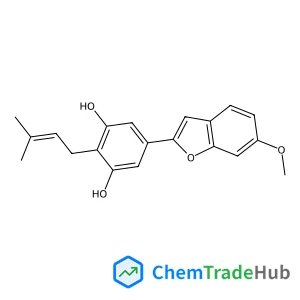
5-(6-Methoxy-1-benzofuran-2-yl)-2-(3-methyl-2-buten-1-yl)-1,3-benzenediol
CAS Number:
1017277-40-5
Molecular Formula:
C20H20O4
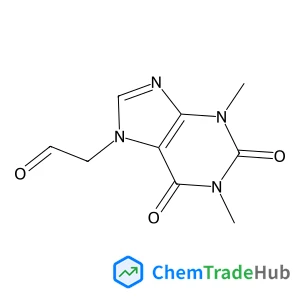
(1,3-Dimethyl-2,6-dioxo-1,2,3,6-tetrahydro-7H-purin-7-yl)acetaldehyde
CAS Number:
5614-53-9
Molecular Formula:
C9H10N4O3
Recommended Suppliers





Disclaimer
This page provides academic journal information for reference and research purposes only. We are not affiliated with any journal publishers and do not handle publication submissions. For publication-related inquiries, please contact the respective journal publishers directly.
If you notice any inaccuracies in the information displayed, please contact us at support@chemtradehub.com. We will promptly review and address your concerns.