












Enzymatic synthesis of poly(ω-pentadecalactone-co-butylene-co-3,3′-dithiodipropionate) copolyesters and self-assembly of the PEGylated copolymer micelles as redox-responsive nanocarriers for doxorubicin delivery
Literature Information
Publication Date
2015-01-14
DOI
10.1039/C4PY01321B
Impact Factor
5.582
Authors
Bo Liu, Xiaofang Zhang, Ya Chen, Zhicheng Yao, Zhe Yang, Di Gao, Qing Jiang, Jie Liu, Zhaozhong Jiang
View Original
Abstract
Biodegradable copolyesters bearing disulfide functional groups in the main chain have been successfully synthesized by lipase-catalyzed copolymerization of lactone with disulfide-containing diester and diol. When poly(ethylene glycol) methyl ether (MeO-PEG-OH) was added as a chain terminating agent, the corresponding amphiphilic PEG-polyester block copolymers were formed. NMR analyses of the synthesized poly(ω-pentadecalactone-co-butylene-co-3,3′-dithiodipropionate) (PPBD) and PEG-PPBD copolymers indicate that the repeat unit distributions in PPBD chains or PPBD segments of PEG-PPBD chains are nearly statistically random. These new functional polyesters possess low toxicity and their hydrophobicity can be systematically adjusted by varying the lactone content in the polymers. In aqueous medium, the amphiphilic PEG-PPBD block copolymers self-assembled readily to form nanosized micelles that are capable of serving as efficient redox-responsive nanocarriers for anticancer drug delivery. The addition of D,L-dithiothreitol (DTT) reductant into the medium caused substantial swelling of the PEG-PPBD micelles and effectively triggered a fast drug release from the doxorubicin (DOX)-loaded micelles. Consistently, an in vitro cytotoxicity study revealed that the efficacy of DOX-loaded PEG-PPBD micelles against HepG2 cancer cells is enhanced by intracellular glutathione (GSH) after the internalization of the micelles by the cells.
Recommended Journals
Related Literature
Molecular dynamics simulations and NMR spectroscopy studies of trehalose–lipid bilayer systems
Jon Kapla, Olof Engström, Baltzar Stevensson, Jakob Wohlert, Göran Widmalm, Arnold Maliniak
2015-07-22
Paper
DOI: 10.1039/C5CP02472B
Critical assessment of enhancement factor measurements in surface-enhanced Raman scattering on different substrates
Daniel C. Rodrigues, Michele L. de Souza, Klester S. Souza, Diego P. dos Santos, Gustavo F. S. Andrade, Marcia L. A. Temperini
2015-01-26
Paper
DOI: 10.1039/C4CP05080K
Calculating average surface enhancement factors of randomly nanostructured electrodes by a combination of SERS and impedance spectroscopy
J. Kozuch, N. Petrusch, U. Gernert, I. M. Weidinger
2015-01-09
Paper
DOI: 10.1039/C4CP05015K
Tip-enhanced Raman spectroscopy of graphene-like and graphitic platelets on ultraflat gold nanoplates
Farshid Pashaee, Faranak Sharifi, Giovanni Fanchini, François Lagugné-Labarthet
2015-02-10
Paper
DOI: 10.1039/C4CP05252H
SERS activity of Ag decorated nanodiamond and nano-β-SiC, diamond-like-carbon and thermally annealed diamond thin film surfaces
Mohan Kumar Kuntumalla, Vadali Venkata Satya Siva Srikanth, Satyavathi Ravulapalli, Upender Gangadharini, Harish Ojha, Narayana Rao Desai, Chandrahas Bansal
2015-02-05
Paper
DOI: 10.1039/C4CP05236F
Stability, equilibrium morphology and hydration of ZrC(111) and (110) surfaces with H2O: a combined periodic DFT and atomistic thermodynamic study
Eric Osei-Agyemang, Jean-Francois Paul, Romain Lucas, Sylvie Foucaud, Sylvain Cristol
2015-07-16
Paper
DOI: 10.1039/C5CP03031E
Composition-dependent band gaps and indirect–direct band gap transitions of group-IV semiconductor alloys
Zhen Zhu, Jiamin Xiao, Haibin Sun, Yue Hu, Ronggen Cao, Yin Wang, Li Zhao, Jun Zhuang
2015-07-15
Paper
DOI: 10.1039/C5CP02558C
Particle size dependence of the surface-enhanced Raman scattering properties of densely arranged two-dimensional assemblies of Au(core)–Ag(shell) nanospheres
Kosuke Sugawa, Tsuyoshi Akiyama, Yoshimasa Tanoue, Takashi Harumoto, Sayaka Yanagida, Atsuo Yasumori, Shohei Tomita, Joe Otsuki
2014-12-19
Paper
DOI: 10.1039/C4CP05058D
Six-fold-symmetry internal rotation in toluenes: the low barrier challenge of 2,6- and 3,5-difluorotoluene
K. P. Rajappan Nair, Michaela K. Jahn, Alberto Lesarri, Vadim V. Ilyushin, Jens-Uwe Grabow
2015-09-22
Paper
DOI: 10.1039/C5CP03751D
You might also like
Compound Q&A
Is 2-(2-chloroacetamido)-3-phenylpropanoic acid (CAS: 7765-11-9) safe?
2-(2-Chloroacetamido)-3-phenylpropanoic acid (CAS: 7765-11-9) is generally consi...
7765-11-92-(2-chloroacetamido...
Compound Q&A
Is 2-(Benzyloxy)-5-bromobenzoic acid (CAS: 62176-31-2) safe?
2-(Benzyloxy)-5-bromobenzoic acid can be handled safely if appropriate precautio...
62176-31-22-(Benzyloxy)-5-brom...
Compound Q&A
What is (4-Methyl-1,2,5-oxadiazol-3-yl)methanamine hydrochloride (CAS: 1159825-48-5)?
(4-Methyl-1,2,5-oxadiazol-3-yl)methanamine hydrochloride is a chemical compound ...
1159825-48-5(4-Methyl-1,2,5-oxad...
Compound Q&A
What is 2-(5-Hexylthiophen-2-yl)-4,4,5,5-tetramethyl-1,3,2-dioxaborolane (CAS: 917985-54-7)?
2-(5-Hexylthiophen-2-yl)-4,4,5,5-tetramethyl-1,3,2-dioxaborolane (CAS: 917985-54...
917985-54-72-(5-Hexylthiophen-2...
Compound Q&A
Are there alternatives to 4-(8-Methyl-9H-1,3-dioxolo[4,5-h][2,3]benzodiazepin-5-yl)benzenamine (CAS: 102771-26-6) in synthesis?
While 4-(8-Methyl-9H-1,3-dioxolo[4,5-h][2,3]benzodiazepin-5-yl)benzenamine (CAS:...
102771-26-64-(8-Methyl-9H-1,3-d...
Compound Q&A
What is the market or research trend for tert-butyl 3-hydroxy-4,5,7,8-tetrahydro-2H-pyrazolo[3,4-d]azepine-6-carboxylate (CAS: 851376-80-2)?
The market for tert-butyl 3-hydroxy-4,5,7,8-tetrahydro-2H-pyrazolo[3,4-d]azepine...
851376-80-2tert-butyl 3-hydroxy...
Compound Q&A
How should waste containing 3,5-Diamino-1H-pyrazole-4-carbonitrile (CAS: 6844-58-2) be handled?
Waste containing 3,5-Diamino-1H-pyrazole-4-carbonitrile (CAS: 6844-58-2) should ...
6844-58-23,5-Diamino-1H-pyraz...
Compound Q&A
How is (6-Fluoro-3-pyridinyl)boronic acid (CAS: 351019-18-6) typically synthesized?
(6-Fluoro-3-pyridinyl)boronic acid can be synthesized through the reaction of 6-...
351019-18-6(6-Fluoro-3-pyridiny...
Compound Q&A
What industries use Dibenzyl carbonimidoylbiscarbamate (CAS: 10065-79-9)?
Dibenzyl carbonimidoylbiscarbamate (CAS: 10065-79-9) finds applications in vario...
10065-79-9Dibenzyl carbonimido...
Compound Q&A
What is the market or research trend for (beta,beta,2,3,4,5,6-~2~H_7_)Phenylalanine (CAS: 74228-83-4)?
The market for (beta,beta,2,3,4,5,6-~2~H_7_)Phenylalanine (CAS: 74228-83-4) is g...
74228-83-4(beta,beta,2,3,4,5,6...
Source Journal
Polymer Chemistry

CiteScore:
8.6
Self-citation Rate:
7.3%
Articles per Year:
457
Polymer Chemistry welcomes submissions in all areas of polymer science that have a strong focus on macromolecular chemistry. Manuscripts may cover a broad range of fields, yet no direct application focus is required.
Recommended Compounds
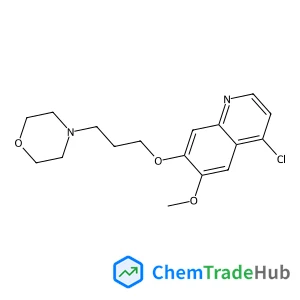
4-(3-((4-Chloro-6-methoxyquinolin-7-yl)oxy)propyl)morpholine
CAS Number:
205448-32-4
Molecular Formula:
C17H21ClN2O3
Recommended Suppliers






Disclaimer
This page provides academic journal information for reference and research purposes only. We are not affiliated with any journal publishers and do not handle publication submissions. For publication-related inquiries, please contact the respective journal publishers directly.
If you notice any inaccuracies in the information displayed, please contact us at support@chemtradehub.com. We will promptly review and address your concerns.