












![2-{[4-(2-Methoxyethyl)phenoxy]methyl}oxirane structure](https://static.chemtradehub.com/structs/567/56718-70-8-f037.webp "2-{[4-(2-Methoxyethyl)phenoxy]methyl}oxirane structure")
Bulk AGET ATRP of methyl methacrylate using iron(iii) acetylacetonate as a catalyst
Literature Information
Publication Date
2014-08-13
DOI
10.1039/C4PY00968A
Impact Factor
5.582
Authors
Yuan Liu, Tianchi Xu, Lifen Zhang, Zhenping Cheng, Xiulin Zhu
View Original
Abstract
In this work, polymerization of methyl methacrylate (MMA) was successfully conducted by atom transfer radical polymerization with activators generated by electron transfer (AGET ATRP) at 90 °C, using iron(III) acetylacetonate (Fe(acac)3) as a catalyst, ethyl alpha-bromophenylacetate (EBPA) as an initiator, ascorbic acid (AsAc) as a reducing agent and triphenyl phosphine (PPh3) as a ligand. The polymerization kinetics showed that the polymerization rate (the conversion reached up to 98.1% after 60 min) was much higher than that mediated by inorganic iron salts and it was affected by the feed of the iron catalyst. Moreover, the kinetic plots were linear, and the molecular weights of the resulting polymers with molecular weight distribution around 1.2, increased linearly with monomer conversions, indicating good features of “living”/controlled radical polymerizations. The end-functionality of the polymers was confirmed by 1H NMR spectroscopy and a chain extension experiment.
Recommended Journals
Related Literature
Surface features and catalytic activity of sulfated zirconia catalysts from hydrothermal precursors
C. Morterra, G. Cerrato, S. Ardizzone, C. L. Bianchi, M. Signoretto, F. Pinna
2002-05-30
Paper
DOI: 10.1039/B110444F
Triaziridine and tetrazetidinevs. cyclic water trimer and tetramer: A computational approach to the relationship between molecular and supramolecular conformational analysis
Manuel Alcamí, Otilia Mó, Manuel Yáñez, Ibon Alkorta, José Elguero
2002-04-30
Paper
DOI: 10.1039/B108270C
Low-frequency depolarized Raman-spectral density of liquid water from femtosecond optical Kerr-effect measurements: Lineshape analysis of restricted translational modes
Kathrin Winkler, Jörg Lindner, Peter Vöhringer
2002-05-01
Paper
DOI: 10.1039/B200299J
Calorimetric study of adsorption of non-ionic surfactants on silica gels: Estimating the role of lateral interactions between surface aggregates
Mateusz Drach, Jolanta Narkiewicz-Michałek, Gerhard H. Findenegg, Zoltán Király
2002-05-01
Paper
DOI: 10.1039/B200357K
Doping level change of polythiophene film during its electrochemical growth process
Mingxiao Fu, Gaoquan Shi, Fengen Chen, Xiaoyin Hong
2002-05-07
Paper
DOI: 10.1039/B201041K
Synthesis and photophysical properties of ruthenium(II) bis(2,2′∶6′,2″-terpyridine) complexes constructed from a diethynylated-thiophene residue
Anthony Harriman, Annabelle Mayeux, Antoinette De Nicola, Raymond Ziessel
2002-04-22
Paper
DOI: 10.1039/B109966N
Space-resolved fluorescence properties of phenolphthalein-hydrotalcite nanocomposites
L. Latterini, F. Elisei, G. G. Aloisi, U. Costantino, M. Nocchetti
2002-05-07
Paper
DOI: 10.1039/B201167K
Potential energy and free energy surfaces of the formic acid dimer: Correlated ab initio calculations and molecular dynamics simulations
Jana Chocholoušová, Jaroslav Vacek, Pavel Hobza
2002-04-22
Paper
DOI: 10.1039/B110872G
Phase synchronization of nonidentical chaotic electrochemical oscillators
István Z. Kiss, John L. Hudson
2002-05-09
Paper
DOI: 10.1039/B200716A
Spectral properties of a fluorescing molecule within a spherical metallic nanocavity
Jörg Enderlein
2002-05-07
Paper
DOI: 10.1039/B200502F
You might also like
Compound Q&A
How should waste containing (6-Bromo-2-naphthyl)oxy](dimethyl)(2-methyl-2-propanyl)silane be handled?
Waste containing (6-Bromo-2-naphthyl)oxy](dimethyl)(2-methyl-2-propanyl)silane (...
100751-65-3[(6-Bromo-2-naphthyl...
Compound Q&A
How is 7-Fluoro-4-isoquinolinecarboxylic acid (CAS: 1841081-40-0) typically synthesized?
7-Fluoro-4-isoquinolinecarboxylic acid can be synthesized via a multi-step proce...
1841081-40-07-Fluoro-4-isoquinol...
Compound Q&A
What are the physical and chemical properties of 2,3,5,6-Tetrabromothieno[3,2-b]thiophene (CAS: 124638-53-5)?
2,3,5,6-Tetrabromothieno[3,2-b]thiophene is a crystalline compound with a high m...
124638-53-52,3,5,6-Tetrabromoth...
Compound Q&A
Is 1-[4-(Benzylamino)-7,8-dihydro-5H-pyrano[4,3-d]pyrimidin-2-yl]-2-methyl-1H-indole-4-carboxamide (CAS: 1542705-92-9) safe?
1-[4-(Benzylamino)-7,8-dihydro-5H-pyrano[4,3-d]pyrimidin-2-yl]-2-methyl-1H-indol...
1542705-92-91-[4-(Benzylamino)-7...
Compound Q&A
What is the market or research trend for imidazo[5,1-d]-1,2,3,5-tetrazine-8-carboxylic acid, 3,4-dihydro-3-methyl-4-oxo- (CAS: 113942-30-6)?
The market for imidazo[5,1-d]-1,2,3,5-tetrazine-8-carboxylic acid, 3,4-dihydro-3...
113942-30-6Imidazo[5,1-d]-1,2,3...
Compound Q&A
What is 3-(Triisopropylsilyl)propiolaldehyde (CAS: 163271-80-5)?
3-(Triisopropylsilyl)propiolaldehyde is a synthetic organic compound with the CA...
163271-80-53-(Triisopropylsilyl...
Compound Q&A
What regulatory guidelines apply to 6-Nitro-2H-1,4-benzoxazin-3(4H)-one (CAS: 81721-87-1)?
6-Nitro-2H-1,4-benzoxazin-3(4H)-one (CAS: 81721-87-1) is subject to various regu...
81721-87-16-Nitro-2H-1,4-benzo...
Compound Q&A
How should waste containing (3-Fluorophenyl)(4-{[(2-methyl-2-propanyl)oxy]carbonyl}-1-piperazinyl)acetic acid (CAS: 885272-91-3) be handled?
Waste containing (3-Fluorophenyl)(4-{[(2-methyl-2-propanyl)oxy]carbonyl}-1-piper...
885272-91-3(3-Fluorophenyl)(4-{...
Compound Q&A
What are the physical and chemical properties of N,N'-4,4'-Biphenyldiyldiisonicotinamide (CAS: 55119-40-9)?
N,N'-4,4'-Biphenyldiyldiisonicotinamide is a white crystalline solid with a mole...
55119-40-9N,N'-4,4'-Biphenyldi...
Compound Q&A
What industries use 6-Bromo-8-fluoro-2-quinazolinol (CAS: 1036756-15-6)?
6-Bromo-8-fluoro-2-quinazolinol is primarily used in the pharmaceutical industry...
1036756-15-66-Bromo-8-fluoro-2-q...
Source Journal
Polymer Chemistry

CiteScore:
8.6
Self-citation Rate:
7.3%
Articles per Year:
457
Polymer Chemistry welcomes submissions in all areas of polymer science that have a strong focus on macromolecular chemistry. Manuscripts may cover a broad range of fields, yet no direct application focus is required.
Recommended Compounds
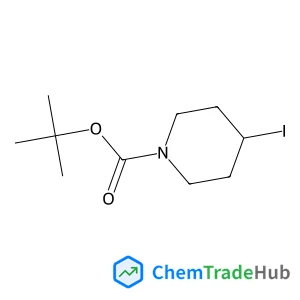
2-Methyl-2-propanyl 4-iodo-1-piperidinecarboxylate
CAS Number:
301673-14-3
Molecular Formula:
C10H18INO2
Recommended Suppliers







Disclaimer
This page provides academic journal information for reference and research purposes only. We are not affiliated with any journal publishers and do not handle publication submissions. For publication-related inquiries, please contact the respective journal publishers directly.
If you notice any inaccuracies in the information displayed, please contact us at support@chemtradehub.com. We will promptly review and address your concerns.