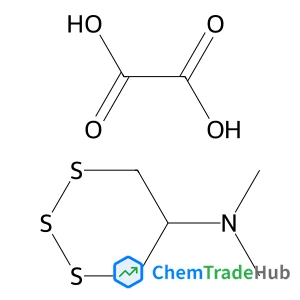
Oxalic acid compound with cyclohexylsulfamothioic O-acid (11)
CAS Number:
31895-22-4
Molecular Formula:
C7H13NO4S3
C. Morterra, G. Cerrato, S. Ardizzone, C. L. Bianchi, M. Signoretto, F. Pinna
ZrO2–SO4 (SZ) powders were prepared by calcining at 740, 820, and 900 K hydrous precursors, obtained by a hydrothermal precipitation route from ZrCl4 solutions at 334 K, and subsequently sulfated with H2SO4 (1 M). The samples were characterised as to phase composition (XRD, Raman spectroscopy), surface area (BET) and total sulfur content. Surface functionalities and acidity features were investigated by FTIR spectroscopy of the powders themselves and of probe molecules (carbon monoxide, pyridine) adsorbed thereon. By a revised Hammett–Bertolacini technique, both the density and strength of the (protonic) surface sites were obtained. XPS analyses of the samples were performed by elaboration of the sulfur 2p, oxygen 1s and zirconium 3d spectral regions. Catalytic tests were performed both in the gas phase, for the isomerisation of n-butane at 423 and 523 K, and in liquid media, for the esterification of benzoic acid to methylbenzoate. Correlations were obtained with the samples’ calcination temperature, catalytic activity, distribution of Lewis/Brønsted acid sites, and spectral features of the XPS Zr 3d doublet.
Surya Singh, Mrinal Kanti Biswas
DOI: 10.1039/D3VA00222E
Ella T. Williams, Nathan Lazarus
DOI: 10.1039/D3LP00109A
Yanhao Miao, Qidi Sun, Guozhu Mao, Wanqing Dai, Cui Tang, Jiayu Chen
DOI: 10.1039/D3VA00268C
Yaqi Hu, Zhong Liang, Yabin Zhang
DOI: 10.1039/D3EY00225J
C. Emereole, R. Jansen, O. J. Okonkwo
DOI: 10.1039/D3VA00119A
Bhavana Bhatt
DOI: 10.1039/D3LP00152K
Stefano Carnati, Andrea Pozzi, Davide Spanu, Damiano Monticelli, Roberta Bettinetti, Ginevra Boldrocchi
DOI: 10.1039/D3VA00254C
Xijun Wang, Kaihang Shi, Anyang Peng, Randall Q. Snurr
DOI: 10.1039/D3EY00234A
Waste containing (6-Bromo-2-naphthyl)oxy](dimethyl)(2-methyl-2-propanyl)silane (...
7-Fluoro-4-isoquinolinecarboxylic acid can be synthesized via a multi-step proce...
2,3,5,6-Tetrabromothieno[3,2-b]thiophene is a crystalline compound with a high m...
1-[4-(Benzylamino)-7,8-dihydro-5H-pyrano[4,3-d]pyrimidin-2-yl]-2-methyl-1H-indol...
The market for imidazo[5,1-d]-1,2,3,5-tetrazine-8-carboxylic acid, 3,4-dihydro-3...
3-(Triisopropylsilyl)propiolaldehyde is a synthetic organic compound with the CA...
6-Nitro-2H-1,4-benzoxazin-3(4H)-one (CAS: 81721-87-1) is subject to various regu...
Waste containing (3-Fluorophenyl)(4-{[(2-methyl-2-propanyl)oxy]carbonyl}-1-piper...
N,N'-4,4'-Biphenyldiyldiisonicotinamide is a white crystalline solid with a mole...
6-Bromo-8-fluoro-2-quinazolinol is primarily used in the pharmaceutical industry...

Physical Chemistry Chemical Physics (PCCP) is an international journal co-owned by 19 physical chemistry and physics societies from around the world. This journal publishes original, cutting-edge research in physical chemistry, chemical physics and biophysical chemistry. To be suitable for publication in PCCP, articles must include significant innovation and/or insight into physical chemistry; this is the most important criterion that reviewers and Editors will judge against when evaluating submissions. The journal has a broad scope and welcomes contributions spanning experiment, theory, computation and data science. Topical coverage includes spectroscopy, dynamics, kinetics, statistical mechanics, thermodynamics, electrochemistry, catalysis, surface science, quantum mechanics, quantum computing and machine learning. Interdisciplinary research areas such as polymers and soft matter, materials, nanoscience, energy, surfaces/interfaces, and biophysical chemistry are welcomed if they demonstrate significant innovation and/or insight into physical chemistry. Joined experimental/theoretical studies are particularly appreciated when complementary and based on up-to-date approaches.
![2,9-Dichloro-5,12-dihydroquinolino[2,3-b]acridine-7,14-dione structure](https://static.chemtradehub.com/structs/308/3089-17-6-750b.webp "2,9-Dichloro-5,12-dihydroquinolino[2,3-b]acridine-7,14-dione structure")