












Fatty acid-based (bis) 6-membered cyclic carbonates as efficient isocyanate free poly(hydroxyurethane) precursors
Literature Information
Publication Date
2014-07-15
DOI
10.1039/C4PY00922C
Impact Factor
5.582
Authors
Carine Alfos
View Original
Abstract
(Bis) 6-membered cyclic carbonates were prepared from methyl 10-undecenoate, which is produced from ricinoleic acid, a main constituent of castor oil. Kinetic studies on these new fatty acid-based 6-membered cyclic carbonates revealed that they are much more reactive than their homologs, 5-membered ones (30 times). Poly(hydroxyurethane)s (PHUs) were then synthesized from these bis 6-membered cyclic carbonates at a temperature as low as room temperature and in the solvent or bulk. Unexpectedly, chemical gels were obtained. The latter were the consequence of side reactions of carbonate ring-opening with the hydroxyl groups of the formed poly(hydroxyurethane)s. Quenching with a large excess of hexylamine enabled the breaking-up of the gel with the formation of urea linkages.
Related Literature
High pressure investigations of (n-alkanes + ether) mixtures‡
Urszula Domańska, Piotr Morawski
2002-04-30
Paper
DOI: 10.1039/B200711H
Two-step mechanism in cationic lipoplex formation as observed by dynamic light scattering, dielectric relaxation and circular dichroism methods
2002-05-13
Paper
DOI: 10.1039/B110503E
Reactions of chemically activated C9H9 species. Part I. The product distribution of the reaction of phenyl radicals with propyne
Luc Vereecken, Holger F. Bettinger, Jozef Peeters
2002-04-22
Paper
DOI: 10.1039/B109452A
Metal clusters in plasma polymer matrices Part IV. Electrical properties of Ag clusters
Michael Wark, Alfred Baalmann, Ulrich Simon, Nils Jaeger
2002-04-26
Paper
DOI: 10.1039/B111038A
A model of the motion of a long DNA chain in a pulsed electric field
V. V. Chasovskikh, L. L. Frumin, S. E. Peltek, G. V. Zilberstein
2002-05-08
Paper
DOI: 10.1039/B110042D
Spectral properties of a fluorescing molecule within a spherical metallic nanocavity
Jörg Enderlein
2002-05-07
Paper
DOI: 10.1039/B200502F
Phase synchronization of nonidentical chaotic electrochemical oscillators
István Z. Kiss, John L. Hudson
2002-05-09
Paper
DOI: 10.1039/B200716A
Surface features and catalytic activity of sulfated zirconia catalysts from hydrothermal precursors
C. Morterra, G. Cerrato, S. Ardizzone, C. L. Bianchi, M. Signoretto, F. Pinna
2002-05-30
Paper
DOI: 10.1039/B110444F
Laser spectroscopy of 1,2,3,4-tetrahydro-1-naphthol·ROH (R = H, CH3) clusters
A. Paladini, M. Satta, D. Catone, A. Filippi, S. Piccirillo, M. Speranza
2002-05-16
Paper
DOI: 10.1039/B201347A
Implementation of RI-CC2 triplet excitation energies with an application to trans-azobenzene
Kasper Hald
2002-05-02
Paper
DOI: 10.1039/B110847F
You might also like
Compound Q&A
How should waste containing (6-Bromo-2-naphthyl)oxy](dimethyl)(2-methyl-2-propanyl)silane be handled?
Waste containing (6-Bromo-2-naphthyl)oxy](dimethyl)(2-methyl-2-propanyl)silane (...
100751-65-3[(6-Bromo-2-naphthyl...
Compound Q&A
How is 7-Fluoro-4-isoquinolinecarboxylic acid (CAS: 1841081-40-0) typically synthesized?
7-Fluoro-4-isoquinolinecarboxylic acid can be synthesized via a multi-step proce...
1841081-40-07-Fluoro-4-isoquinol...
Compound Q&A
What are the physical and chemical properties of 2,3,5,6-Tetrabromothieno[3,2-b]thiophene (CAS: 124638-53-5)?
2,3,5,6-Tetrabromothieno[3,2-b]thiophene is a crystalline compound with a high m...
124638-53-52,3,5,6-Tetrabromoth...
Compound Q&A
Is 1-[4-(Benzylamino)-7,8-dihydro-5H-pyrano[4,3-d]pyrimidin-2-yl]-2-methyl-1H-indole-4-carboxamide (CAS: 1542705-92-9) safe?
1-[4-(Benzylamino)-7,8-dihydro-5H-pyrano[4,3-d]pyrimidin-2-yl]-2-methyl-1H-indol...
1542705-92-91-[4-(Benzylamino)-7...
Compound Q&A
What is the market or research trend for imidazo[5,1-d]-1,2,3,5-tetrazine-8-carboxylic acid, 3,4-dihydro-3-methyl-4-oxo- (CAS: 113942-30-6)?
The market for imidazo[5,1-d]-1,2,3,5-tetrazine-8-carboxylic acid, 3,4-dihydro-3...
113942-30-6Imidazo[5,1-d]-1,2,3...
Compound Q&A
What is 3-(Triisopropylsilyl)propiolaldehyde (CAS: 163271-80-5)?
3-(Triisopropylsilyl)propiolaldehyde is a synthetic organic compound with the CA...
163271-80-53-(Triisopropylsilyl...
Compound Q&A
What regulatory guidelines apply to 6-Nitro-2H-1,4-benzoxazin-3(4H)-one (CAS: 81721-87-1)?
6-Nitro-2H-1,4-benzoxazin-3(4H)-one (CAS: 81721-87-1) is subject to various regu...
81721-87-16-Nitro-2H-1,4-benzo...
Compound Q&A
How should waste containing (3-Fluorophenyl)(4-{[(2-methyl-2-propanyl)oxy]carbonyl}-1-piperazinyl)acetic acid (CAS: 885272-91-3) be handled?
Waste containing (3-Fluorophenyl)(4-{[(2-methyl-2-propanyl)oxy]carbonyl}-1-piper...
885272-91-3(3-Fluorophenyl)(4-{...
Compound Q&A
What are the physical and chemical properties of N,N'-4,4'-Biphenyldiyldiisonicotinamide (CAS: 55119-40-9)?
N,N'-4,4'-Biphenyldiyldiisonicotinamide is a white crystalline solid with a mole...
55119-40-9N,N'-4,4'-Biphenyldi...
Compound Q&A
What industries use 6-Bromo-8-fluoro-2-quinazolinol (CAS: 1036756-15-6)?
6-Bromo-8-fluoro-2-quinazolinol is primarily used in the pharmaceutical industry...
1036756-15-66-Bromo-8-fluoro-2-q...
Source Journal
Polymer Chemistry

CiteScore:
8.6
Self-citation Rate:
7.3%
Articles per Year:
457
Polymer Chemistry welcomes submissions in all areas of polymer science that have a strong focus on macromolecular chemistry. Manuscripts may cover a broad range of fields, yet no direct application focus is required.
Recommended Compounds
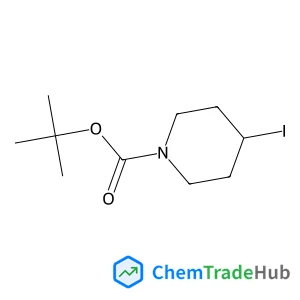
2-Methyl-2-propanyl 4-iodo-1-piperidinecarboxylate
CAS Number:
301673-14-3
Molecular Formula:
C10H18INO2
![2,2'-{2,2-Propanediylbis[(2,6-dibromo-4,1-phenylene)oxy]}diethanol structure](https://static.chemtradehub.com/structs/416/4162-45-2-b3d6.webp "2,2'-{2,2-Propanediylbis[(2,6-dibromo-4,1-phenylene)oxy]}diethanol structure")
2,2'-{2,2-Propanediylbis[(2,6-dibromo-4,1-phenylene)oxy]}diethanol
CAS Number:
4162-45-2
Molecular Formula:
C19H20Br4O4
Recommended Suppliers






Disclaimer
This page provides academic journal information for reference and research purposes only. We are not affiliated with any journal publishers and do not handle publication submissions. For publication-related inquiries, please contact the respective journal publishers directly.
If you notice any inaccuracies in the information displayed, please contact us at support@chemtradehub.com. We will promptly review and address your concerns.