













Synthesis and migration insertion polymerization (MIP) of CpFe(CO)2(CH2)6PPh2 (FpC6P) for PFpC6P: macromolecule stability, degradability and redox activity
Literature Information
Publication Date
2014-08-07
DOI
10.1039/C4PY00862F
Impact Factor
5.582
Authors
Kai Cao, Brahamjot Nayyar, Xiaohui Tian, Xiaosong Wang
View Original
Abstract
CpFe(CO)2(CH2)6PPh2 (FpC6P) is synthesized as a monomer for bulk migration insertion polymerization (MIP). Due to the presence of a longer alkyl spacer in FpC6P, intramolecular cyclization reactions, which are observed during the MIP of CpFe(CO)2(CH2)3PPh2 (FpC3P), were completely suppressed under the conditions of the polymerization. The resultant PFpC6P is soluble in common organic solvents and stable enough for GPC analysis. However, the polymer degrades in solution over a few days because the PFpC6P chain is constructed from relatively weak metal coordination bonds. In the presence of an oxidant, e.g. H2O2, degradation of the polymers was accelerated. When the solution was exposed to LED light (wavelength: 400–410 nm), degradation was completed in 20 minutes with CO release first followed by the dissociation of phosphine. DSC analysis indicates that PFpC6P has a Tg of ca. 68 °C, which is lower than that of PFpC3P (ca. 99 °C). TGA analysis reveals that PFpC6P is thermally stable up to 170 °C and leaves a ca. 35.2% char yield at 676 °C after three stages of weight loss. CV data shows that the polymer in DMF has reversible redox activity, with an oxidation peak at 0.74 V and a reduction peak at 0.56 V (relative to a Ag electrode).
Related Literature
Solubilization of organic compounds into as-synthesized spherical mesoporous silica
Yoshikazu Miyake, Toshimi Yumoto, Hajime Kitamura, Taichi Sugimoto
2002-05-10
Paper
DOI: 10.1039/B200074C
Scanning tunneling microscopy study of WS2nanotubes
Luana Scheffer, R. Rosentzveig, A. Margolin, G. Seifert, S. R. Cohen, R. Tenne
2002-05-01
Communication
DOI: 10.1039/B201244H
The influence of the starch indicator on front waves in the iodate–arsenous acid system with applied electric fields
J. H. Merkin
2002-04-26
Paper
DOI: 10.1039/B110364B
Stability and reactivity patterns of medium-sized vanadium oxide cluster cations VxOy+ (4 ⩽ x ⩽ 14)
André Fielicke, Klaus Rademann
2002-05-14
Paper
DOI: 10.1039/B108046F
A spectroscopic and computational exploration of tryptophan–water cluster structures in the gas phase
Lavina C. Snoek, Romano T. Kroemer, John P. Simons
2002-04-22
Paper
DOI: 10.1039/B200059H
Optical characterization of quasi-monomolecular layers of the nonlinear polymer polyDCHD-HS
Emilia Giorgetti, Giancarlo Margheri, Stefano Sottini, Guido Toci, Maurizio Muniz-Miranda, Laura Moroni, Giovanna Dellepiane
2002-05-17
Paper
DOI: 10.1039/B111492C
An X-ray absorption near edge spectroscopy study of trace amount technetium implanted in apatite
C. Gaillard, C. Den Auwer, S. D. Conradson
2002-05-14
Communication
DOI: 10.1039/B202618J
EPR spectra and structure of bis-chlorinated dimethyl ether radical cation, CH2ClOCH2Cl+
Yoshiteru Itagaki, Peng Wang, Masaru Shiotani, Akinori Hasegawa
2002-05-16
Paper
DOI: 10.1039/B200440B
Active control of product selection in a chemical reaction: a view of the current scene
2002-04-11
Invited Article
DOI: 10.1039/B109911F
Active sites in sol–gel prepared silica-alumina for photoinduced non-oxidative methane coupling
Hisao Yoshida, Norimitsu Matsushita, Yuko Kato, Tadashi Hattori
2002-04-22
Paper
DOI: 10.1039/B111101A
You might also like
Compound Q&A
How should waste containing (6-Bromo-2-naphthyl)oxy](dimethyl)(2-methyl-2-propanyl)silane be handled?
Waste containing (6-Bromo-2-naphthyl)oxy](dimethyl)(2-methyl-2-propanyl)silane (...
100751-65-3[(6-Bromo-2-naphthyl...
Compound Q&A
How is 7-Fluoro-4-isoquinolinecarboxylic acid (CAS: 1841081-40-0) typically synthesized?
7-Fluoro-4-isoquinolinecarboxylic acid can be synthesized via a multi-step proce...
1841081-40-07-Fluoro-4-isoquinol...
Compound Q&A
What are the physical and chemical properties of 2,3,5,6-Tetrabromothieno[3,2-b]thiophene (CAS: 124638-53-5)?
2,3,5,6-Tetrabromothieno[3,2-b]thiophene is a crystalline compound with a high m...
124638-53-52,3,5,6-Tetrabromoth...
Compound Q&A
Is 1-[4-(Benzylamino)-7,8-dihydro-5H-pyrano[4,3-d]pyrimidin-2-yl]-2-methyl-1H-indole-4-carboxamide (CAS: 1542705-92-9) safe?
1-[4-(Benzylamino)-7,8-dihydro-5H-pyrano[4,3-d]pyrimidin-2-yl]-2-methyl-1H-indol...
1542705-92-91-[4-(Benzylamino)-7...
Compound Q&A
What is the market or research trend for imidazo[5,1-d]-1,2,3,5-tetrazine-8-carboxylic acid, 3,4-dihydro-3-methyl-4-oxo- (CAS: 113942-30-6)?
The market for imidazo[5,1-d]-1,2,3,5-tetrazine-8-carboxylic acid, 3,4-dihydro-3...
113942-30-6Imidazo[5,1-d]-1,2,3...
Compound Q&A
What is 3-(Triisopropylsilyl)propiolaldehyde (CAS: 163271-80-5)?
3-(Triisopropylsilyl)propiolaldehyde is a synthetic organic compound with the CA...
163271-80-53-(Triisopropylsilyl...
Compound Q&A
What regulatory guidelines apply to 6-Nitro-2H-1,4-benzoxazin-3(4H)-one (CAS: 81721-87-1)?
6-Nitro-2H-1,4-benzoxazin-3(4H)-one (CAS: 81721-87-1) is subject to various regu...
81721-87-16-Nitro-2H-1,4-benzo...
Compound Q&A
How should waste containing (3-Fluorophenyl)(4-{[(2-methyl-2-propanyl)oxy]carbonyl}-1-piperazinyl)acetic acid (CAS: 885272-91-3) be handled?
Waste containing (3-Fluorophenyl)(4-{[(2-methyl-2-propanyl)oxy]carbonyl}-1-piper...
885272-91-3(3-Fluorophenyl)(4-{...
Compound Q&A
What are the physical and chemical properties of N,N'-4,4'-Biphenyldiyldiisonicotinamide (CAS: 55119-40-9)?
N,N'-4,4'-Biphenyldiyldiisonicotinamide is a white crystalline solid with a mole...
55119-40-9N,N'-4,4'-Biphenyldi...
Compound Q&A
What industries use 6-Bromo-8-fluoro-2-quinazolinol (CAS: 1036756-15-6)?
6-Bromo-8-fluoro-2-quinazolinol is primarily used in the pharmaceutical industry...
1036756-15-66-Bromo-8-fluoro-2-q...
Source Journal
Polymer Chemistry

CiteScore:
8.6
Self-citation Rate:
7.3%
Articles per Year:
457
Polymer Chemistry welcomes submissions in all areas of polymer science that have a strong focus on macromolecular chemistry. Manuscripts may cover a broad range of fields, yet no direct application focus is required.
Recommended Compounds

Oxalic acid compound with cyclohexylsulfamothioic O-acid (11)
CAS Number:
31895-22-4
Molecular Formula:
C7H13NO4S3
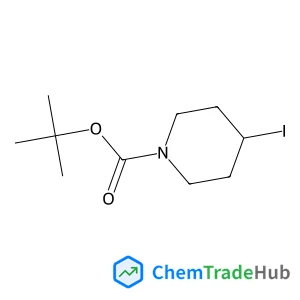
2-Methyl-2-propanyl 4-iodo-1-piperidinecarboxylate
CAS Number:
301673-14-3
Molecular Formula:
C10H18INO2

Recommended Suppliers





Disclaimer
This page provides academic journal information for reference and research purposes only. We are not affiliated with any journal publishers and do not handle publication submissions. For publication-related inquiries, please contact the respective journal publishers directly.
If you notice any inaccuracies in the information displayed, please contact us at support@chemtradehub.com. We will promptly review and address your concerns.