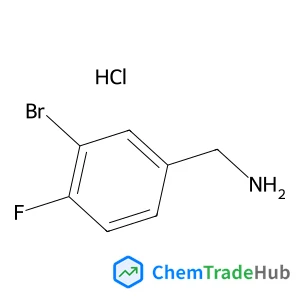
1-(3-Bromo-4-fluorophenyl)methanamine hydrochloride (1:1)
CAS Number:
202865-68-7
Molecular Formula:
C7H8BrClFN
Haiyang Gao, Yong Liu, Guiliang Li, Zefan Xiao, Guodong Liang, Qing Wu
Polyethylene-block-polynorbornene (PE-b-PNB) copolymers were synthesized using an amine–imine nickel catalyst by sequential monomer addition in a living fashion. Norbornene homopolymerizations catalyzed by amine–imine nickel catalyst were firstly evaluated and high-molecular-weight polynorbornenes (PNBs) with polydispersities of 1.9–3.0 were produced. Introduction of the PE building block can significantly slow down the insertion rate of the norbornene monomer to afford a low-molecular-weight PNB block. Well-defined PE-b-PNB block copolymers (Mw/Mn < 1.16) were prepared by combination of living polymerization of ethylene for 15 min and sequential polymerization of norbornene. The block copolymer architecture was studied and confirmed by FT-IR, NMR, DSC, and transmission electron microscopy (TEM).

Saudi Pharmaceutical Journal

Russian Journal of General Chemistry

Journal of Saudi Chemical Society

Journal of Peptide Science

Current Opinion in Colloid & Interface Science

New Journal of Chemistry

Drug Discovery Today

Chemistry Education Research and Practice

Journal of Natural Medicines

Crystallography Reports
Rocio Esquembre, Jesus M. Sanz, J. Gerard Wall, Francisco del Monte, C. Reyes Mateo, M. Luisa Ferrer
DOI: 10.1039/C3CP44299C
Vincenzo Barone, Ivo Cacelli, Alessandro Ferretti
DOI: 10.1039/C3CP50974E
Tetsuhiro Kudo, Hajime Ishihara
DOI: 10.1039/C3CP51969D
DOI: 10.1039/C3CP50907A
Xiaoqian Ren, Tingting You, Li Jiang, Hongyan Zhang, Penggang Yin, Lin Guo
DOI: 10.1039/C3CP51385H
Minhua Shao, Brandon H. Smith, Sandra Guerrero, Lesia Protsailo, Dong Su, Keiichi Kaneko, Jonathan H. Odell, Michael P. Humbert, Kotaro Sasaki, Jesse Marzullo, Robert M. Darling
DOI: 10.1039/C3CP52252K
Imre Bakó, Ákos Bencsura, Kersti Hermannson, Szabolcs Bálint, Tamás Grósz, Julianna Oláh
DOI: 10.1039/C3CP52271G
Robert P. Lynch, Nathan Quill, Shohei Nakahara, D. Noel Buckley
DOI: 10.1039/C3CP52253A
Deya Das, Seungchul Kim, Kwang-Ryeol Lee, Abhishek K. Singh
DOI: 10.1039/C3CP52891J
When considering alternatives to 1-(4-Chlorophenyl)-N-hydroxymethanimine (CAS: 3...
This compound should be stored in a cool, dry place away from direct sunlight. I...
3-(4-Bromophenyl)-5-(2-fluorophenyl)-1,2,4-oxadiazole is synthesized through a m...
5-Chloro-2-(4-chlorophenyl)-4-methyl-6-[3-(1-piperidinyl)propoxy]pyrimidine (CAS...
2-Chloro-4-(difluoromethoxy)pyridine is used in the pharmaceutical industry for ...
3-Chloro-6-methylpyridazine (CAS: 1121-79-5) is classified under the Globally Ha...
Several alternatives can be used in the synthesis of Methyl 4,5-dimethyl-2-nitro...
Alternatives to (2E,2'E)-3,3'-(1,4-Phenylene)bisacrylaldehyde include other acry...
3-Amino-5-chloropyridin-2-ol hydrochloride is an organic compound with the CAS n...
When handling 6,7-Difluoro-2,3-dihydro-4H-chromen-4-one, it is essential to wear...

Polymer Chemistry welcomes submissions in all areas of polymer science that have a strong focus on macromolecular chemistry. Manuscripts may cover a broad range of fields, yet no direct application focus is required.
![6-Bromo-2,3-dihydro-1H-pyrido[2,3-b][1,4]oxazine structure](https://static.chemtradehub.com/structs/120/1203499-17-5-b4d1.webp "6-Bromo-2,3-dihydro-1H-pyrido[2,3-b][1,4]oxazine structure")
![(2S)-2-{[(9H-Fluoren-9-ylmethoxy)carbonyl]amino}-4-(methylselanyl)butanoic acid structure](https://static.chemtradehub.com/structs/121/1217852-49-7-f252.webp "(2S)-2-{[(9H-Fluoren-9-ylmethoxy)carbonyl]amino}-4-(methylselanyl)butanoic acid structure")