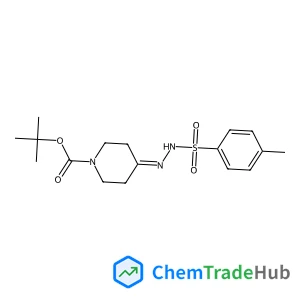
tert-Butyl 4-(2-(p-Tolylsulfonyl)hydrazono)piperidine-1-carboxylate
CAS Number:
1046478-89-0
Molecular Formula:
C17H25N3O4S
Minhua Shao, Brandon H. Smith, Sandra Guerrero, Lesia Protsailo, Dong Su, Keiichi Kaneko, Jonathan H. Odell, Michael P. Humbert, Kotaro Sasaki, Jesse Marzullo, Robert M. Darling
A comprehensive experimental study was conducted on the dealloying of PdNi6 nanoparticles under various conditions. A two-stage dealloying protocol was developed to leach >95% of Ni while minimizing the dissolution of Pd. The final structure of the dealloyed particle was strongly dependent on the acid used and temperature. When H2SO4 and HNO3 solutions were used in the first stage of dealloying, solid and porous particles were generated, respectively. The porous particles have a 3-fold higher electrochemical surface area per Pd mass than the solid ones. The dealloyed PdNi6 nanoparticles were then used as a core material for the synthesis of core–shell catalysts. These catalysts were synthesized in gram-size batches and involved Pt displacement of an underpotentially deposited (UPD) Cu monolayer. The resulting materials were characterized by scanning transmission electron microscopy (STEM) and in situ X-ray diffraction (XRD). The oxygen reduction reaction (ORR) activity of the core–shell catalysts is 7-fold higher than the state-of-the-art Pt/C. The high activity was confirmed by a more than 40 mV improvement in fuel cell performance with a Pt loading of 0.1 mg cm−2 by using the core–shell catalysts.
DOI: 10.1039/D0AN00142B
Jitraporn Vongsvivut, Philip Heraud, Adarsha Gupta, Munish Puri, Don McNaughton, Colin J. Barrow
DOI: 10.1039/C3AN00485F
Duo Lin, Jiahui Zhou, Yun Yu, Weiwei Chen, Pei-Hsuan Liao, Hao Huang, Kien Voon Kong
DOI: 10.1039/C9AY01466G
Shazzad Rassel, Chao Xu, Steven Zhang, Dayan Ban
DOI: 10.1039/C9AN02354B
Michaela Meyns, Sebastian Primpke, Gunnar Gerdts
DOI: 10.1039/C9AY01193E
Jisu Hur, Wonwoong Lee, Beom Hee Kim, Hyun Ji Kim, Do Hee Lee, Ji Hyun Lee, Yong Moon Lee, Han Bin Oh, Jongki Hong
DOI: 10.1039/C9AY01517E
When considering alternatives to 1-(4-Chlorophenyl)-N-hydroxymethanimine (CAS: 3...
This compound should be stored in a cool, dry place away from direct sunlight. I...
3-(4-Bromophenyl)-5-(2-fluorophenyl)-1,2,4-oxadiazole is synthesized through a m...
5-Chloro-2-(4-chlorophenyl)-4-methyl-6-[3-(1-piperidinyl)propoxy]pyrimidine (CAS...
2-Chloro-4-(difluoromethoxy)pyridine is used in the pharmaceutical industry for ...
3-Chloro-6-methylpyridazine (CAS: 1121-79-5) is classified under the Globally Ha...
Several alternatives can be used in the synthesis of Methyl 4,5-dimethyl-2-nitro...
Alternatives to (2E,2'E)-3,3'-(1,4-Phenylene)bisacrylaldehyde include other acry...
3-Amino-5-chloropyridin-2-ol hydrochloride is an organic compound with the CAS n...
When handling 6,7-Difluoro-2,3-dihydro-4H-chromen-4-one, it is essential to wear...

Physical Chemistry Chemical Physics (PCCP) is an international journal co-owned by 19 physical chemistry and physics societies from around the world. This journal publishes original, cutting-edge research in physical chemistry, chemical physics and biophysical chemistry. To be suitable for publication in PCCP, articles must include significant innovation and/or insight into physical chemistry; this is the most important criterion that reviewers and Editors will judge against when evaluating submissions. The journal has a broad scope and welcomes contributions spanning experiment, theory, computation and data science. Topical coverage includes spectroscopy, dynamics, kinetics, statistical mechanics, thermodynamics, electrochemistry, catalysis, surface science, quantum mechanics, quantum computing and machine learning. Interdisciplinary research areas such as polymers and soft matter, materials, nanoscience, energy, surfaces/interfaces, and biophysical chemistry are welcomed if they demonstrate significant innovation and/or insight into physical chemistry. Joined experimental/theoretical studies are particularly appreciated when complementary and based on up-to-date approaches.