


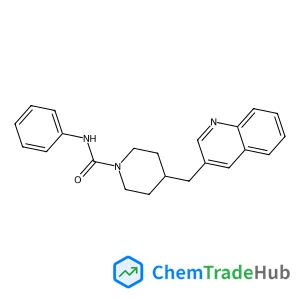
N-phenyl-4-(quinolin-3-ylmethyl)piperidine-1-carboxamide
CAS Number:
959151-50-9
Molecular Formula:
C22H23N3O
B. D. Gervasoni, G. N. Khairallah, R. A. J. O'Hair, U. Wille
Mass spectrometric techniques were used to obtain detailed insight into the reactions of peroxyl radicals with model systems of (damaged) polyesters. Using a distonic radical ion approach, it was shown that N-methylpyridinium peroxyl radical cations, Pyr+OO˙, do not react with non-activated C–H bonds typically present in polyesters that resist degradation. Structural damage in the polymer, for example small amounts of alkene moieties formed during the manufacturing process, is required to enable reaction with Pyr+OO˙, which proceeds with high preference through addition to the π system rather than via allylic hydrogen atom abstraction (kadd/kHAT > 20 for internal alkenes). This is due to the very fast and strongly exothermic subsequent fragmentation of the peroxyl–alkene radical adduct to epoxides and highly reactive Pyr+O˙, which both could promote further degradation of the polymer through non-radical and radical pathways. This work provides essential experimental support that the basic autoxidation mechanism is a too simplistic model to rationalize radical mediated degradation of polymers under ambient conditions.

Advanced Engineering Materials

Mini-Reviews in Medicinal Chemistry

Contact Lens & Anterior Eye

Environmental Toxicology and Pharmacology

Coloration Technology

Angewandte Chemie International Edition

Journal of Enzyme inhibition and Medicinal Chemistry

Molecules

Molecular Diversity

Current Pharmaceutical Biotechnology
Douglas Henderson, Robert S. Eisenberg
DOI: 10.1039/B203184A
A. Fomenko, H. Pospíšil, Z. Sedláková, J. Pleštil
DOI: 10.1039/B203378J
Vladimir L. Solozhenko
DOI: 10.1039/B206691B
Miyuki Yabuki, Ryoji Takahashi, Satoshi Sato, Toshiaki Sodesawa, Katsuyuki Ogura
DOI: 10.1039/B205645C
Chao Yang Wang
DOI: 10.1039/B206133N
Rainer Vogt, Sarka Langer, Evert Ljungström
DOI: 10.1039/B203529B
Horst Hippler, Béla Viskolcz
DOI: 10.1039/B201883G
Dean C. Sayle, S. Andrada Maicaneanu, Graeme W. Watson
DOI: 10.1039/B205725P
Jianzhun Jiang, Xiangyun Wang, Weijin Zhou, Hongcheng Gao, Jinguang Wu
DOI: 10.1039/B203467K
Waste containing 2-Ethyl-4-Methyl-1H-Imidazole-5-Carbaldehyde (CAS: 88634-80-4) ...
Triethoxy(octyl)silane (CAS: 1385031-14-0) is widely used in the pharmaceuticals...
Several alternatives to 3-iodo-7-nitro-1H-indazole (CAS: 864724-64-1) exist in t...
Yes, there are alternatives to Benzene, bis[(trimethoxysilyl)ethyl] (CAS: 266317...
Isothiazole-3-carbonitrile (CAS: 1452-17-1) is generally considered safe when us...
(3-Chlorophenyl)methanol (CAS: 873-63-2) is considered low to moderately toxic. ...
(2S,3S)-2-Hydroxy-3-({[(2-methyl-2-propanyl)oxy]carbonyl}amino)-3-(2-naphthyl)pr...
Proper handling of methyl 2-(bromomethyl)-5-methoxybenzoate requires the use of ...
6,8-Dibromoimidazo[1,2-a]pyridine-2-carboxylic acid (CAS: 904805-36-3) is an aro...
3-Amino-5-bromo-2-pyridinecarbonitrile is considered safe when handled under pro...

Physical Chemistry Chemical Physics (PCCP) is an international journal co-owned by 19 physical chemistry and physics societies from around the world. This journal publishes original, cutting-edge research in physical chemistry, chemical physics and biophysical chemistry. To be suitable for publication in PCCP, articles must include significant innovation and/or insight into physical chemistry; this is the most important criterion that reviewers and Editors will judge against when evaluating submissions. The journal has a broad scope and welcomes contributions spanning experiment, theory, computation and data science. Topical coverage includes spectroscopy, dynamics, kinetics, statistical mechanics, thermodynamics, electrochemistry, catalysis, surface science, quantum mechanics, quantum computing and machine learning. Interdisciplinary research areas such as polymers and soft matter, materials, nanoscience, energy, surfaces/interfaces, and biophysical chemistry are welcomed if they demonstrate significant innovation and/or insight into physical chemistry. Joined experimental/theoretical studies are particularly appreciated when complementary and based on up-to-date approaches.
![L-Threonine, N-[[4,7,10-tris(carboxymethyl)-1,4,7,10-tetraazacyclododec-1-yl]acetyl]-D-phenylalanyl-L-cysteinyl-L-tyrosyl-D-tryptophyl-L-lysyl-L-threonyl-L-cysteinyl-, cyclic (2→7)-disulfide, acetate (salt) (9CI) structure](https://static.chemtradehub.com/structs/177/177943-89-4-6312.webp "L-Threonine, N-[[4,7,10-tris(carboxymethyl)-1,4,7,10-tetraazacyclododec-1-yl]acetyl]-D-phenylalanyl-L-cysteinyl-L-tyrosyl-D-tryptophyl-L-lysyl-L-threonyl-L-cysteinyl-, cyclic (2→7)-disulfide, acetate (salt) (9CI) structure")
![4,4'-[2,5-Biphenyldiylbis(oxy)]dianiline structure](https://static.chemtradehub.com/structs/941/94148-67-1-24c6.webp "4,4'-[2,5-Biphenyldiylbis(oxy)]dianiline structure")
![4-Nitrophenyl N-{[(2-methyl-2-propanyl)oxy]carbonyl}-L-isoleucinate structure](https://static.chemtradehub.com/structs/169/16948-38-2-c88f.webp "4-Nitrophenyl N-{[(2-methyl-2-propanyl)oxy]carbonyl}-L-isoleucinate structure")



