












Structural investigation of resorcinol based symmetrical banana mesogens by XRD, NMR and polarization measurements
Literature Information
Publication Date
2015-01-12
DOI
10.1039/C4CP05844E
Impact Factor
3.676
Authors
M. Kesava Reddy, E. Varathan, B. Jacintha, Nitin P. Lobo, Arun Roy, T. Narasimhaswamy, K. V. Ramanathan
View Original
Abstract
Synthesis and structural characterization of two novel symmetrical banana mesogens built from resorcinol with seven phenyl rings linked by ester and imine with a terminal dodecyl/dodecyloxy chain has been carried out. Density functional theory (DFT) has been employed for obtaining the geometry optimized structures, the dipole moments and 13C NMR chemical shifts. The HOPM and DSC studies revealed enantiotropic B2 and B7 phases for the dodecyl and dodecyloxy homologs respectively. The powder X-ray studies of both the mesogens indicate the presence of layer ordering. The polarization measurements reveal an anti-ferroelectric switching for the B2 phase of the dodecyl homolog whose structure has been identified as SmCSPA. The B7 phase of the dodecyloxy homolog was found to be non-switchable. High resolution 13C NMR study of the dodecyl homolog in its mesophase has been carried out. 13C–1H dipolar couplings obtained from the 2-dimensional separated local field spectroscopy experiment were used to obtain the orientational order parameters of the different segments of the mesogen. Very large 13C–1H dipolar couplings observed for the carbons of the central phenyl ring (9.7–12.3 kHz) in comparison to the dipolar couplings of those of the side arm phenyl rings (less than 3 kHz) are a direct consequence of the ordering in the banana phase and the shape of the molecule. From the ratio of the local order parameter values, the bent-angle of the mesogen could be determined in a straight forward manner to be 120.5°.
Related Literature
Calculation of the surface tension of cyclic and aromatic hydrocarbons from Monte Carlo simulations using an anisotropic united atom model (AUA)
A. Ghoufi, V. Lachet
2009-05-20
Paper
DOI: 10.1039/B823295D
Effect of comonomer content on the crystallization kinetics and morphology of biodegradable poly(3-hydroxybutyrate-co-3-hydroxyhexanoate)
Haoyuan Cai, Zhaobin Qiu
2009-08-26
Paper
DOI: 10.1039/B907677H
The CO–Ne van der Waals complex: ab initio intermolecular potential energy, interaction induced electric dipole moment and polarizability surfaces, and second virial coefficients
Angelika Baranowska, Berta Fernández, Antonio Rizzo, Branislav Jansík
2009-08-20
Paper
DOI: 10.1039/B905806K
An ellipsometry study of silicananoparticle layers at the water surface
Antonio Stocco, Dominique Langevin, Bingbo Wei, Bernard P. Binks
2009-09-16
Paper
DOI: 10.1039/B907903C
Acceleration of the Z to Ephotoisomerization of penta-2,4-dieniminium by hydrogen out-of-plane motion: theoretical study on a model system of retinal protonated Schiff base
Masato Sumita, Mikhail N. Ryazantsev, Kazuya Saito
2009-06-09
Paper
DOI: 10.1039/B900882A
Molecular self-assembly in a model amphiphile system
Lorna Dougan, John L. Finney, Alan K. Soper
2010-06-10
Paper
DOI: 10.1039/C003407J
Self-promotion mechanism for CO electrooxidation on gold
Paramaconi Rodriguez, Marc T. M. Koper
2010-06-24
Paper
DOI: 10.1039/B926365A
The interplay of van der Waals and weak chemical forces in the adsorption of salicylic acid on NaCl(001)
Wei Chen, Christoph Tegenkamp, Herbert Pfnür, Thomas Bredow
2009-08-24
Communication
DOI: 10.1039/B911944B
Influence of surfactants and viscosity in the preparation process of battery electrodes containing nanoparticles
A. Hintennach, P. Novák
2009-08-18
Paper
DOI: 10.1039/B911674E
You might also like
Compound Q&A
How should waste containing N-Methoxy-N-methyl-1,3-thiazole-5-carboxamide (CAS: 898825-89-3) be handled?
Waste containing N-Methoxy-N-methyl-1,3-thiazole-5-carboxamide (CAS: 898825-89-3...
898825-89-3N-Methoxy-N-methyl-1...
Compound Q&A
How should N-(4-Biphenylyl)dibenzo[b,d]furan-4-amine (CAS: 1318338-47-4) be stored?
N-(4-Biphenylyl)dibenzo[b,d]furan-4-amine should be stored in a tightly sealed c...
1318338-47-4N-(4-Biphenylyl)dibe...
Compound Q&A
What is the market or research trend for 3-Acetamido-5-amino-2,4,6-triiodobenzoic acid (CAS: 1713-07-1)?
The market for 3-Acetamido-5-amino-2,4,6-triiodobenzoic acid (CAS: 1713-07-1) is...
1713-07-13-Acetamido-5-amino-...
Compound Q&A
How should Benzyl 2-O-acetyl-3,4,6-tri-O-benzyl-beta-D-galactopyranoside (CAS: 61820-03-9) be stored?
Benzyl 2-O-acetyl-3,4,6-tri-O-benzyl-beta-D-galactopyranoside (CAS: 61820-03-9) ...
61820-03-9Benzyl 2-O-acetyl-3,...
Compound Q&A
What regulatory guidelines apply to 2-Ethylpiperazine dihydrochloride (CAS: 438050-52-3)?
2-Ethylpiperazine dihydrochloride (CAS: 438050-52-3) is regulated under the Glob...
438050-52-32-Ethylpiperazine di...
Compound Q&A
What regulatory guidelines apply to 1,1'-[1,3-Phenylenebis(methylene)]bis(3-methyl-1H-pyrrole-2,5-dione) (CAS: 119462-56-5)?
1,1'-[1,3-Phenylenebis(methylene)]bis(3-methyl-1H-pyrrole-2,5-dione) (CAS: 11946...
119462-56-51,1'-[1,3-Phenyleneb...
Compound Q&A
Are there alternatives to 5-Fluoro-2-(1-pyrrolidinyl)pyridine (CAS: 1287217-79-1) in synthesis?
Several alternatives can be used in the synthesis of 5-Fluoro-2-(1-pyrrolidinyl)...
1287217-79-15-Fluoro-2-(1-pyrrol...
Compound Q&A
What precautions should be taken when handling 1-((2R,3R,4R,5R)-5-((bis(4-methoxyphenyl)(phenyl)methoxy)methyl)-4-hydroxy-3-methoxytetrahydrofuran-2-yl)-5-methylpyrimidine-2,4(1H,3H)-dione (CAS: 153631-19-7)?
Proper personal protective equipment (PPE) must be worn when handling this compo...
153631-19-71-((2R,3R,4R,5R)-5-(...
Compound Q&A
What precautions should be taken when handling 6-Bromoimidazo[1,2-a]pyridin-8-amine (CAS: 676371-00-9)?
When handling 6-Bromoimidazo[1,2-a]pyridin-8-amine, it is important to wear appr...
676371-00-96-Bromoimidazo[1,2-a...
Compound Q&A
Are there alternatives to (2S,4R)-4-(4-Nitrobenzyl)pyrrolidine-2-carboxylic acid hydrochloride (CAS: 1049740-22-8) in synthesis?
Alternatives to (2S,4R)-4-(4-Nitrobenzyl)pyrrolidine-2-carboxylic acid hydrochlo...
1049740-22-8(2S,4R)-4-(4-Nitrobe...
Source Journal
Physical Chemistry Chemical Physics

CiteScore:
5.5
Self-citation Rate:
10.3%
Articles per Year:
3036
Physical Chemistry Chemical Physics (PCCP) is an international journal co-owned by 19 physical chemistry and physics societies from around the world. This journal publishes original, cutting-edge research in physical chemistry, chemical physics and biophysical chemistry. To be suitable for publication in PCCP, articles must include significant innovation and/or insight into physical chemistry; this is the most important criterion that reviewers and Editors will judge against when evaluating submissions. The journal has a broad scope and welcomes contributions spanning experiment, theory, computation and data science. Topical coverage includes spectroscopy, dynamics, kinetics, statistical mechanics, thermodynamics, electrochemistry, catalysis, surface science, quantum mechanics, quantum computing and machine learning. Interdisciplinary research areas such as polymers and soft matter, materials, nanoscience, energy, surfaces/interfaces, and biophysical chemistry are welcomed if they demonstrate significant innovation and/or insight into physical chemistry. Joined experimental/theoretical studies are particularly appreciated when complementary and based on up-to-date approaches.
Recommended Compounds
![5-Acetyl-2,3-dihydrobenzo[b]furan structure](https://static.chemtradehub.com/structs/908/90843-31-5-eea4.webp "5-Acetyl-2,3-dihydrobenzo[b]furan structure")
![[4-(Heptyloxy)phenyl]boronic acid structure](https://static.chemtradehub.com/structs/136/136370-19-9-ad33.webp "[4-(Heptyloxy)phenyl]boronic acid structure")
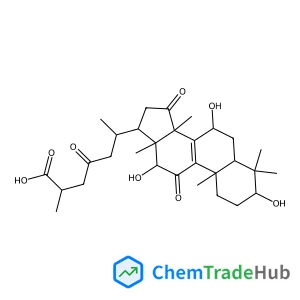
(3beta,7beta,12beta)-3,7,12-Trihydroxy-11,15,23-trioxolanost-8-en-26-oic acid
CAS Number:
98665-22-6
Molecular Formula:
C30H44O8
Recommended Suppliers



Disclaimer
This page provides academic journal information for reference and research purposes only. We are not affiliated with any journal publishers and do not handle publication submissions. For publication-related inquiries, please contact the respective journal publishers directly.
If you notice any inaccuracies in the information displayed, please contact us at support@chemtradehub.com. We will promptly review and address your concerns.