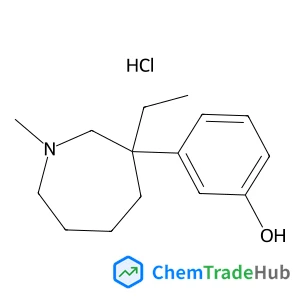
3-(3-Ethyl-1-methyl-3-azepanyl)phenol hydrochloride (1:1)
CAS Number:
59263-76-2
Molecular Formula:
C15H24ClNO
Lorna Dougan, John L. Finney, Alan K. Soper
The physical origin of the large and negative excess entropy of mixing of alcohols and water remains controversial. In contrast to standard explanations that evoke concepts of water structuring, recent work has shown that, at ambient conditions, it can be quantitatively explained in terms of molecular scale partial demixing of the two components. Here, we estimate the negative excess entropy (ΔSE) of aqueous methanol at low temperature and high pressure using experimentally-derived structural data and a recently introduced cluster model. On cooling to 190 K the cluster sizes increase, but the change in ΔSE, which according to this method of calculation depends on the surface area to volume ratio of the clusters, is not significant, suggesting that the topology of the clusters must change with decreased temperature. On compression the cluster sizes also increase, and ΔSE is now positive, suggesting an even more pronounced change in cluster topology with increased pressure. This work suggests that it is the amphiphilic nature of a molecule that determines aggregation and self-assembly processes in aqueous solution. The results therefore give useful insight into the processes of cold and pressure denaturation of proteins.

Molecular Pharmacology

Science

Helvetica Chimica Acta

Organic Preparations and Procedures International

Journal of Physics and Chemistry of Solids

Fibre Chemistry

Journal of Heterocyclic Chemistry

Proceedings of the National Academy of Sciences of the United States of America

European Journal of Wood and Wood Products

Israel Journal of Chemistry
Sébastien Maron, Nadège Ollier, Thierry Gacoin, Géraldine Dantelle
DOI: 10.1039/C7CP00451F
Hyun Joon Chang, Myeongsang Lee, Jae In Kim, Sungsoo Na
DOI: 10.1039/C7CP01418J
Haiying He, Yesukhei Jagvaral
DOI: 10.1039/C7CP00915A
Houyang Chen
DOI: 10.1039/C6CP08621G
Mónika Kéri, Zoltán Nagy, Levente Novák, Edit Szarvas, Lajos P. Balogh, István Bányai
DOI: 10.1039/C7CP00875A
Jiayue Yang, Bo Jiang
DOI: 10.1039/C7CP01428G
Jorge Royes, Víctor Polo, Santiago Uriel, Luis Oriol, Milagros Piñol, Rosa M. Tejedor
DOI: 10.1039/C7CP01739A
Frédéric Aitken, Ferdinand Volino, Luis Guillermo Mendoza-Luna, Klaus von Haeften, Jussi Eloranta
DOI: 10.1039/C7CP03067C
Elena Castellucci, Laura Bussotti, Lorenzo Zani, Gianna Reginato
DOI: 10.1039/C7CP01956D
Waste containing N-Methoxy-N-methyl-1,3-thiazole-5-carboxamide (CAS: 898825-89-3...
N-(4-Biphenylyl)dibenzo[b,d]furan-4-amine should be stored in a tightly sealed c...
The market for 3-Acetamido-5-amino-2,4,6-triiodobenzoic acid (CAS: 1713-07-1) is...
Benzyl 2-O-acetyl-3,4,6-tri-O-benzyl-beta-D-galactopyranoside (CAS: 61820-03-9) ...
2-Ethylpiperazine dihydrochloride (CAS: 438050-52-3) is regulated under the Glob...
1,1'-[1,3-Phenylenebis(methylene)]bis(3-methyl-1H-pyrrole-2,5-dione) (CAS: 11946...
Several alternatives can be used in the synthesis of 5-Fluoro-2-(1-pyrrolidinyl)...
Proper personal protective equipment (PPE) must be worn when handling this compo...
When handling 6-Bromoimidazo[1,2-a]pyridin-8-amine, it is important to wear appr...
Alternatives to (2S,4R)-4-(4-Nitrobenzyl)pyrrolidine-2-carboxylic acid hydrochlo...

Physical Chemistry Chemical Physics (PCCP) is an international journal co-owned by 19 physical chemistry and physics societies from around the world. This journal publishes original, cutting-edge research in physical chemistry, chemical physics and biophysical chemistry. To be suitable for publication in PCCP, articles must include significant innovation and/or insight into physical chemistry; this is the most important criterion that reviewers and Editors will judge against when evaluating submissions. The journal has a broad scope and welcomes contributions spanning experiment, theory, computation and data science. Topical coverage includes spectroscopy, dynamics, kinetics, statistical mechanics, thermodynamics, electrochemistry, catalysis, surface science, quantum mechanics, quantum computing and machine learning. Interdisciplinary research areas such as polymers and soft matter, materials, nanoscience, energy, surfaces/interfaces, and biophysical chemistry are welcomed if they demonstrate significant innovation and/or insight into physical chemistry. Joined experimental/theoretical studies are particularly appreciated when complementary and based on up-to-date approaches.