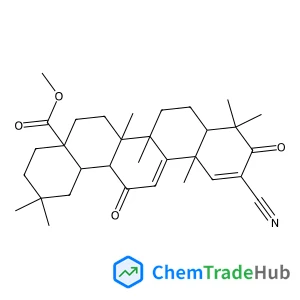
Methyl 2-cyano-3,12-dioxooleana-1,9(11)-dien-28-oate
CAS Number:
218600-53-4
Molecular Formula:
C32H43NO4
Haoyuan Cai, Zhaobin Qiu
Crystallization kinetics and morphology of biodegradable poly(3-hydroxybutyrate-co-3-hydroxyhexanoate) (PHBHHx) containing 7, 10 and 18 mol% 3-hydroxyhexanoate (HHx) comonomer were investigated by differential scanning calorimetry, polarized optical microscopy and wide angle X-ray diffraction in detail in this work. The experimental results indicate that overall isothermal crystallization rates of PHBHHx copolymers are reduced with increasing crystallization temperature and HHx content; however, the crystallization mechanism remains unchanged. Moreover, the equilibrium melting point temperatures of PHBHHx copolymers decrease with increasing the HHx content. Banded spherulites morphology and spherulitic growth rates of PHBHHx have been studied in a wide crystallization temperature range. Both band spacing and spherulite growth rate decrease with increasing the HHx comonomer content. All the investigated PHBHHx copolymers exhibit a crystallization regime II to III transition, and the crystallization regime transition temperature shifts to low temperature range with increasing the HHx content. In addition, increasing the HHx content does not modify the crystal structure or crystal cell parameters but decreases the crystallinity of PHBHHx.
Mónika Kéri, Zoltán Nagy, Levente Novák, Edit Szarvas, Lajos P. Balogh, István Bányai
DOI: 10.1039/C7CP00875A
Haiying He, Yesukhei Jagvaral
DOI: 10.1039/C7CP00915A
L. Ellis-Gibbings, A. D. Bass, P. Cloutier, G. García, L. Sanche
DOI: 10.1039/C7CP00715A
Amedeo Capobianco, Alessandro Landi, Andrea Peluso
DOI: 10.1039/C7CP02029E
Michael Stenrup, Elisa Pieri, Vincent Ledentu, Nicolas Ferré
DOI: 10.1039/C7CP00991G
Victor Gray, Ambra Dreos, Paul Erhart, Bo Albinsson, Kasper Moth-Poulsen, Maria Abrahamsson
DOI: 10.1039/C7CP01368J
E. Avellanal-Zaballa, G. Durán-Sampedro, A. Prieto-Castañeda, A. R. Agarrabeitia, I. García-Moreno, I. López-Arbeloa, J. Bañuelos, M. J. Ortiz
DOI: 10.1039/C7CP01626C
Frédéric Aitken, Ferdinand Volino, Luis Guillermo Mendoza-Luna, Klaus von Haeften, Jussi Eloranta
DOI: 10.1039/C7CP03067C
Clem Stross, Simon McIntosh-Smith, Edward G. Hohenstein, Fred R. Manby
DOI: 10.1039/C7CP00492C
DOI: 10.1039/C7CP01263B
Waste containing N-Methoxy-N-methyl-1,3-thiazole-5-carboxamide (CAS: 898825-89-3...
N-(4-Biphenylyl)dibenzo[b,d]furan-4-amine should be stored in a tightly sealed c...
The market for 3-Acetamido-5-amino-2,4,6-triiodobenzoic acid (CAS: 1713-07-1) is...
Benzyl 2-O-acetyl-3,4,6-tri-O-benzyl-beta-D-galactopyranoside (CAS: 61820-03-9) ...
2-Ethylpiperazine dihydrochloride (CAS: 438050-52-3) is regulated under the Glob...
1,1'-[1,3-Phenylenebis(methylene)]bis(3-methyl-1H-pyrrole-2,5-dione) (CAS: 11946...
Several alternatives can be used in the synthesis of 5-Fluoro-2-(1-pyrrolidinyl)...
Proper personal protective equipment (PPE) must be worn when handling this compo...
When handling 6-Bromoimidazo[1,2-a]pyridin-8-amine, it is important to wear appr...
Alternatives to (2S,4R)-4-(4-Nitrobenzyl)pyrrolidine-2-carboxylic acid hydrochlo...

Physical Chemistry Chemical Physics (PCCP) is an international journal co-owned by 19 physical chemistry and physics societies from around the world. This journal publishes original, cutting-edge research in physical chemistry, chemical physics and biophysical chemistry. To be suitable for publication in PCCP, articles must include significant innovation and/or insight into physical chemistry; this is the most important criterion that reviewers and Editors will judge against when evaluating submissions. The journal has a broad scope and welcomes contributions spanning experiment, theory, computation and data science. Topical coverage includes spectroscopy, dynamics, kinetics, statistical mechanics, thermodynamics, electrochemistry, catalysis, surface science, quantum mechanics, quantum computing and machine learning. Interdisciplinary research areas such as polymers and soft matter, materials, nanoscience, energy, surfaces/interfaces, and biophysical chemistry are welcomed if they demonstrate significant innovation and/or insight into physical chemistry. Joined experimental/theoretical studies are particularly appreciated when complementary and based on up-to-date approaches.