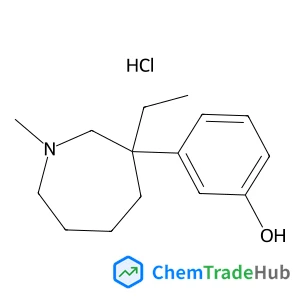
3-(3-Ethyl-1-methyl-3-azepanyl)phenol hydrochloride (1:1)
CAS Number:
59263-76-2
Molecular Formula:
C15H24ClNO
The first page of this article is displayed as the abstract.
Amedeo Capobianco, Alessandro Landi, Andrea Peluso
DOI: 10.1039/C7CP02029E
Boris Le Guennic, Giovanni Scalmani, Michael J. Frisch, Adèle D. Laurent
DOI: 10.1039/C7CP01190C
Ander Camiruaga, Imanol Usabiaga, Aran Insausti, José A. Fernández
DOI: 10.1039/C7CP00615B
Erica Earl, Scott Calabrese Barton
DOI: 10.1039/C7CP00239D
Mónika Kéri, Zoltán Nagy, Levente Novák, Edit Szarvas, Lajos P. Balogh, István Bányai
DOI: 10.1039/C7CP00875A
E. Avellanal-Zaballa, G. Durán-Sampedro, A. Prieto-Castañeda, A. R. Agarrabeitia, I. García-Moreno, I. López-Arbeloa, J. Bañuelos, M. J. Ortiz
DOI: 10.1039/C7CP01626C
Cristina Ortega-Moo, Rocio Durán, Bárbara Herrera, Soledad Gutiérrez-Oliva, Rubicelia Vargas
DOI: 10.1039/C7CP01304C
Lei Yang, Yanjie Guo, Dongfeng Diao
DOI: 10.1039/C7CP01962A
Leigh Weston, A. Janotti, X. Y. Cui, C. Stampfl, C. G. Van de Walle
DOI: 10.1039/C7CP01471F
Waste containing N-Methoxy-N-methyl-1,3-thiazole-5-carboxamide (CAS: 898825-89-3...
N-(4-Biphenylyl)dibenzo[b,d]furan-4-amine should be stored in a tightly sealed c...
The market for 3-Acetamido-5-amino-2,4,6-triiodobenzoic acid (CAS: 1713-07-1) is...
Benzyl 2-O-acetyl-3,4,6-tri-O-benzyl-beta-D-galactopyranoside (CAS: 61820-03-9) ...
2-Ethylpiperazine dihydrochloride (CAS: 438050-52-3) is regulated under the Glob...
1,1'-[1,3-Phenylenebis(methylene)]bis(3-methyl-1H-pyrrole-2,5-dione) (CAS: 11946...
Several alternatives can be used in the synthesis of 5-Fluoro-2-(1-pyrrolidinyl)...
Proper personal protective equipment (PPE) must be worn when handling this compo...
When handling 6-Bromoimidazo[1,2-a]pyridin-8-amine, it is important to wear appr...
Alternatives to (2S,4R)-4-(4-Nitrobenzyl)pyrrolidine-2-carboxylic acid hydrochlo...

Physical Chemistry Chemical Physics (PCCP) is an international journal co-owned by 19 physical chemistry and physics societies from around the world. This journal publishes original, cutting-edge research in physical chemistry, chemical physics and biophysical chemistry. To be suitable for publication in PCCP, articles must include significant innovation and/or insight into physical chemistry; this is the most important criterion that reviewers and Editors will judge against when evaluating submissions. The journal has a broad scope and welcomes contributions spanning experiment, theory, computation and data science. Topical coverage includes spectroscopy, dynamics, kinetics, statistical mechanics, thermodynamics, electrochemistry, catalysis, surface science, quantum mechanics, quantum computing and machine learning. Interdisciplinary research areas such as polymers and soft matter, materials, nanoscience, energy, surfaces/interfaces, and biophysical chemistry are welcomed if they demonstrate significant innovation and/or insight into physical chemistry. Joined experimental/theoretical studies are particularly appreciated when complementary and based on up-to-date approaches.