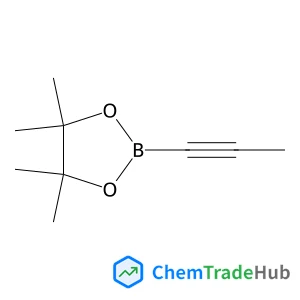
4,4,5,5-Tetramethyl-2-(1-propyn-1-YL)-1,3,2-dioxaborolane
CAS Number:
347389-75-7
Molecular Formula:
C9H15BO2
Peng Zheng, Savan Suri, Nianqiang Wu
The wide plasmonic tuning range of nanotriangle and nanohole array patterns fabricated by nanosphere lithography makes them promising in surface-enhanced Raman scattering (SERS) sensors. Unfortunately, it is challenging to optimize these patterns for SERS sensing because their optical response is a complex mixture of localized surface plasmon resonance (SPR) and propagating surface plasmon polariton (SPP). In this paper, transmission and reflection measurements are combined with finite difference time domain simulations to identify and separate each plasmonic mode, discerning which resonance leads to the electromagnetic field enhancement. The SERS enhancement is found to be dominated by the absorption, which is shifted from the transmission and reflection dips usually used as tuning points, and by the ‘gap’ defects formed within the pattern. These effects have different spectral and geometric dependences, forming two optimization curves which can be used to predict the best performance for a given excitation wavelength. The developed model is verified with experimental SERS measurements for several nanohole sizes and periodicities, and then used to give optimal fabrication parameters for a range of measurement conditions. The results will promote the application of two-dimensional plasmonic nanoarrays in SERS sensors.

Journal of Saudi Chemical Society

Current Opinion in Colloid & Interface Science

Drug Discovery Today

Nature Medicine

Russian Journal of Applied Chemistry

Russian Chemical Bulletin

Saudi Pharmaceutical Journal

Chemistry Education Research and Practice

Organic Process Research & Development

New Journal of Chemistry
Xuefeng Zhao, Xinping Long, Xiaogan Dai, Kaili Zhang, Ming Li, Feng Guo, Zhiqiang Qiao, Yushi Wen
DOI: 10.1039/C9CP05734J
Xuejiao Ma, Dan Zhou, Yan Yan, Jing Xu, Siyuan Liu, Yulan Wang, Manai Cui, Yuheng Cheng, Yu Miao, Yanhui Liu
DOI: 10.1039/C9CP02422K
Adriana Alieva, Cinzia Casiraghi
DOI: 10.1039/D0CP00592D
Seiji Katakura, Naoya Nishi, Kazuya Kobayashi, Tetsuo Sakka
DOI: 10.1039/C9CP05297F
Björn Drobot, Moritz Schmidt, Takaya Abe, Koji Okuwaki, Florian Brulfert, Sven Falke, Sergey A. Samsonov, Yuto Komeiji, Christian Betzel, Thorsten Stumpf, Johannes Raff
DOI: 10.1039/C9CP03750K
Dieter Freude, Alexander G. Stepanov
DOI: 10.1039/D0CP00270D
Lin-Yan Feng, Rui Li, Hua-Jin Zhai
DOI: 10.1039/C9CP03254A
Antton Curutchet, Pauline Colinet, Carine Michel, Stephan N. Steinmann, Tangui Le Bahers
DOI: 10.1039/D0CP00281J
Skandar Taj, Diane Baird, Alexander Rosu-Finsen, Martin R. S. McCoustra
DOI: 10.1039/C9CP90226K
6-(3-Fluorophenyl)picolinic acid is generally considered safe for laboratory use...
(3R)-3-Pyrrolidinol is used in the pharmaceutical industry as a precursor for dr...
When handling (4R,5R)-4,5-Diethoxycarbonyl-2,2-dimethyldioxolane (CAS: 59779-75-...
1-(6-Chloroimidazo[1,2-b]pyridazin-3-yl)ethanone is often synthesized via a mult...
The market for N-Ethyl-3,4-dimethylbenzylamine (CAS: 39180-83-1) remains steady,...
Tert-butyl 3-(pyrrolidin-1-yl)azetidine-1-carboxylate is a chemical compound wit...
1-Bromo-3-chloro-2,4-dimethoxybenzene (CAS: 1228956-93-1) falls under the classi...
The safety of 8-Bromo-2-methyl-3,4-dihydroisoquinolin-1(2H)-one (CAS: 1368622-07...
Benzyl [(3S)-2,6-dioxo-3-piperidinyl]carbamate is generally safe when handled wi...
1-{[4-(4,4,5,5-Tetramethyl-1,3,2-dioxaborolan-2-yl)phenyl]sulfonyl}pyrrolidine s...

Physical Chemistry Chemical Physics (PCCP) is an international journal co-owned by 19 physical chemistry and physics societies from around the world. This journal publishes original, cutting-edge research in physical chemistry, chemical physics and biophysical chemistry. To be suitable for publication in PCCP, articles must include significant innovation and/or insight into physical chemistry; this is the most important criterion that reviewers and Editors will judge against when evaluating submissions. The journal has a broad scope and welcomes contributions spanning experiment, theory, computation and data science. Topical coverage includes spectroscopy, dynamics, kinetics, statistical mechanics, thermodynamics, electrochemistry, catalysis, surface science, quantum mechanics, quantum computing and machine learning. Interdisciplinary research areas such as polymers and soft matter, materials, nanoscience, energy, surfaces/interfaces, and biophysical chemistry are welcomed if they demonstrate significant innovation and/or insight into physical chemistry. Joined experimental/theoretical studies are particularly appreciated when complementary and based on up-to-date approaches.
![Methyl 2-[5-(3-Phenoxyphenyl)-2H-tetrazol-2-yl]acetate structure](https://static.chemtradehub.com/structs/130/1305320-60-8-84b4.webp "Methyl 2-[5-(3-Phenoxyphenyl)-2H-tetrazol-2-yl]acetate structure")
![1-Benzyl-1,7-diazaspiro[4.4]nonane dihydrochloride structure](https://static.chemtradehub.com/structs/115/1159822-71-5-0320.webp "1-Benzyl-1,7-diazaspiro[4.4]nonane dihydrochloride structure")