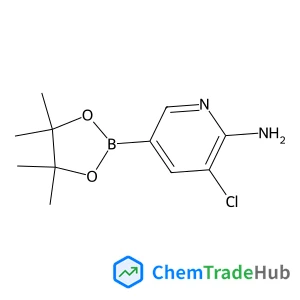
3-Chloro-5-(4,4,5,5-tetramethyl-1,3,2-dioxaborolan-2-yl)-2-pyridinamine
CAS Number:
1032758-99-8
Molecular Formula:
C11H16BClN2O2
Yefei Wang
In this work, molecular dynamics simulations are adopted to investigate the microscopic dewetting mechanism of nanoscale water films on methylated silica surfaces. The simulation results show that the dewetting process is divided into two stages: the appearance of dry patches and the quick contraction of the water film. First, the appearance of dry patches is due to the fluctuation in the film thickness originating from capillary wave instability. Second, for the fast contraction of water film, the unsaturated electrostatic and hydrogen bond interactions among water molecules are the driving forces, which induce the quick contraction of the water film. Finally, the effect of film thickness on water films dewetting is studied. Research results suggest that upon increasing the water film thickness from 6 to 8 Å, the final dewetting patterns experience separate droplets and striation-shaped structures, respectively. But upon further increasing the water film thickness, the water film is stable and there are no dry patches. The microscopic dewetting behaviors of water films on methylated silica surfaces discussed here are helpful in understanding many phenomena in scientific and industrial processes better.
Pengfei Qiu, Kunpeng Zhao, Dudi Ren, Xun Shi
DOI: 10.1039/D0CP00733A
Bhaskar Rana, John M. Herbert
DOI: 10.1039/D0CP05216G
S. Mandal, R. Gopal, M. Shcherbinin, A. D’Elia, H. Srinivas, R. Richter, B. Bapat, S. R. Krishnan, V. Sharma
DOI: 10.1039/D0CP00689K
DOI: 10.1039/D0CP00524J
Zhibo Ma
DOI: 10.1039/C9CP06893G
Arusha Acharyya, Dayoung Shin, Thomas Troxler, Feng Gai
DOI: 10.1039/D0CP00397B
Eugenii Ya. Misochko, Alexander V. Akimov, Denis V. Korchagin, Yulia S. Ganushevich, Egor A. Melnikov, Vasili A. Miluykov
DOI: 10.1039/D0CP05254J
J. Järvinen, D. Zvezdov, J. Ahokas, S. Sheludiakov, L. Lehtonen, S. Vasiliev, L. Vlasenko, Y. Ishikawa, Y. Fujii
DOI: 10.1039/C9CP06859G
Yannick J. Dappe, Oleksiy L. Kapitanchuk, Delphine Coursault, Emmanuelle Lacaze
DOI: 10.1039/C9CP06519A
Li Wang, Denglu Hou, Chunfang Wu, Yuanping Shi, Shaohui Shi, Weikun Gao, Shunzhen Feng, Yingdi Liu, Li Li, Denghui Ji
DOI: 10.1039/C9CP05608D
This compound is mainly used as an intermediate in the synthesis of antipsychoti...
Waste containing 1-(D-Ribofuranosyl)-1,4-dihydro-3-pyridinecarboxamide (CAS: 191...
2-Methyl-2-propanyl 3-bromo-3-(hydroxymethyl)-1-azetidinecarboxylate (CAS: 20079...
N-(4-Chloro-2-pyridinyl)acetamide (CAS: 245056-66-0) is a chemical compound with...
5-Chloro-2-hydroxybenzoic acid, also known as 5-chlorosalicylic acid, is an arom...
When handling 1,1-Dichloro-1-fluoroethane (CAS: 1717-00-6), it is important to u...
Fmoc-(2S,3R)-3-phenylpyrrolidine-2-carboxylic acid is a white crystalline solid ...
4-Amino-5-bromo-2-pyridinecarboxylic acid is primarily used as a precursor in th...
Handling this compound should be done with personal protective equipment (PPE) i...
When handling 8-bromo-2,2-dimethyl-3,4-dihydro-2H-1,4-benzoxazin-3-one, use prop...

Physical Chemistry Chemical Physics (PCCP) is an international journal co-owned by 19 physical chemistry and physics societies from around the world. This journal publishes original, cutting-edge research in physical chemistry, chemical physics and biophysical chemistry. To be suitable for publication in PCCP, articles must include significant innovation and/or insight into physical chemistry; this is the most important criterion that reviewers and Editors will judge against when evaluating submissions. The journal has a broad scope and welcomes contributions spanning experiment, theory, computation and data science. Topical coverage includes spectroscopy, dynamics, kinetics, statistical mechanics, thermodynamics, electrochemistry, catalysis, surface science, quantum mechanics, quantum computing and machine learning. Interdisciplinary research areas such as polymers and soft matter, materials, nanoscience, energy, surfaces/interfaces, and biophysical chemistry are welcomed if they demonstrate significant innovation and/or insight into physical chemistry. Joined experimental/theoretical studies are particularly appreciated when complementary and based on up-to-date approaches.