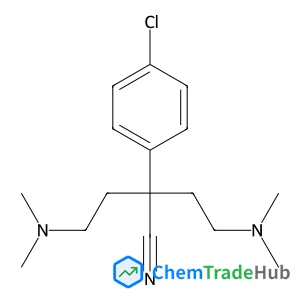
2-(4-Chlorophenyl)-4-(dimethylamino)-2-(2-(dimethylamino)ethyl)butanenitrile
CAS Number:
1246816-57-8
Molecular Formula:
C16H24ClN3
Yannick J. Dappe, Oleksiy L. Kapitanchuk, Delphine Coursault, Emmanuelle Lacaze
Combining STM measurements on three different substrates (HOPG, MoS2, and Au[111]) together with DFT calculations allow for analysis of the origin of the self-assembly of 4-cyano-4′-n-decylbiphenyl (10CB) molecules into kinked row structures using a previously developed phenomenological model. This molecule has an alkyl chain with 10 carbons and a cyanobiphenyl group with a particularly large dipole moment. 10CB represents a toy model that we use here to unravel the relationship between the induced kinked structure, in particular the corresponding chirality expression, and the balanced intermolecular/molecule–substrate interaction. We show that the local ordered structure is driven by the typical alkyl chain/substrate interaction for HOPG and Au[111] and the cyanobiphenyl group/substrate interaction for MoS2. The strongest molecule/substrate interactions are observed for MoS2 and Au[111]. These strong interactions should have led to non-kinked, commensurate adsorbed structures. However, this latter appears impossible due to steric interactions between the neighboring cyanobiphenyl groups that lead to a fan-shape structure of the cyanobiphenyl packing on the three substrates. As a result, the kink-induced chirality is particularly large on MoS2 and Au[111]. A further breaking of symmetry is observed on Au[111] due to an asymmetry of the facing molecules in the rows induced by similar interactions with the substrate of both the alkyl chain and the cyanobiphenyl group. We calculate that the overall 10CB/Au[111] interaction is of the order of 2 eV per molecule. The close 10CB/MoS2 interaction, in contrast, is dominated by the cyanobiphenyl group, being particularly large possibly due to dipole–dipole interactions between the cyanobiphenyl groups and the MoS2 substrate.
DOI: 10.1039/C7CP08620B
Qianshun Wei, Dexia Zhou, Hongtao Bian
DOI: 10.1039/C8CP00099A
Riley J. Hickman, Robert A. Lang, Tao Zeng
DOI: 10.1039/C8CP01394B
Xiao Ling, Katrin F. Domke, Sapun H. Parekh
DOI: 10.1039/C8CP01625A
Xianming Cheng, Yane Zheng
DOI: 10.1039/C7CP08376A
Dandan Ma, Haisheng Ren, Jianyi Ma
DOI: 10.1039/C7CP07673H
Tao Yang, Diego M. Andrada
DOI: 10.1039/C8CP00951A
D. Schleier, P. Constantinidis, N. Faßheber, I. Fischer, G. Friedrichs, P. Hemberger, E. Reusch, B. Sztáray, K. Voronova
DOI: 10.1039/C7CP07893E
This compound is mainly used as an intermediate in the synthesis of antipsychoti...
Waste containing 1-(D-Ribofuranosyl)-1,4-dihydro-3-pyridinecarboxamide (CAS: 191...
2-Methyl-2-propanyl 3-bromo-3-(hydroxymethyl)-1-azetidinecarboxylate (CAS: 20079...
N-(4-Chloro-2-pyridinyl)acetamide (CAS: 245056-66-0) is a chemical compound with...
5-Chloro-2-hydroxybenzoic acid, also known as 5-chlorosalicylic acid, is an arom...
When handling 1,1-Dichloro-1-fluoroethane (CAS: 1717-00-6), it is important to u...
Fmoc-(2S,3R)-3-phenylpyrrolidine-2-carboxylic acid is a white crystalline solid ...
4-Amino-5-bromo-2-pyridinecarboxylic acid is primarily used as a precursor in th...
Handling this compound should be done with personal protective equipment (PPE) i...
When handling 8-bromo-2,2-dimethyl-3,4-dihydro-2H-1,4-benzoxazin-3-one, use prop...

Physical Chemistry Chemical Physics (PCCP) is an international journal co-owned by 19 physical chemistry and physics societies from around the world. This journal publishes original, cutting-edge research in physical chemistry, chemical physics and biophysical chemistry. To be suitable for publication in PCCP, articles must include significant innovation and/or insight into physical chemistry; this is the most important criterion that reviewers and Editors will judge against when evaluating submissions. The journal has a broad scope and welcomes contributions spanning experiment, theory, computation and data science. Topical coverage includes spectroscopy, dynamics, kinetics, statistical mechanics, thermodynamics, electrochemistry, catalysis, surface science, quantum mechanics, quantum computing and machine learning. Interdisciplinary research areas such as polymers and soft matter, materials, nanoscience, energy, surfaces/interfaces, and biophysical chemistry are welcomed if they demonstrate significant innovation and/or insight into physical chemistry. Joined experimental/theoretical studies are particularly appreciated when complementary and based on up-to-date approaches.