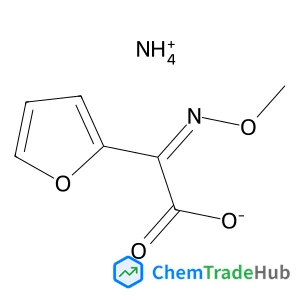
Ammonium (Z)-2-(furan-2-yl)-2-(methoxyimino)acetate
CAS Number:
97148-39-5
Molecular Formula:
C7H10N2O4
Marina Poliak, Alexey Fomin, Vladimir Tsionsky, Sergey Cheskis, Irenaeus Wlokas, Igor Rahinov
In this work we have investigated the mechanism of nanoparticle synthesis in a low pressure, premixed, laminar flat flame of CH4–O2, doped with iron pentacarbonyl using a combined quartz-crystal-microbalance-particle-mass-spectrometry apparatus. We have unambiguously demonstrated that the formation of nanoparticles in iron pentacarbonyl-doped flames occurs very early, in close proximity to the burner surface, prior to the flame front. This early rise of nanoparticle mass concentration is followed by a sharp drop in nanoparticle concentration at the high temperature flame front. This “prompt” nanoparticle generation is consistent with kinetic models describing iron cluster formation. The observation of this phenomenon in a quasi-one-dimensional premixed flat flame strengthens our previous findings and points out that the “prompt” nanoparticle formation is a general phenomenon, not limited to diffusion flames. It presents a challenge and a trigger for further development of the existing mechanisms for gas phase synthesis of iron oxide particles in flames.
Benjamin E. Ketz, Xavier G. Ottenwaelder, Robert M. Waymouth
DOI: 10.1039/B511202H
Colleen A. Williams, Alexander J. Blake, Peter Hubberstey, Martin Schröder
DOI: 10.1039/B509929C
Hyunseok Kim, Phil Ho Lee, Tom Livinghouse
DOI: 10.1039/B505738H
Masahiko Maekawa, Susumu Kitagawa, Takayoshi Kuroda-Sowa, Megumu Munakata
DOI: 10.1039/B518411H
Chinh Q. Nguyen, Adekunle Adeogun, Mohammad Afzaal, Mohammad A. Malik, Paul O'Brien
DOI: 10.1039/B603198F
Takeaki Iwamoto, Takashi Abe, Chizuko Kabuto, Mitsuo Kira
DOI: 10.1039/B509878E
Lican Lu, Nianfa Yang, Yuanli Cai
DOI: 10.1039/B512057H
Sonia Taktak, Margaret Flook, Bruce M. Foxman, Lawrence Que, Jr., Elena V. Rybak-Akimova
DOI: 10.1039/B508004E
1H-Indazole-6-carbonitrile finds applications in pharmaceuticals, where it serve...
Waste containing Dioctyl (2E)-2-butenedioate (CAS: 2997-85-5) should be collecte...
Sodium [(1,2-benzoxazol-3-ylmethyl)sulfonyl]azanide is primarily used in pharmac...
Dimethyl 4-(4,4,5,5-tetramethyl-1,3,2-dioxaborolan-2-yl)-2,6-pyridinedicarboxyla...
Waste containing 2-Fluoro-6-hydrazinopyridine (CAS: 80714-39-2) should be manage...
6-Formyl-2-pyridinecarboxylic acid is an organic compound with the molecular for...
Research trends for this compound indicate a focus on its potential applications...
9H-Tribenzo[b,d,f]azepine is typically synthesized via a multi-step process invo...
1-Cyclopropyl-7-ethoxy-6-fluoro-8-methoxy-4-oxo-1,4-dihydro-3-quinolinecarboxyli...
Waste containing Methyl 3-oxo-1,2,3,4-tetrahydro-6-quinoxalinecarboxylate (CAS: ...

Physical Chemistry Chemical Physics (PCCP) is an international journal co-owned by 19 physical chemistry and physics societies from around the world. This journal publishes original, cutting-edge research in physical chemistry, chemical physics and biophysical chemistry. To be suitable for publication in PCCP, articles must include significant innovation and/or insight into physical chemistry; this is the most important criterion that reviewers and Editors will judge against when evaluating submissions. The journal has a broad scope and welcomes contributions spanning experiment, theory, computation and data science. Topical coverage includes spectroscopy, dynamics, kinetics, statistical mechanics, thermodynamics, electrochemistry, catalysis, surface science, quantum mechanics, quantum computing and machine learning. Interdisciplinary research areas such as polymers and soft matter, materials, nanoscience, energy, surfaces/interfaces, and biophysical chemistry are welcomed if they demonstrate significant innovation and/or insight into physical chemistry. Joined experimental/theoretical studies are particularly appreciated when complementary and based on up-to-date approaches.
![(1S)-1,5-Anhydro-1-[3-(1-benzothiophen-2-ylmethyl)-4-fluorophenyl]-D-glucitol structure](https://static.chemtradehub.com/structs/761/761423-87-4-dbeb.webp "(1S)-1,5-Anhydro-1-[3-(1-benzothiophen-2-ylmethyl)-4-fluorophenyl]-D-glucitol structure")