












Intramolecular alkene hydroaminations catalyzed by a bis(thiophosphinic amidate) Zr(iv) complex
Literature Information
Publication Date
2005-09-20
DOI
10.1039/B505738H
Impact Factor
6.222
Authors
Hyunseok Kim, Phil Ho Lee, Tom Livinghouse
View Original
Abstract
A neutral Zr(IV) complex has been shown to be an effective precatalyst for intramolecular alkene hydroaminations that provide cyclic amines in good to excellent yields.
Related Literature
Suppressing lithium dendrite formation by slowing its desolvation kinetics
2019-10-05
Communication
DOI: 10.1039/C9CC07092C
Effect of sample aerosol transport rate on inductively coupled plasma atomic emission and fluorescence
Paper
DOI: 10.1039/JA9900500239
Benchmarking lithium amide versus amine bonding by charge density and energy decomposition analysis arguments
Felix Engelhardt, Christian Maaß, Diego M. Andrada, Regine Herbst-Irmer, Dietmar Stalke
2018-02-08
Edge Article
DOI: 10.1039/C7SC05368A
In situ synthesis of fluorescent copper nanoclusters for rapid detection of ascorbic acid in biological samples
Xuan Wang, Caicheng Long, Zixin Jiang, Taiping Qing, Kaiwu Zhang, Peng Zhang, Bo Feng
2019-08-29
Paper
DOI: 10.1039/C9AY01627A
ForSDAT: an automated platform for analyzing force spectroscopy measurements
Tal Duanis-Assaf, Yair Razvag, Meital Reches
2019-08-23
Paper
DOI: 10.1039/C9AY01150A
Two-dimensional biomaterials: material science, biological effect and biomedical engineering applications
Wei Feng
2021-08-19
Review Article
DOI: 10.1039/D0CS01138J
Electrochemical determination of bisphenol A using a polyacrylamide–multiwalled carbon nanotube-modified glassy carbon electrode
Jian Han, Faying Li, Liping Jiang, Kai Li, Yunhui Dong, Yueyun Li
2015-08-13
Paper
DOI: 10.1039/C5AY02058A
A CoII complex for 19F MRI-based detection of reactive oxygen species
Meng Yu, Da Xie, Khanh P. Phan, José S. Enriquez, Emily L. Que
2016-11-08
Communication
DOI: 10.1039/C6CC08207F
Photoinduced reductive perfluoroalkylation of phosphine oxides: synthesis of P-perfluoroalkylated phosphines using TMDPO and perfluoroalkyl iodides
Yuki Sato, Shin-ichi Kawaguchi, Akiya Ogawa
2015-05-18
Communication
DOI: 10.1039/C5CC03427B
You might also like
Compound Q&A
What are the main uses of 1H-Indazole-6-carbonitrile (CAS: 141290-59-7)?
1H-Indazole-6-carbonitrile finds applications in pharmaceuticals, where it serve...
141290-59-71H-Indazole-6-carbon...
Compound Q&A
How should waste containing Dioctyl (2E)-2-butenedioate (CAS: 2997-85-5) be handled?
Waste containing Dioctyl (2E)-2-butenedioate (CAS: 2997-85-5) should be collecte...
2997-85-5Dioctyl (2E)-2-buten...
Compound Q&A
What industries use Sodium [(1,2-benzoxazol-3-ylmethyl)sulfonyl]azanide (CAS: 68291-98-5)?
Sodium [(1,2-benzoxazol-3-ylmethyl)sulfonyl]azanide is primarily used in pharmac...
68291-98-5Sodium [(1,2-benzoxa...
Compound Q&A
Are there alternatives to Dimethyl 4-(4,4,5,5-tetramethyl-1,3,2-dioxaborolan-2-yl)-2,6-pyridinedicarboxylate (CAS: 741709-66-0) in synthesis?
Dimethyl 4-(4,4,5,5-tetramethyl-1,3,2-dioxaborolan-2-yl)-2,6-pyridinedicarboxyla...
741709-66-0Dimethyl 4-(4,4,5,5-...
Compound Q&A
How should waste containing 2-Fluoro-6-hydrazinopyridine (CAS: 80714-39-2) be handled?
Waste containing 2-Fluoro-6-hydrazinopyridine (CAS: 80714-39-2) should be manage...
80714-39-22-Fluoro-6-hydrazino...
Compound Q&A
What is 6-Formyl-2-pyridinecarboxylic acid (CAS: 499214-11-8)?
6-Formyl-2-pyridinecarboxylic acid is an organic compound with the molecular for...
499214-11-86-Formyl-2-pyridinec...
Compound Q&A
What is the market or research trend for 3-(3,4-dimethoxyphenyl)-2,5-dimethyl-N-(2-morpholin-4-ylethyl)pyrazolo[1,5-a]pyrimidin-7-amine (CAS: 900874-91-1)?
Research trends for this compound indicate a focus on its potential applications...
900874-91-13-(3,4-dimethoxyphen...
Compound Q&A
How is 9H-Tribenzo[b,d,f]azepine (CAS: 29875-73-8) typically synthesized?
9H-Tribenzo[b,d,f]azepine is typically synthesized via a multi-step process invo...
29875-73-89H-Tribenzo[b,d,f]az...
Compound Q&A
How is 1-Cyclopropyl-7-ethoxy-6-fluoro-8-methoxy-4-oxo-1,4-dihydro-3-quinolinecarboxylic acid (CAS: 1797982-51-4) typically synthesized?
1-Cyclopropyl-7-ethoxy-6-fluoro-8-methoxy-4-oxo-1,4-dihydro-3-quinolinecarboxyli...
1797982-51-41-Cyclopropyl-7-etho...
Compound Q&A
How should waste containing Methyl 3-oxo-1,2,3,4-tetrahydro-6-quinoxalinecarboxylate (CAS: 671820-52-3) be handled?
Waste containing Methyl 3-oxo-1,2,3,4-tetrahydro-6-quinoxalinecarboxylate (CAS: ...
671820-52-3Methyl 3-oxo-1,2,3,4...
Source Journal
Chemical Communications

CiteScore:
8.6
Self-citation Rate:
4.7%
Articles per Year:
2458
ChemComm publishes urgent research which is of outstanding significance and interest to experts in the field, while also appealing to the journal’s broad chemistry readership. Our communication format is ideally suited to short, urgent studies that are of such importance that they require accelerated publication. Our scope covers all topics in chemistry, and research at the interface of chemistry and other disciplines (such as materials science, nanoscience, physics, engineering and biology) where there is a significant novelty in the chemistry aspects. Major topic areas covered include: Analytical Chemistry Catalysis Chemical Biology and medicinal chemistry Computational Chemistry and Machine Learning Energy and sustainable chemistry Environmental Chemistry Green Chemistry Inorganic Chemistry Materials Chemistry Nanoscience Organic Chemistry Physical Chemistry Polymer Chemistry Supramolecular Chemistry
Recommended Compounds
![N-[(9H-Fluoren-9-ylmethoxy)carbonyl]serine structure](https://static.chemtradehub.com/structs/737/73724-45-5-b0dc.webp "N-[(9H-Fluoren-9-ylmethoxy)carbonyl]serine structure")
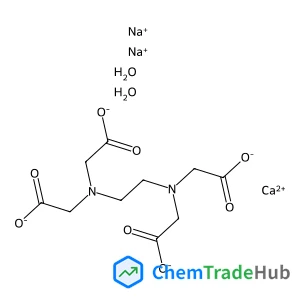
EthylenediaminetetraaceticacidcalciumDisodiumsalthydrate
CAS Number:
23411-34-9
Molecular Formula:
C10H16CaN2Na2O10
Recommended Suppliers





Disclaimer
This page provides academic journal information for reference and research purposes only. We are not affiliated with any journal publishers and do not handle publication submissions. For publication-related inquiries, please contact the respective journal publishers directly.
If you notice any inaccuracies in the information displayed, please contact us at support@chemtradehub.com. We will promptly review and address your concerns.