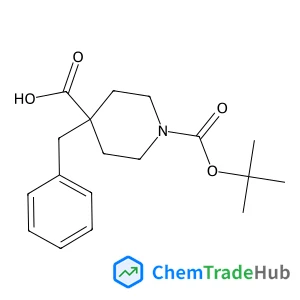
4-Benzyl-1-(tert-butoxycarbonyl)piperidine-4-carboxylic acid
CAS Number:
170838-87-6
Molecular Formula:
C18H25NO4
Luis Gómez-Hortigüela, Teresa Álvaro-Muñoz, Beatriz Bernardo-Maestro, Joaquín Pérez-Pariente
A molecular-mechanics computational study is performed in order to analyze the arrangement of (1R,2S)-(–)-ephedrine molecules within the 12-MR channels of the AFI aluminophosphate microporous framework and the influence on the spatial distribution of dopants embedded in the tetrahedral network. Results showed that ephedrine molecules arrange exclusively as dimers by π–π stacking of the aromatic rings within the AFI channels. Interestingly, the asymmetric nature of ephedrine and the presence of H-bond-forming groups (NH2 and OH) involve a preferential orientation where consecutive dimers within the channels are rotated by an angle of +30°; this is driven by the establishment of inter-dimer H-bonds. This preferential orientation leads to the development of a supramolecular enantiomerically-pure helicoidal (chiral) arrangement of ephedrine dimers. In addition, the computational results demonstrate that the particular molecular structure of ephedrine imparts a strong trend to attract negative charges to the vicinity of the NH2+ positively-charged groups. Hence divalent dopants such as Mg, whose replacement by trivalent Al in the aluminophosphate network involves the generation of a negative charge, will tend to locate close to the NH2+ molecular groups, suggesting that an imprinting of the organic arrangement to the spatial distribution of dopants would be feasible. Combined with the trend of ephedrine to arrange in a helicoidal fashion, an enantiomerically-pure helicoidal distribution of dopants would be expected, thus inducing a new type of chirality in microporous materials.
Emmanuel Assaf, Coralie Schoemaecker, Luc Vereecken, Christa Fittschen
DOI: 10.1039/C7CP05770A
Sandeep P. Patil, Sri Harsha Chilakamarri, Bernd Markert
DOI: 10.1039/C8CP01061G
N. C. Michenfelder, H. A. Ernst, C. Schweigert, M. Olzmann, A.-N. Unterreiner
DOI: 10.1039/C7CP07774B
Qianshun Wei, Dexia Zhou, Hongtao Bian
DOI: 10.1039/C8CP00099A
Alexander Alijah, Thibaud Cours, Nejm-Eddine Jaidane, Najoua Derbel
DOI: 10.1039/C7CP08659H
Zhilin Yang, Yang Zhou, Hui Huang, Dingguo Xu, Chaoyang Zhang
DOI: 10.1039/C8CP00345A
Mantas Šimėnas, Aneta Ciupa, Gediminas Usevičius, Kęstutis Aidas, Daniel Klose, Gunnar Jeschke, Mirosław Mączka, Georg Völkel, Andreas Pöppl, Jūras Banys
DOI: 10.1039/C8CP01426D
Cloé Azarias, Isabelle Navizet, Paul Fleurat-Lessard, Boris Le Guennic, Jean-Alexandre Richard, Denis Jacquemin
DOI: 10.1039/C8CP01587B
TaeGi Lee, Kunio Shimura, DaeGwi Kim
DOI: 10.1039/C7CP07812A
Carolyn E. Carr, Luis A. Marky
DOI: 10.1039/C7CP08329G
This compound is mainly used as an intermediate in the synthesis of antipsychoti...
Waste containing 1-(D-Ribofuranosyl)-1,4-dihydro-3-pyridinecarboxamide (CAS: 191...
2-Methyl-2-propanyl 3-bromo-3-(hydroxymethyl)-1-azetidinecarboxylate (CAS: 20079...
N-(4-Chloro-2-pyridinyl)acetamide (CAS: 245056-66-0) is a chemical compound with...
5-Chloro-2-hydroxybenzoic acid, also known as 5-chlorosalicylic acid, is an arom...
When handling 1,1-Dichloro-1-fluoroethane (CAS: 1717-00-6), it is important to u...
Fmoc-(2S,3R)-3-phenylpyrrolidine-2-carboxylic acid is a white crystalline solid ...
4-Amino-5-bromo-2-pyridinecarboxylic acid is primarily used as a precursor in th...
Handling this compound should be done with personal protective equipment (PPE) i...
When handling 8-bromo-2,2-dimethyl-3,4-dihydro-2H-1,4-benzoxazin-3-one, use prop...

Physical Chemistry Chemical Physics (PCCP) is an international journal co-owned by 19 physical chemistry and physics societies from around the world. This journal publishes original, cutting-edge research in physical chemistry, chemical physics and biophysical chemistry. To be suitable for publication in PCCP, articles must include significant innovation and/or insight into physical chemistry; this is the most important criterion that reviewers and Editors will judge against when evaluating submissions. The journal has a broad scope and welcomes contributions spanning experiment, theory, computation and data science. Topical coverage includes spectroscopy, dynamics, kinetics, statistical mechanics, thermodynamics, electrochemistry, catalysis, surface science, quantum mechanics, quantum computing and machine learning. Interdisciplinary research areas such as polymers and soft matter, materials, nanoscience, energy, surfaces/interfaces, and biophysical chemistry are welcomed if they demonstrate significant innovation and/or insight into physical chemistry. Joined experimental/theoretical studies are particularly appreciated when complementary and based on up-to-date approaches.
![2,6-Bis({(2R)-2-[hydroxy(diphenyl)methyl]-1-pyrrolidinyl}methyl)-4-methylphenol structure](https://static.chemtradehub.com/structs/877/877395-58-9-70bf.webp "2,6-Bis({(2R)-2-[hydroxy(diphenyl)methyl]-1-pyrrolidinyl}methyl)-4-methylphenol structure")