












Electron paramagnetic resonance of a copper doped [(CH3)2NH2][Zn(HCOO)3] hybrid perovskite framework
Literature Information
Publication Date
2018-04-12
DOI
10.1039/C8CP01426D
Impact Factor
3.676
Authors
Mantas Šimėnas, Aneta Ciupa, Gediminas Usevičius, Kęstutis Aidas, Daniel Klose, Gunnar Jeschke, Mirosław Mączka, Georg Völkel, Andreas Pöppl, Jūras Banys
View Original
Abstract
We report a continuous-wave (CW) and pulse electron paramagnetic resonance (EPR) as well as pulse electron nuclear double resonance (ENDOR) study of Cu2+ doped [(CH3)2NH2][Zn(HCOO)3] hybrid perovskite which exhibits a structural phase transition. The multifrequency (X, Q and W-band) CW EPR measurements allow the temperature evolution of the Cu2+ ion local environment to be studied. The spectrum of the ordered (low-temperature) phase reveals an axially distorted octahedral Cu2+ site confirming the successful replacement of the Zn2+ ions and formation of the CuO6 octahedra. The CW EPR spectrum of the disordered (high-temperature) phase shows an additional broad line which gradually diminishes on cooling. The EPR linewidth of the axially symmetric Cu2+ ion site exhibits an anomaly at the phase transition point and Arrhenius-type behavior in the disordered phase. The temperature dependent Cu2+ spin Hamiltonian parameters change abruptly at the phase transition point indicating a strong first-order character of the transition. The X-band pulse ENDOR spectrum of the ordered phase reveals several protons in the vicinity of the Cu2+ center.
Related Literature
Maxwell-Hall access resistance in graphene nanopores
Michael Zwolak
2018-01-24
Communication
DOI: 10.1039/C7CP07924A
Thickness dependent Raman spectra and interfacial interaction between Ag and epitaxial graphene on 6H-SiC(0001)
Xiangtai Liu, Qinglong Fang, Tingwei Hu, Dayan Ma, Xiaohe Zhang, Shuai Liu, Fei Ma
2018-02-02
Paper
DOI: 10.1039/C7CP07338K
Ion hydration: linking self-diffusion and reorientational motion to water structure
Seishi Shimizu
2018-02-08
Paper
DOI: 10.1039/C7CP07309G
Real time monitoring of the minute dynamic variation at the crude oil–water interface
Ziling Ding, Yan Xiong
2018-01-26
Paper
DOI: 10.1039/C7CP07491C
Collisional excitation of interstellar PO(X2Π) by He: new ab initio potential energy surfaces and scattering calculations
François Lique, Izaskun Jiménez-Serra, Serena Viti, Sarantos Marinakis
2017-09-25
Paper
DOI: 10.1039/C7CP05605B
Selective sodium intercalation into sodium nickel–manganese sulfate for dual Na–Li-ion batteries
Delyana M. Marinova, Rosica R. Kukeva, Ekaterina N. Zhecheva, Radostina K. Stoyanova
2018-04-09
Paper
DOI: 10.1039/C8CP01667D
Thermoelectric properties of Ag-doped CuS nanocomposites synthesized by a facile polyol method
Tarachand, S. Hussain, N. P. Lalla, Y.-K. Kuo, A. Lakhani, V. G. Sathe, U. Deshpande, G. S. Okram
2018-01-25
Paper
DOI: 10.1039/C7CP07986A
An organoferroelasticity driven by molecular conformational change
Sajjad Husain Mir, Satoshi Takamizawa
2017-12-04
Communication
DOI: 10.1039/C7CP07206F
You might also like
Compound Q&A
What are the main uses of 1-(3-Aminophenyl)-3-[(3R)-1-(3,3-dimethyl-2-oxobutyl)-2-oxo-5-(2-pyridinyl)-2,3-dihydro-1H-1,4-benzodiazepin-3-yl]urea (CAS: 155412-88-7)?
This compound is mainly used as an intermediate in the synthesis of antipsychoti...
155412-88-71-(3-Aminophenyl)-3-...
Compound Q&A
How should waste containing 1-(D-Ribofuranosyl)-1,4-dihydro-3-pyridinecarboxamide (CAS: 19132-12-8) be handled?
Waste containing 1-(D-Ribofuranosyl)-1,4-dihydro-3-pyridinecarboxamide (CAS: 191...
19132-12-81-(D-Ribofuranosyl)-...
Compound Q&A
What regulatory guidelines apply to 2-Methyl-2-propanyl 3-bromo-3-(hydroxymethyl)-1-azetidinecarboxylate (CAS: 2007919-81-3)?
2-Methyl-2-propanyl 3-bromo-3-(hydroxymethyl)-1-azetidinecarboxylate (CAS: 20079...
2007919-81-32-Methyl-2-propanyl ...
Compound Q&A
What is N-(4-Chloro-2-pyridinyl)acetamide (CAS: 245056-66-0)?
N-(4-Chloro-2-pyridinyl)acetamide (CAS: 245056-66-0) is a chemical compound with...
245056-66-0N-(4-Chloro-2-pyridi...
Compound Q&A
What is 5-Chloro-2-hydroxybenzoic acid (CAS: 321-14-2)?
5-Chloro-2-hydroxybenzoic acid, also known as 5-chlorosalicylic acid, is an arom...
321-14-25-Chloro-2-hydroxybe...
Compound Q&A
What precautions should be taken when handling 1,1-Dichloro-1-fluoroethane (CAS: 1717-00-6)?
When handling 1,1-Dichloro-1-fluoroethane (CAS: 1717-00-6), it is important to u...
1717-00-61,1-Dichloro-1-fluor...
Compound Q&A
What are the physical and chemical properties of Fmoc-(2S,3R)-3-phenylpyrrolidine-2-carboxylic acid (CAS: 281655-32-1)?
Fmoc-(2S,3R)-3-phenylpyrrolidine-2-carboxylic acid is a white crystalline solid ...
281655-32-1Fmoc-(2S,3R)-3-pheny...
Compound Q&A
What are the main uses of 4-Amino-5-bromo-2-pyridinecarboxylic acid (CAS: 1363381-01-4)?
4-Amino-5-bromo-2-pyridinecarboxylic acid is primarily used as a precursor in th...
1363381-01-44-Amino-5-bromo-2-py...
Compound Q&A
What precautions should be taken when handling (S)-tert-butyl 2-((2-(4-bromophenyl)-2-oxoethyl)carbamoyl)pyrrolidine-1-carboxylate (CAS: 1007881-98-2)?
Handling this compound should be done with personal protective equipment (PPE) i...
1007881-98-2(S)-tert-butyl 2-((2...
Compound Q&A
What precautions should be taken when handling 8-bromo-2,2-dimethyl-3,4-dihydro-2H-1,4-benzoxazin-3-one (CAS: 688363-73-7)?
When handling 8-bromo-2,2-dimethyl-3,4-dihydro-2H-1,4-benzoxazin-3-one, use prop...
688363-73-78-bromo-2,2-dimethyl...
Source Journal
Physical Chemistry Chemical Physics

CiteScore:
5.5
Self-citation Rate:
10.3%
Articles per Year:
3036
Physical Chemistry Chemical Physics (PCCP) is an international journal co-owned by 19 physical chemistry and physics societies from around the world. This journal publishes original, cutting-edge research in physical chemistry, chemical physics and biophysical chemistry. To be suitable for publication in PCCP, articles must include significant innovation and/or insight into physical chemistry; this is the most important criterion that reviewers and Editors will judge against when evaluating submissions. The journal has a broad scope and welcomes contributions spanning experiment, theory, computation and data science. Topical coverage includes spectroscopy, dynamics, kinetics, statistical mechanics, thermodynamics, electrochemistry, catalysis, surface science, quantum mechanics, quantum computing and machine learning. Interdisciplinary research areas such as polymers and soft matter, materials, nanoscience, energy, surfaces/interfaces, and biophysical chemistry are welcomed if they demonstrate significant innovation and/or insight into physical chemistry. Joined experimental/theoretical studies are particularly appreciated when complementary and based on up-to-date approaches.
Recommended Compounds
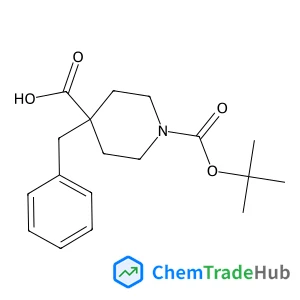
4-Benzyl-1-(tert-butoxycarbonyl)piperidine-4-carboxylic acid
CAS Number:
170838-87-6
Molecular Formula:
C18H25NO4
![1-[3-(4-Morpholinylsulfonyl)phenyl]methanamine structure](https://static.chemtradehub.com/structs/933/933989-32-3-51af.webp "1-[3-(4-Morpholinylsulfonyl)phenyl]methanamine structure")

Recommended Suppliers






Disclaimer
This page provides academic journal information for reference and research purposes only. We are not affiliated with any journal publishers and do not handle publication submissions. For publication-related inquiries, please contact the respective journal publishers directly.
If you notice any inaccuracies in the information displayed, please contact us at support@chemtradehub.com. We will promptly review and address your concerns.