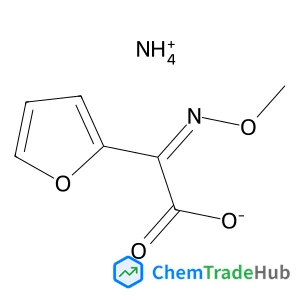
Ammonium (Z)-2-(furan-2-yl)-2-(methoxyimino)acetate
CAS Number:
97148-39-5
Molecular Formula:
C7H10N2O4
Mohammad Goli, Shant Shahbazian
The Structural theory of chemistry introduces chemical/molecular structure as a combination of relative arrangement and bonding patterns of atoms in a molecule. Nowadays, the structure of atoms in molecules is derived from the topological analysis of the quantum theory of atoms in molecules (QTAIM). In this context, a molecular structure is varied by large geometrical variations and concomitant reorganization of electronic structure that usually take place in chemical reactions or under extreme hydrostatic pressure. In this report, a new mode of structural variation is introduced within the context of the newly proposed multi-component QTAIM (MC-QTAIM) that originates from the mass variation of nuclei. Accordingly, XCN and CNX series of species are introduced where X stands for a quantum particle with a unit of positive charge and a variable mass that is varied in discrete steps between the mass of a proton and a positron. Ab initio non-Born–Oppenheimer (non-BO) calculations are done on both series of species and the resulting non-BO wavefunctions are used for the MC-QTAIM analysis, revealing a triatomic structure for the proton mass and a diatomic structure for the positron mass. In both series of species, a critical mass between that of proton and positron mass is discovered where the transition from triatomic to diatomic structure takes place. This abrupt structural transformation has a topological nature resembling the usual phase transitions in thermodynamics. The discovered mass-induced structural transformation is a hidden aspect of the Structural theory which is revealed only beyond the BO paradigm, when nuclei are treated as quantum waves instead of clamped point charges.
Meng-Xiang Wu, Xue-Rui Wei, Yu-Fang Wei, Ru Sun, Yu-Jie Xu
DOI: 10.1039/C9AY01355E
Rory Devlin, Jonathan Sperry
DOI: 10.1039/C9CC07943B
Philipp Rietsch, Jan Soyka, Steffen Brülls, Jasmin Er, Katrin Hoffmann, Julia Beerhues, Biprajit Sarkar, Ute Resch-Genger, Siegfried Eigler
DOI: 10.1039/C9CC90456E
Chengkai Li, Wuchao Zhao, Jianghua He, Yuetao Zhang
DOI: 10.1039/C9CC06402H
Cheng Liu, Raoqi Li, Ni Xia, Yonghua Xiong
DOI: 10.1039/C9AY01337G
Shivamurthy Ravindra Yashas, Shadakshari Sandeep, Ballagere Puttaraju Shivakumar, Ningappa Kumar Swamy
DOI: 10.1039/C9AY01468C
Shuange Yao, Wei Xiao, Hui Chen, Yong Tang, Qifang Song, Qubo Zheng, Ning Deng
DOI: 10.1039/C9AY01454C
Xue Li, Xin He, Qiang Zhang, Yangyang Chang, Meng Liu
DOI: 10.1039/C9AY01060B
Jiawei Li, Pan Li, Changjun Hou, Danqun Huo, Yixia Yang
DOI: 10.1039/C9AY01577A
Shiping Zhu, Tony Wigglesworth, Yiliang Wu
DOI: 10.1039/C3CC43920H
1H-Indazole-6-carbonitrile finds applications in pharmaceuticals, where it serve...
Waste containing Dioctyl (2E)-2-butenedioate (CAS: 2997-85-5) should be collecte...
Sodium [(1,2-benzoxazol-3-ylmethyl)sulfonyl]azanide is primarily used in pharmac...
Dimethyl 4-(4,4,5,5-tetramethyl-1,3,2-dioxaborolan-2-yl)-2,6-pyridinedicarboxyla...
Waste containing 2-Fluoro-6-hydrazinopyridine (CAS: 80714-39-2) should be manage...
6-Formyl-2-pyridinecarboxylic acid is an organic compound with the molecular for...
Research trends for this compound indicate a focus on its potential applications...
9H-Tribenzo[b,d,f]azepine is typically synthesized via a multi-step process invo...
1-Cyclopropyl-7-ethoxy-6-fluoro-8-methoxy-4-oxo-1,4-dihydro-3-quinolinecarboxyli...
Waste containing Methyl 3-oxo-1,2,3,4-tetrahydro-6-quinoxalinecarboxylate (CAS: ...

Physical Chemistry Chemical Physics (PCCP) is an international journal co-owned by 19 physical chemistry and physics societies from around the world. This journal publishes original, cutting-edge research in physical chemistry, chemical physics and biophysical chemistry. To be suitable for publication in PCCP, articles must include significant innovation and/or insight into physical chemistry; this is the most important criterion that reviewers and Editors will judge against when evaluating submissions. The journal has a broad scope and welcomes contributions spanning experiment, theory, computation and data science. Topical coverage includes spectroscopy, dynamics, kinetics, statistical mechanics, thermodynamics, electrochemistry, catalysis, surface science, quantum mechanics, quantum computing and machine learning. Interdisciplinary research areas such as polymers and soft matter, materials, nanoscience, energy, surfaces/interfaces, and biophysical chemistry are welcomed if they demonstrate significant innovation and/or insight into physical chemistry. Joined experimental/theoretical studies are particularly appreciated when complementary and based on up-to-date approaches.