












Highly efficient cyclotrimerization of isocyanates using N-heterocyclic olefins under bulk conditions
Literature Information
Publication Date
2019-09-23
DOI
10.1039/C9CC06402H
Impact Factor
6.222
Authors
Chengkai Li, Wuchao Zhao, Jianghua He, Yuetao Zhang
View Original
Abstract
With a catalyst loading as low as 0.005%, high to excellent yields of isocyanurates could be achieved from N-heterocyclic olefin mediated organocatalytic cyclotrimerization of a wide range of isocyanates under bulk conditions. Experimental details coupled with structural characterization of the key intermediates led to comprehensive mechanistic studies of cyclotrimerization.
Related Literature
Active site and mechanism of the selective catalytic reduction of NO by NH3 over V2O5: A periodic first-principles study
Xilin Yin, Huanmei Han, Akira Miyamoto
2000-08-15
Paper
DOI: 10.1039/B003838P
Shock tube combustion of liquid hydrocarbon sprays of toluene
2001-09-06
Paper
DOI: 10.1039/B101803P
Theoretical study of the photodissociation dynamics of ClOOCl
Alessandro Toniolo, Giovanni Granucci, Silvia Inglese, Maurizio Persico
2001-09-12
Paper
DOI: 10.1039/B104044H
Thermal, electrochemical and structural properties of stabilized LiNiyCo1−y−zMzO2 lithium-ion cathode material prepared by a chemical route
A. D'Epifanio, F. Croce, F. Ronci, V. Rossi Albertini, E. Traversa, B. Scrosati
2001-09-11
Paper
DOI: 10.1039/B104615M
Separation of linear, mono-methyl and di-methyl alkanes in the 5–7 carbon atom range by exploiting configurational entropy effects during sorption on silicalite-1
S. Calero, B. Smit, R. Krishna
2001-09-12
Paper
DOI: 10.1039/B103118J
Dynamic colloidal interactions between protein-stabilised particles—experiment and simulation
Herley Casanova, Jianshe Chen, Eric Dickinson, Brent S. Murray, Phillip V. Nelson, Martin Whittle
2000-08-09
Paper
DOI: 10.1039/B004023L
Apparent and partial ideal molar isentropic compressibilities of binary liquid mixtures
Michael I. Davis, Gérard Douhéret, João Carlos R. Reis, Michael J. Blandamer
2001-09-21
Paper
DOI: 10.1039/B104974G
Investigation of guanine-rich DNA telomeric structure by a covalently linked BODIPY dye
Paper
DOI: 10.1039/A901361J
Adsorption and diffusion of repulsively interacting particles on a triangular lattice
F. Nieto, A. A. Tarasenko
2000-06-30
Paper
DOI: 10.1039/B002575P
Electrochemistry of Co–Ru hetero-dinuclear porphyrin complex in a Nafion matrix
Takane Imaoka, Kimihisa Yamamoto
2001-09-17
Paper
DOI: 10.1039/B105789H
You might also like
Compound Q&A
What are the main uses of 1H-Indazole-6-carbonitrile (CAS: 141290-59-7)?
1H-Indazole-6-carbonitrile finds applications in pharmaceuticals, where it serve...
141290-59-71H-Indazole-6-carbon...
Compound Q&A
How should waste containing Dioctyl (2E)-2-butenedioate (CAS: 2997-85-5) be handled?
Waste containing Dioctyl (2E)-2-butenedioate (CAS: 2997-85-5) should be collecte...
2997-85-5Dioctyl (2E)-2-buten...
Compound Q&A
What industries use Sodium [(1,2-benzoxazol-3-ylmethyl)sulfonyl]azanide (CAS: 68291-98-5)?
Sodium [(1,2-benzoxazol-3-ylmethyl)sulfonyl]azanide is primarily used in pharmac...
68291-98-5Sodium [(1,2-benzoxa...
Compound Q&A
Are there alternatives to Dimethyl 4-(4,4,5,5-tetramethyl-1,3,2-dioxaborolan-2-yl)-2,6-pyridinedicarboxylate (CAS: 741709-66-0) in synthesis?
Dimethyl 4-(4,4,5,5-tetramethyl-1,3,2-dioxaborolan-2-yl)-2,6-pyridinedicarboxyla...
741709-66-0Dimethyl 4-(4,4,5,5-...
Compound Q&A
How should waste containing 2-Fluoro-6-hydrazinopyridine (CAS: 80714-39-2) be handled?
Waste containing 2-Fluoro-6-hydrazinopyridine (CAS: 80714-39-2) should be manage...
80714-39-22-Fluoro-6-hydrazino...
Compound Q&A
What is 6-Formyl-2-pyridinecarboxylic acid (CAS: 499214-11-8)?
6-Formyl-2-pyridinecarboxylic acid is an organic compound with the molecular for...
499214-11-86-Formyl-2-pyridinec...
Compound Q&A
What is the market or research trend for 3-(3,4-dimethoxyphenyl)-2,5-dimethyl-N-(2-morpholin-4-ylethyl)pyrazolo[1,5-a]pyrimidin-7-amine (CAS: 900874-91-1)?
Research trends for this compound indicate a focus on its potential applications...
900874-91-13-(3,4-dimethoxyphen...
Compound Q&A
How is 9H-Tribenzo[b,d,f]azepine (CAS: 29875-73-8) typically synthesized?
9H-Tribenzo[b,d,f]azepine is typically synthesized via a multi-step process invo...
29875-73-89H-Tribenzo[b,d,f]az...
Compound Q&A
How is 1-Cyclopropyl-7-ethoxy-6-fluoro-8-methoxy-4-oxo-1,4-dihydro-3-quinolinecarboxylic acid (CAS: 1797982-51-4) typically synthesized?
1-Cyclopropyl-7-ethoxy-6-fluoro-8-methoxy-4-oxo-1,4-dihydro-3-quinolinecarboxyli...
1797982-51-41-Cyclopropyl-7-etho...
Compound Q&A
How should waste containing Methyl 3-oxo-1,2,3,4-tetrahydro-6-quinoxalinecarboxylate (CAS: 671820-52-3) be handled?
Waste containing Methyl 3-oxo-1,2,3,4-tetrahydro-6-quinoxalinecarboxylate (CAS: ...
671820-52-3Methyl 3-oxo-1,2,3,4...
Source Journal
Chemical Communications

CiteScore:
8.6
Self-citation Rate:
4.7%
Articles per Year:
2458
ChemComm publishes urgent research which is of outstanding significance and interest to experts in the field, while also appealing to the journal’s broad chemistry readership. Our communication format is ideally suited to short, urgent studies that are of such importance that they require accelerated publication. Our scope covers all topics in chemistry, and research at the interface of chemistry and other disciplines (such as materials science, nanoscience, physics, engineering and biology) where there is a significant novelty in the chemistry aspects. Major topic areas covered include: Analytical Chemistry Catalysis Chemical Biology and medicinal chemistry Computational Chemistry and Machine Learning Energy and sustainable chemistry Environmental Chemistry Green Chemistry Inorganic Chemistry Materials Chemistry Nanoscience Organic Chemistry Physical Chemistry Polymer Chemistry Supramolecular Chemistry
Recommended Compounds

Trichloro(3,3,4,4,5,5,6,6,7,7,8,8,8-tridecafluorooctyl)silane
CAS Number:
78560-45-9
Molecular Formula:
C8H4Cl3F13Si
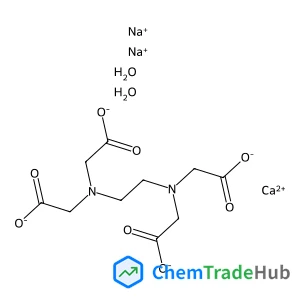
EthylenediaminetetraaceticacidcalciumDisodiumsalthydrate
CAS Number:
23411-34-9
Molecular Formula:
C10H16CaN2Na2O10
Recommended Suppliers





Disclaimer
This page provides academic journal information for reference and research purposes only. We are not affiliated with any journal publishers and do not handle publication submissions. For publication-related inquiries, please contact the respective journal publishers directly.
If you notice any inaccuracies in the information displayed, please contact us at support@chemtradehub.com. We will promptly review and address your concerns.