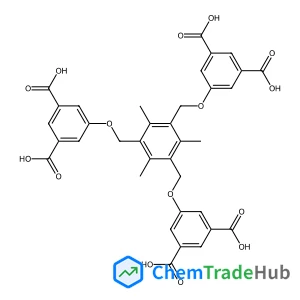
5,5',5''-(((2,4,6-Trimethylbenzene-1,3,5-triyl)tris(methylene))tris(oxy))triisophthalic acid
CAS Number:
1159974-70-5
Molecular Formula:
C36H30O15
Jan Swenson
The dynamics of supercooled water in aqueous solutions of the single amino acid L-lysine has been studied by broadband dielectric spectroscopy. The chosen biological system is unique in the sense that the water content is high enough to fully dissolve the amino acid, but low enough to avoid crystallisation to ice at any temperature. This is not possible to achieve for proteins or other larger biomolecules, where either hydrated samples without ice or solutions with large quantities of ice, or a cryoprotectant sugar, have to be studied at low temperatures. Thus, it is a key finding to be able to study water and biomolecular dynamics in a non-crystallized and biologically realistic solution at supercooled temperatures. Here, we focus on the water dynamics in this unique biological solution of L-lysine and water. We show that this unique system also gives rise to unique water dynamics, since, for the first time, a continuation of a cooperative (α-like) water relaxation is observed after a crossover to a more local β-like water relaxation has occurred with decreasing temperature. This implies that the supercooled water in the biological solution shows a twofold relaxation behaviour, with one relaxation identical to the main relaxation of water in hard confinements and one relaxation almost identical to the main water relaxation in ordinary aqueous solutions.
Sibylle Müller, Klaus Müllen
DOI: 10.1039/B509220E
Hao-Ling Sun, Hongtao Shi, Fei Zhao, Limin Qi, Song Gao
DOI: 10.1039/B507240A
Tsutomu Kimura, Toshiaki Murai
DOI: 10.1039/B507755A
Bo Tang, Jinye Niu, Chengguang Yu, Linhai Zhuo, Jiechao Ge
DOI: 10.1039/B502978C
Katsuhiro Maeda, Yasuaki Matsushita, Muneyoshi Ezaka
DOI: 10.1039/B507863F
Nagendra K. Sharma, Krishna N. Ganesh
DOI: 10.1039/B506870C
Hui Hong, Tim Stinear, Paul Skelton, Jonathan B. Spencer, Peter F. Leadlay
DOI: 10.1039/B506835E
Patrick J. Hrdlicka, T. Santhosh Kumar, Jesper Wengel
DOI: 10.1039/B506986F
Seigo Ito, Paul Liska, Pascal Comte, Raphaël Charvet, Peter Péchy, Udo Bach, Lukas Schmidt-Mende, Shaik Mohammed Zakeeruddin, Andreas Kay, Mohammad K. Nazeeruddin, Michael Grätzel
DOI: 10.1039/B505718C
Jeane Bordini, Peter C. Ford, Elia Tfouni
DOI: 10.1039/B507407J
Waste containing N-Methoxy-N-methyl-1,3-thiazole-5-carboxamide (CAS: 898825-89-3...
N-(4-Biphenylyl)dibenzo[b,d]furan-4-amine should be stored in a tightly sealed c...
The market for 3-Acetamido-5-amino-2,4,6-triiodobenzoic acid (CAS: 1713-07-1) is...
Benzyl 2-O-acetyl-3,4,6-tri-O-benzyl-beta-D-galactopyranoside (CAS: 61820-03-9) ...
2-Ethylpiperazine dihydrochloride (CAS: 438050-52-3) is regulated under the Glob...
1,1'-[1,3-Phenylenebis(methylene)]bis(3-methyl-1H-pyrrole-2,5-dione) (CAS: 11946...
Several alternatives can be used in the synthesis of 5-Fluoro-2-(1-pyrrolidinyl)...
Proper personal protective equipment (PPE) must be worn when handling this compo...
When handling 6-Bromoimidazo[1,2-a]pyridin-8-amine, it is important to wear appr...
Alternatives to (2S,4R)-4-(4-Nitrobenzyl)pyrrolidine-2-carboxylic acid hydrochlo...

Physical Chemistry Chemical Physics (PCCP) is an international journal co-owned by 19 physical chemistry and physics societies from around the world. This journal publishes original, cutting-edge research in physical chemistry, chemical physics and biophysical chemistry. To be suitable for publication in PCCP, articles must include significant innovation and/or insight into physical chemistry; this is the most important criterion that reviewers and Editors will judge against when evaluating submissions. The journal has a broad scope and welcomes contributions spanning experiment, theory, computation and data science. Topical coverage includes spectroscopy, dynamics, kinetics, statistical mechanics, thermodynamics, electrochemistry, catalysis, surface science, quantum mechanics, quantum computing and machine learning. Interdisciplinary research areas such as polymers and soft matter, materials, nanoscience, energy, surfaces/interfaces, and biophysical chemistry are welcomed if they demonstrate significant innovation and/or insight into physical chemistry. Joined experimental/theoretical studies are particularly appreciated when complementary and based on up-to-date approaches.