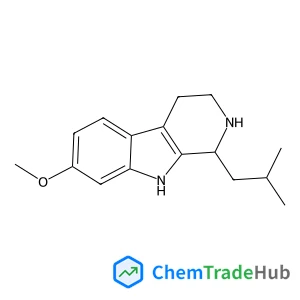
1-Isobutyl-7-methoxy-2,3,4,9-tetrahydro-1H-beta-carboline
CAS Number:
175975-76-5
Molecular Formula:
C16H22N2O
Celesztina Domonkos, Ilona Fitos, Júlia Visy, Ferenc Zsila
Spectroscopic studies combined with computational analysis indicate the inherent conformational flexibility of the β-carbolin derivative evodiamine (EVD) featured with diverse pharmacological activities. Qualitative evaluation of the circular dichroism (CD) spectra of EVD enantiomers complemented with quantum chemical calculations reveals a chiral exciton signature that can be assigned to the folded, L-shaped conformation of the molecule. Changes of the exciton couplet measured in different solvents and the near-UV CD profile upon binding to human serum albumin (HSA) refer to the structural adaptability of EVD. The enantioselectivity of EVD–HSA interaction is demonstrated showing the binding preference of the (R)-enantiomer. Comparison of experimental and calculated CD spectra of various conformers of EVD as well as the results of molecular docking data suggest that the (R)-antipode is accomodated within the IIA subdomain of HSA in ridge-tile conformation. Rutaecarpine (RTC), the close congener of EVD, forms much tighter association complexes both with HSA and α1-acid glycoprotein. In contrast to EVD, the nearly planar geometry of the indoloquinazoline ring system of RTC allows its stacked dimeric binding to the HSA.
Anthony R. Chianese, Brian M. Zeglis, Robert H. Crabtree
DOI: 10.1039/B409672J
José Barluenga, María Marco-Arias, Francisco González-Bobes, Alfredo Ballesteros, José M. González
DOI: 10.1039/B411227J
Chang-Cheng You, Chantu R. Saha-Möller, Frank Würthner
DOI: 10.1039/B407551J
Moon Gyu Han, Stephen H. Foulger
DOI: 10.1039/B409396H
Achim Müller, Yunshan Zhou, Lijuan Zhang, Hartmut Bögge, Marc Schmidtmann, Martin Dressel, Joris van Slageren
DOI: 10.1039/B407753A
Lionel Nicole, Cédric Boissière, David Grosso, Peter Hesemann, Joël Moreau, Clément Sanchez
DOI: 10.1039/B408869G
Ian J. Munslow, Andrew R. Wade, Robert J. Deeth, Peter Scott
DOI: 10.1039/B409113B
Yu Liu, Hao Wang, Heng-Yi Zhang, Peng Liang
DOI: 10.1039/B409356A
Chi-Fung Choi, Po-Ting Tsang, Jian-Dong Huang, Elaine Y. M. Chan, Wing-Hung Ko, Wing-Ping Fong, Dennis K. P. Ng
DOI: 10.1039/B405868B
Xueguang Wang, Kyle S. K. Lin, Jerry C. C. Chan, Soofin Cheng
DOI: 10.1039/B408022J
Waste containing 6-Chloro-5-(2'-hydroxy-3'-methoxy-4-biphenylyl)-3-(3-methoxyphe...
(3alpha,5alpha)-3-Hydroxypregnane-11,20-dione is primarily used in the pharmaceu...
The market for 4-Amino-6-chloro-2-pyridinecarboxylic acid (CAS: 546141-56-4) is ...
Alternatives to (2-Benzoylethyl)trimethylammonium chloride (CAS: 24472-88-6) in ...
N-[4-Nitro-3-(trifluoromethyl)phenyl]acetamide (CAS: 393-12-4) is generally safe...
Alternative reagents such as other phosphates or similar functional groups can b...
There are alternatives to N,N'-Bis(3-aminopropyl)-1,3-propanediamine (CAS: 4605-...
When handling Aluminium trihexadecanoate, it is important to use appropriate per...
(1,1-Dioxido-3-oxo-1,2-benzothiazol-2(3H)-yl)acetic acid is a chemical compound ...
Several alternatives to 5,5-dimethyloxolan-2-one (CAS: 3123-97-5) can be used in...

Physical Chemistry Chemical Physics (PCCP) is an international journal co-owned by 19 physical chemistry and physics societies from around the world. This journal publishes original, cutting-edge research in physical chemistry, chemical physics and biophysical chemistry. To be suitable for publication in PCCP, articles must include significant innovation and/or insight into physical chemistry; this is the most important criterion that reviewers and Editors will judge against when evaluating submissions. The journal has a broad scope and welcomes contributions spanning experiment, theory, computation and data science. Topical coverage includes spectroscopy, dynamics, kinetics, statistical mechanics, thermodynamics, electrochemistry, catalysis, surface science, quantum mechanics, quantum computing and machine learning. Interdisciplinary research areas such as polymers and soft matter, materials, nanoscience, energy, surfaces/interfaces, and biophysical chemistry are welcomed if they demonstrate significant innovation and/or insight into physical chemistry. Joined experimental/theoretical studies are particularly appreciated when complementary and based on up-to-date approaches.

![(2R,6S)-6-[(Benzyloxy)methyl]-4-{[(2-methyl-2-propanyl)oxy]carbonyl}-2-morpholinecarboxylic acid structure](https://static.chemtradehub.com/structs/109/1093085-91-6-3382.webp "(2R,6S)-6-[(Benzyloxy)methyl]-4-{[(2-methyl-2-propanyl)oxy]carbonyl}-2-morpholinecarboxylic acid structure")