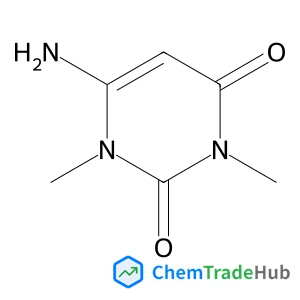
6-amino-1,3-dimethyl-1,2,3,4-tetrahydropyrimidine-2,4-dione
CAS Number:
6642-31-5
Molecular Formula:
C6H9N3O2
Yu Liu, Hao Wang, Heng-Yi Zhang, Peng Liang
A water-soluble nanometer-scale metallocapped polyrotaxane has been prepared by the inclusion complexation of azo-calixarenes with metallo-bridged bis(β-CD)s, displaying highly selective binding for Ca2+.
Seda Çakir, Sylvain Gabriele, Philippe Dubois, Filip Du Prez, Laetitia Mespouille
DOI: 10.1039/C6PY01663D
DOI: 10.1039/C5PY01058F
Wei Chen, Yanyan Zhou, Ying Li, Jun Sun, Xiangqiang Pan, Qian Yu, Nianchen Zhou, Zhengbiao Zhang, Xiulin Zhu
DOI: 10.1039/C6PY01638C
B. Sutisna, G. Polymeropoulos, E. Mygiakis, V. Musteata, K.-V. Peinemann, D.-M. Smilgies, N. Hadjichristidis, S. P. Nunes
DOI: 10.1039/C6PY01401A
Ying Zhao, Ling He, Song Qin, Guo-Hong Tao
DOI: 10.1039/C6PY01472K
Shuhui Zhang, Libang He, Yinxin Yang, Bo Yang, Yixue Liao, Xinyuan Xu, Jiyao Li, Xiao Yang, Jianshu Li
DOI: 10.1039/C6PY01362G
Xiayu Peng
DOI: 10.1039/C4PY01462F
Adam Nunns
DOI: 10.1039/C4PY01512F
1-(2,4,6-Trifluorophenyl)ethanol is an organic compound with the CAS number 1250...
1-(2,4-Dimethoxybenzyl)-4-(hydroxymethyl)-2-pyrrolidinone (CAS: 919111-34-5) is ...
(7S,15R)-6β,15-Diacetoxy-7α,20-epoxy-7-hydroxykaura-2,16-dien-1-one is a crystal...
The compound rac-ethyl (1r,4r)-4-hydroxycyclohexane-1-carboxylate, trans (CAS: 3...
The market for 2-(2,4-Difluorophenoxy)-3-nitropyridine (CAS: 175135-62-3) is cur...
The main uses of 6-Diazo-5-oxo-L-norleucine (CAS: 157-03-9) include research in ...
When handling 2-Aminoethyl-mono-amide-DOTA-tris(tBu ester) (CAS: 173308-19-5), i...
5-Methylimidazo[1,2-a]pyridine-3-carbaldehyde (CAS: 178488-37-4) can be synthesi...
There are alternative reagents that can be used in the synthesis of 2,4,6-Trihyd...
(2Z)-3-(5-Fluoro-1H-indol-3-yl)-2-sulfanylacrylic acid is a chemical compound wi...

ChemComm publishes urgent research which is of outstanding significance and interest to experts in the field, while also appealing to the journal’s broad chemistry readership. Our communication format is ideally suited to short, urgent studies that are of such importance that they require accelerated publication. Our scope covers all topics in chemistry, and research at the interface of chemistry and other disciplines (such as materials science, nanoscience, physics, engineering and biology) where there is a significant novelty in the chemistry aspects. Major topic areas covered include: Analytical Chemistry Catalysis Chemical Biology and medicinal chemistry Computational Chemistry and Machine Learning Energy and sustainable chemistry Environmental Chemistry Green Chemistry Inorganic Chemistry Materials Chemistry Nanoscience Organic Chemistry Physical Chemistry Polymer Chemistry Supramolecular Chemistry
![1,1',1'',1'''-[Disulfanediylbis(carbonothioylnitrilo)]tetraethane structure](https://static.chemtradehub.com/structs/97-/97-77-8-f3e4.webp "1,1',1'',1'''-[Disulfanediylbis(carbonothioylnitrilo)]tetraethane structure")