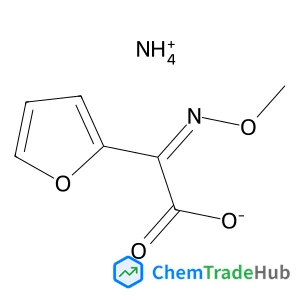
Ammonium (Z)-2-(furan-2-yl)-2-(methoxyimino)acetate
CAS Number:
97148-39-5
Molecular Formula:
C7H10N2O4
Matthew P. Conley, Aaron J. Rossini, Aleix Comas-Vives, Maxence Valla, Gilles Casano, Olivier Ouari, Paul Tordo, Anne Lesage, Lyndon Emsley, Christophe Copéret
Grafting reactive molecular complexes on dehydroxylated amorphous silica is a strategy to develop “single-site” heterogeneous catalysts. In general, only the reactivity of isolated silanols is invoked for silica dehydroxylated at 700 °C ([SiO2-700]), though ca. 10% of the surface silanols are in fact geminal Q2-silanols. Here we report the reaction of allyltributylstannane with [SiO2-700] and find that the geminal Q2-silanols react to form products that would formally arise from vicinal Q3-silanols that are not present on [SiO2-700], indicating that a surface rearrangement occurs. The reorganization of the silica surface is unique to silica dehydroxylated at 700 °C or above. The findings were identified using Dynamic Nuclear Polarization Surface Enhanced NMR Spectroscopy (DNP SENS) combined with DFT calculations.
Judith H. Cohen, Karin M. Balss, Eugena Akerman-Revis, Mark Inderbitzen, James Lisk, Asha Marathe, Robert O'Brien, Elaine Pottinger-Cooper, William Rudd, Cheryl Wendel, George Papandreou, Cynthia A. Maryanoff
DOI: 10.1039/C2AY25030F
Vittorio Albergamo, Emma L. Schymanski, Rick Helmus, Milou M. L. Dingemans, Michiel H. S. Kraak
DOI: 10.1039/C9EW00741E
Siying Che, Ilja Popovs, Huimin Luo, Yali Luo, Wei Guo, Hao Chen, Tao Wang, Kecheng Jie, Congmin Wang
DOI: 10.1039/C9CC06767A
Xuan Wang, Caicheng Long, Zixin Jiang, Taiping Qing, Kaiwu Zhang, Peng Zhang, Bo Feng
DOI: 10.1039/C9AY01627A
Giancarla Alberti, Valeria M. Nurchi, Lisa R. Magnaghi, Raffaela Biesuz
DOI: 10.1039/C9AY01538H
Jian Han, Faying Li, Liping Jiang, Kai Li, Yunhui Dong, Yueyun Li
DOI: 10.1039/C5AY02058A
Jana Pisk, Tomica Hrenar, Mirta Rubčić, Gordana Pavlović, Vladimir Damjanović, Jasna Lovrić, Marina Cindrić, Višnja Vrdoljak
DOI: 10.1039/C7CE02136D
Weiya Pu, Xueru Liu, Jinye Sun, Mengxing Cui
DOI: 10.1039/C9CC07461A
1H-Indazole-6-carbonitrile finds applications in pharmaceuticals, where it serve...
Waste containing Dioctyl (2E)-2-butenedioate (CAS: 2997-85-5) should be collecte...
Sodium [(1,2-benzoxazol-3-ylmethyl)sulfonyl]azanide is primarily used in pharmac...
Dimethyl 4-(4,4,5,5-tetramethyl-1,3,2-dioxaborolan-2-yl)-2,6-pyridinedicarboxyla...
Waste containing 2-Fluoro-6-hydrazinopyridine (CAS: 80714-39-2) should be manage...
6-Formyl-2-pyridinecarboxylic acid is an organic compound with the molecular for...
Research trends for this compound indicate a focus on its potential applications...
9H-Tribenzo[b,d,f]azepine is typically synthesized via a multi-step process invo...
1-Cyclopropyl-7-ethoxy-6-fluoro-8-methoxy-4-oxo-1,4-dihydro-3-quinolinecarboxyli...
Waste containing Methyl 3-oxo-1,2,3,4-tetrahydro-6-quinoxalinecarboxylate (CAS: ...

Physical Chemistry Chemical Physics (PCCP) is an international journal co-owned by 19 physical chemistry and physics societies from around the world. This journal publishes original, cutting-edge research in physical chemistry, chemical physics and biophysical chemistry. To be suitable for publication in PCCP, articles must include significant innovation and/or insight into physical chemistry; this is the most important criterion that reviewers and Editors will judge against when evaluating submissions. The journal has a broad scope and welcomes contributions spanning experiment, theory, computation and data science. Topical coverage includes spectroscopy, dynamics, kinetics, statistical mechanics, thermodynamics, electrochemistry, catalysis, surface science, quantum mechanics, quantum computing and machine learning. Interdisciplinary research areas such as polymers and soft matter, materials, nanoscience, energy, surfaces/interfaces, and biophysical chemistry are welcomed if they demonstrate significant innovation and/or insight into physical chemistry. Joined experimental/theoretical studies are particularly appreciated when complementary and based on up-to-date approaches.
![N-[(9H-Fluoren-9-ylmethoxy)carbonyl]serine structure](https://static.chemtradehub.com/structs/737/73724-45-5-b0dc.webp "N-[(9H-Fluoren-9-ylmethoxy)carbonyl]serine structure")