












Copper-catalyzed 1,1-arylalkylation of terminal alkynes with diazo esters and organoboronic acids
Literature Information
Publication Date
2019-10-17
DOI
10.1039/C9CC07461A
Impact Factor
6.222
Authors
Weiya Pu, Xueru Liu, Jinye Sun, Mengxing Cui
View Original
Abstract
A novel copper-catalyzed 1,1-arylalkylation of terminal alkynes with diazo esters and organoboronic acids is described. With this methodology, (E)-β-aryl-β,γ-unsaturated esters can be easily constructed in good to excellent yields directly from readily available and inexpensive traditional coupling reagents.
Related Literature
Oxygen transport and surface exchange mechanisms in LSCrF–ScCeSZ dual-phase ceramics
Zonghao Shen, Stephen J. Skinner, John A. Kilner
2019-05-24
Paper
DOI: 10.1039/C9CP02175B
On the preparation and NMR spectroscopic characterization of potassium aluminium tetrahydride KAlH4
Bodo Zibrowius, Michael Felderhoff
2019-05-17
Paper
DOI: 10.1039/C9CP01059A
Judging the feasibility of TiO2 as photocatalyst for chemical energy conversion by quantitative reactivity determinants
Martin Dilla, Nikolaos G. Moustakas, Ahmet E. Becerikli, Tim Peppel, Armin Springer, Jennifer Strunk, Simon Ristig
2019-06-03
Paper
DOI: 10.1039/C9CP00981G
The performance of adsorption, dissociation and diffusion mechanism of hydrogen on the Ti-doped ZrCo(110) surface
Qingqing Wang, Xianggang Kong, Huilei Han, Ge Sang, Guanghui Zhang, Tao Gao
2019-05-15
Paper
DOI: 10.1039/C9CP02491C
Study on the icosahedral fullerene structure with ultra-light and pressure resistance character
Yifan Zhao, Yin Lian, Huifeng Tan
2019-05-07
Paper
DOI: 10.1039/C8CP07787H
Molecular mechanisms of pore formation and membrane disruption by the antimicrobial lantibiotic peptide Mutacin 1140
Rudramani Pokhrel, Nisha Bhattarai, Prabin Baral, Jae H. Park, Martin Handfield
2019-05-24
Paper
DOI: 10.1039/C9CP01558B
Non-adiabatic molecular dynamics investigation of the size dependence of the electronic relaxation in polyacenes
Evgeny Posenitskiy, Mathias Rapacioli, Bruno Lepetit, Didier Lemoine, Fernand Spiegelman
2019-05-17
Paper
DOI: 10.1039/C9CP00603F
Hydrogenation-controlled mechanical properties in graphene helicoids: exceptional distribution-dependent behavior
Ali Sharifian, Hamid Hassanzadeh Afrouzi, Mostafa Baghani
2019-05-07
Paper
DOI: 10.1039/C9CP01361J
Block copolymers as bile salt sequestrants: intriguing structures formed in a mixture of an oppositely charged amphiphilic block copolymer and bile salt
Karin Schillén, Luciano Galantini, Guanqun Du, Alessandra Del Giudice, Viveka Alfredsson, Anna M. Carnerup, Nicolae V. Pavel, Giancarlo Masci, Bo Nyström
2019-05-20
Paper
DOI: 10.1039/C9CP01744E
On the ligand–core interaction in ligand-protected gold superatoms. Insights from Au25(XR)18 (X = S, Se, Te) via relativistic DFT calculations
2019-05-24
Paper
DOI: 10.1039/C9CP02077B
You might also like
Compound Q&A
What are the main uses of 1H-Indazole-6-carbonitrile (CAS: 141290-59-7)?
1H-Indazole-6-carbonitrile finds applications in pharmaceuticals, where it serve...
141290-59-71H-Indazole-6-carbon...
Compound Q&A
How should waste containing Dioctyl (2E)-2-butenedioate (CAS: 2997-85-5) be handled?
Waste containing Dioctyl (2E)-2-butenedioate (CAS: 2997-85-5) should be collecte...
2997-85-5Dioctyl (2E)-2-buten...
Compound Q&A
What industries use Sodium [(1,2-benzoxazol-3-ylmethyl)sulfonyl]azanide (CAS: 68291-98-5)?
Sodium [(1,2-benzoxazol-3-ylmethyl)sulfonyl]azanide is primarily used in pharmac...
68291-98-5Sodium [(1,2-benzoxa...
Compound Q&A
Are there alternatives to Dimethyl 4-(4,4,5,5-tetramethyl-1,3,2-dioxaborolan-2-yl)-2,6-pyridinedicarboxylate (CAS: 741709-66-0) in synthesis?
Dimethyl 4-(4,4,5,5-tetramethyl-1,3,2-dioxaborolan-2-yl)-2,6-pyridinedicarboxyla...
741709-66-0Dimethyl 4-(4,4,5,5-...
Compound Q&A
How should waste containing 2-Fluoro-6-hydrazinopyridine (CAS: 80714-39-2) be handled?
Waste containing 2-Fluoro-6-hydrazinopyridine (CAS: 80714-39-2) should be manage...
80714-39-22-Fluoro-6-hydrazino...
Compound Q&A
What is 6-Formyl-2-pyridinecarboxylic acid (CAS: 499214-11-8)?
6-Formyl-2-pyridinecarboxylic acid is an organic compound with the molecular for...
499214-11-86-Formyl-2-pyridinec...
Compound Q&A
What is the market or research trend for 3-(3,4-dimethoxyphenyl)-2,5-dimethyl-N-(2-morpholin-4-ylethyl)pyrazolo[1,5-a]pyrimidin-7-amine (CAS: 900874-91-1)?
Research trends for this compound indicate a focus on its potential applications...
900874-91-13-(3,4-dimethoxyphen...
Compound Q&A
How is 9H-Tribenzo[b,d,f]azepine (CAS: 29875-73-8) typically synthesized?
9H-Tribenzo[b,d,f]azepine is typically synthesized via a multi-step process invo...
29875-73-89H-Tribenzo[b,d,f]az...
Compound Q&A
How is 1-Cyclopropyl-7-ethoxy-6-fluoro-8-methoxy-4-oxo-1,4-dihydro-3-quinolinecarboxylic acid (CAS: 1797982-51-4) typically synthesized?
1-Cyclopropyl-7-ethoxy-6-fluoro-8-methoxy-4-oxo-1,4-dihydro-3-quinolinecarboxyli...
1797982-51-41-Cyclopropyl-7-etho...
Compound Q&A
How should waste containing Methyl 3-oxo-1,2,3,4-tetrahydro-6-quinoxalinecarboxylate (CAS: 671820-52-3) be handled?
Waste containing Methyl 3-oxo-1,2,3,4-tetrahydro-6-quinoxalinecarboxylate (CAS: ...
671820-52-3Methyl 3-oxo-1,2,3,4...
Source Journal
Chemical Communications

CiteScore:
8.6
Self-citation Rate:
4.7%
Articles per Year:
2458
ChemComm publishes urgent research which is of outstanding significance and interest to experts in the field, while also appealing to the journal’s broad chemistry readership. Our communication format is ideally suited to short, urgent studies that are of such importance that they require accelerated publication. Our scope covers all topics in chemistry, and research at the interface of chemistry and other disciplines (such as materials science, nanoscience, physics, engineering and biology) where there is a significant novelty in the chemistry aspects. Major topic areas covered include: Analytical Chemistry Catalysis Chemical Biology and medicinal chemistry Computational Chemistry and Machine Learning Energy and sustainable chemistry Environmental Chemistry Green Chemistry Inorganic Chemistry Materials Chemistry Nanoscience Organic Chemistry Physical Chemistry Polymer Chemistry Supramolecular Chemistry
Recommended Compounds
![Sodium (2Z)-7-{[(2R)-2-amino-2-carboxyethyl]sulfanyl}-2-({[(1S)-2,2-dimethylcyclopropyl]carbonyl}amino)-2-heptenoate structure](https://static.chemtradehub.com/structs/811/81129-83-1-441c.webp "Sodium (2Z)-7-{[(2R)-2-amino-2-carboxyethyl]sulfanyl}-2-({[(1S)-2,2-dimethylcyclopropyl]carbonyl}amino)-2-heptenoate structure")
Sodium (2Z)-7-{[(2R)-2-amino-2-carboxyethyl]sulfanyl}-2-({[(1S)-2,2-dimethylcyclopropyl]carbonyl}amino)-2-heptenoate
CAS Number:
81129-83-1
Molecular Formula:
C16H25N2NaO5S
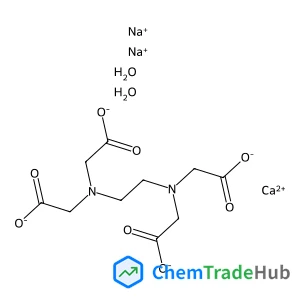
EthylenediaminetetraaceticacidcalciumDisodiumsalthydrate
CAS Number:
23411-34-9
Molecular Formula:
C10H16CaN2Na2O10
Recommended Suppliers





Disclaimer
This page provides academic journal information for reference and research purposes only. We are not affiliated with any journal publishers and do not handle publication submissions. For publication-related inquiries, please contact the respective journal publishers directly.
If you notice any inaccuracies in the information displayed, please contact us at support@chemtradehub.com. We will promptly review and address your concerns.