












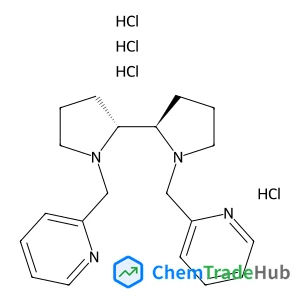
(2R,2'R)-1,1'-Bis(2-pyridinylmethyl)-2,2'-bipyrrolidine tetrahydrochloride
CAS Number:
1228077-88-0
Molecular Formula:
C20H30Cl4N4
Heyuan Liu, Li Shen, Zhaozhen Cao, Xiyou Li
Covalently linked perylenetetracarboxylic diimide (PDI) dimers (D1 and D2) and trimers (T1 and T2) with slipped “face-to-face” stacked structure are prepared and their molecular structures are characterized by 1H NMR, MALDI-TOF mass spectroscopy and elemental analysis. The rigid molecular structures of these compounds make it easier to establish a direct correlation between the aggregate structure and the photophysical properties. The minimized molecular structures of these compounds reveal that they are all “face-to-face” stacked aggregates with large longitudinal displacement. Their absorption spectra show red-shifted bands, suggesting the presence of “J” type excitonic coupling between the PDI subunits in these compounds. However, their steady state and time resolved fluorescence spectra revealed that the emission from the “excimer-like” states dominates the fluorescence of these compounds, this is similar to that of “H-type” aggregates and may be ascribed to the “face-to-face” stacked structure. In the fluorescence spectra of these compounds, a minor “J-type” emission can be identified for the compounds with a relatively large longitudinal displacement. An increase in the number of subunits in one aggregate from 2 to 3 also brings about distinctive changes in their photophysical properties, which can be ascribed to the changes in the stacking structure caused by the steric hindrance.
P. Andrew Evans, Erich W. Baum, Aleem N. Fazal, Maren Pink
DOI: 10.1039/B413438A
Bernard Jousseaume, Christian Laporte, Marie-Claude Rascle, Thierry Toupance
DOI: 10.1039/B303978A
Femke de Loos, Irene C. Reynhout, Jeroen J. L. M. Cornelissen, Alan E. Rowan, Roeland J. M. Nolte
DOI: 10.1039/B412067A
Masao Kawai, Ryoji Tanaka, Hatsuo Yamamura, Keiko Yasuda, Shizuto Narita, Hiroshi Umemoto, Setsuko Ando, Takashi Katsu
DOI: 10.1039/B302351F
Alessandra Lattanzi, Patrizia Iannece, Assunta Vicinanza, Arrigo Scettri
DOI: 10.1039/B303904H
Chang Lu, Aaron E. Smith, Harold G. Craighead
DOI: 10.1039/B411697F
Phillip M. Smith, Amy Lea McCarty, Nhu Yen Nguyen, Melvin E. Zandler, Francis D'Souza
DOI: 10.1039/B303127F
Xuemei Wang, Andrei B. Kharitonov, Eugenii Katz, Itamar Willner
DOI: 10.1039/B303845A
Michinori Takeshita, Miki Nagai, Takehiko Yamato
DOI: 10.1039/B303916A
Carole Gardiennet, Bernard Henry, Paul Kuad, Bernard Spiess, Piotr Tekely
DOI: 10.1039/B413415J
(3.beta.)-3-Hydroxy-N,N-dimethyl-chol-5-en-24-amide (CAS: 79066-03-8) is primari...
5-(Aminomethyl)-2-methoxyphenol (CAS: 89702-89-6) is classified under GHS as a s...
Thieno[2,3-c]pyridin-7(6H)-one (CAS: 28981-13-7) is a heterocyclic organic compo...
1-[(6-Methoxy-3-pyridinyl)methyl]-4-piperidinamine dihydrochloride is generally ...
[(2E)-3-Phenyl-2-propen-1-yl]phosphonic acid (CAS: 146404-58-2) is regulated und...
6-Bromo-7-methoxyquinoline (CAS: 1620515-86-7) falls under the scope of the Glob...
This compound is primarily used in the pharmaceutical industry for the developme...
1-Ethyl-7-[2-methyl-6-(4H-1,2,4-triazol-3-yl)-3-pyridinyl]-3,5-dihydropyrazino[2...
Alternative reagents such as 2-[(dimethylamino)methyl]phenylboronic acid or rela...
3-(Piperidin-4-yloxy)pyridine (CAS: 310881-48-2) is an organic compound with the...

Physical Chemistry Chemical Physics (PCCP) is an international journal co-owned by 19 physical chemistry and physics societies from around the world. This journal publishes original, cutting-edge research in physical chemistry, chemical physics and biophysical chemistry. To be suitable for publication in PCCP, articles must include significant innovation and/or insight into physical chemistry; this is the most important criterion that reviewers and Editors will judge against when evaluating submissions. The journal has a broad scope and welcomes contributions spanning experiment, theory, computation and data science. Topical coverage includes spectroscopy, dynamics, kinetics, statistical mechanics, thermodynamics, electrochemistry, catalysis, surface science, quantum mechanics, quantum computing and machine learning. Interdisciplinary research areas such as polymers and soft matter, materials, nanoscience, energy, surfaces/interfaces, and biophysical chemistry are welcomed if they demonstrate significant innovation and/or insight into physical chemistry. Joined experimental/theoretical studies are particularly appreciated when complementary and based on up-to-date approaches.
![5,7-Dihydroxy-3-(4-hydroxyphenyl)-6-[(1R,6R)-3-methyl-6-prop-1-en-2-ylcyclohex-2-en-1-yl]chromen-4-one structure](https://static.chemtradehub.com/structs/191/1914963-20-4-2b05.webp "5,7-Dihydroxy-3-(4-hydroxyphenyl)-6-[(1R,6R)-3-methyl-6-prop-1-en-2-ylcyclohex-2-en-1-yl]chromen-4-one structure")
![7-Bromo-5-chloro-1H-pyrazolo[4,3-b]pyridine structure](https://static.chemtradehub.com/structs/135/1351813-70-1-a716.webp "7-Bromo-5-chloro-1H-pyrazolo[4,3-b]pyridine structure")





