












Construction of functional porphyrin polystyrene nano-architectures by ATRP
Literature Information
Publication Date
2004-12-01
DOI
10.1039/B412067A
Impact Factor
6.222
Authors
Femke de Loos, Irene C. Reynhout, Jeroen J. L. M. Cornelissen, Alan E. Rowan, Roeland J. M. Nolte
View Original
Abstract
A series of mono-functionalized metallo-porphyrin polystyrenes have been synthesized using atom transfer radical polymerization and their self-assembling behavior was studied by electron microscopy showing that the polystyrene tail-length influences the aggregate architecture.
Recommended Journals
Related Literature
The gas-phase reaction between silylene and 2-butyne: kinetics, isotope studies, pressure dependence studies and quantum chemical calculations
Rosa Becerra, J. Pat Cannady, Guy Dormer, Robin Walsh
2009-04-17
Paper
DOI: 10.1039/B823109E
Lability of metal complexes at spherical sensors. Dynamic voltammetric measurements
Ángela Molina, Francisco Martínez-Ortiz, Eduardo Laborda, Jaume Puy
2010-04-01
Paper
DOI: 10.1039/B922513G
Dissociative double photoionization of CO2 molecules in the 36–49 eV energy range: angular and energy distribution of ion products
P. Candori, S. Falcinelli, M. Lavollée, F. Pirani, R. Richter, F. Vecchiocattivi
2010-04-01
Paper
DOI: 10.1039/B926960F
Shannon entropy as a new measure of aromaticity, Shannon aromaticity
Siamak Noorizadeh, Ehsan Shakerzadeh
2010-03-16
Paper
DOI: 10.1039/B916509F
In situXAS and IR studies on Cu:SAPO-5 and Cu:SAPO-11: the contributory role of monomeric linear copper(i) species in the selective catalytic reduction of NOx by propene
Karina Mathisen, David G. Nicholson
2009-04-24
Paper
DOI: 10.1039/B902491C
Full quadrupolar tensor determination by NMR using a micro-crystal spinning at the magic angle
Suresh Kumar Vasa, Ernst R. H. van Eck, J. W. G. Janssen, Arno P. M. Kentgens
2010-03-22
Paper
DOI: 10.1039/B927449A
A stepwise atomic, valence-molecular, and full-molecular optimisation of the Hartree–Fock/Kohn–Sham energy
Branislav Jansík, Stinne Høst, Mikael P. Johansson, Jeppe Olsen, Poul Jørgensen, Trygve Helgaker
2009-05-19
Paper
DOI: 10.1039/B901987A
Photolysis in aqueous aerosols: 300 nm yields of Fe2+ from a ferrioxalate actinometer and of OH radical from nitrate ions
David L. Bones, Leon F. Phillips
2009-04-24
Paper
DOI: 10.1039/B903329G
Understanding microwave heating effects in single mode type cavities—theory and experiment
John Robinson, Sam Kingman, Derek Irvine, Peter Licence, Alastair Smith, Georgios Dimitrakis, David Obermayer, C. Oliver Kappe
2010-03-16
Paper
DOI: 10.1039/B922797K
You might also like
Compound Q&A
What are the main uses of (3.beta.)-3-Hydroxy-N,N-dimethyl-chol-5-en-24-amide (CAS: 79066-03-8)?
(3.beta.)-3-Hydroxy-N,N-dimethyl-chol-5-en-24-amide (CAS: 79066-03-8) is primari...
79066-03-8(3.beta.)-3-Hydroxy-...
Compound Q&A
What regulatory guidelines apply to 5-(aminomethyl)-2-methoxyphenol (CAS: 89702-89-6)?
5-(Aminomethyl)-2-methoxyphenol (CAS: 89702-89-6) is classified under GHS as a s...
89702-89-65-(aminomethyl)-2-me...
Compound Q&A
What is Thieno[2,3-c]pyridin-7(6H)-one (CAS: 28981-13-7)?
Thieno[2,3-c]pyridin-7(6H)-one (CAS: 28981-13-7) is a heterocyclic organic compo...
28981-13-7Thieno[2,3-c]pyridin...
Compound Q&A
Is 1-[(6-Methoxy-3-pyridinyl)methyl]-4-piperidinamine dihydrochloride (CAS: 1185311-28-7) safe?
1-[(6-Methoxy-3-pyridinyl)methyl]-4-piperidinamine dihydrochloride is generally ...
1185311-28-71-[(6-Methoxy-3-pyri...
Compound Q&A
What regulatory guidelines apply to [(2E)-3-Phenyl-2-propen-1-yl]phosphonic acid (CAS: 146404-58-2)?
[(2E)-3-Phenyl-2-propen-1-yl]phosphonic acid (CAS: 146404-58-2) is regulated und...
146404-58-2[(2E)-3-Phenyl-2-pro...
Compound Q&A
What regulatory guidelines apply to 6-Bromo-7-methoxyquinoline (CAS: 1620515-86-7)?
6-Bromo-7-methoxyquinoline (CAS: 1620515-86-7) falls under the scope of the Glob...
1620515-86-76-Bromo-7-methoxyqui...
Compound Q&A
What industries use (2R)-1-(1-Benzofuran-2-yl)-N-propyl-2-pentanamine (CAS: 260550-89-8)?
This compound is primarily used in the pharmaceutical industry for the developme...
260550-89-8(2R)-1-(1-Benzofuran...
Compound Q&A
What are the main uses of 1-Ethyl-7-[2-methyl-6-(4H-1,2,4-triazol-3-yl)-3-pyridinyl]-3,5-dihydropyrazino[2,3-b]pyrazin-2(1H)-one (CAS: 1228013-15-7)?
1-Ethyl-7-[2-methyl-6-(4H-1,2,4-triazol-3-yl)-3-pyridinyl]-3,5-dihydropyrazino[2...
1228013-15-71-Ethyl-7-[2-methyl-...
Compound Q&A
Are there alternatives to {5-(Acryloylamino)-2-[(dimethylamino)methyl]phenyl}boronic acid (CAS: 1217500-78-1) in synthesis?
Alternative reagents such as 2-[(dimethylamino)methyl]phenylboronic acid or rela...
1217500-78-1{5-(Acryloylamino)-2...
Compound Q&A
What is 3-(Piperidin-4-yloxy)pyridine (CAS: 310881-48-2)?
3-(Piperidin-4-yloxy)pyridine (CAS: 310881-48-2) is an organic compound with the...
310881-48-23-(Piperidin-4-yloxy...
Source Journal
Chemical Communications

CiteScore:
8.6
Self-citation Rate:
4.7%
Articles per Year:
2458
ChemComm publishes urgent research which is of outstanding significance and interest to experts in the field, while also appealing to the journal’s broad chemistry readership. Our communication format is ideally suited to short, urgent studies that are of such importance that they require accelerated publication. Our scope covers all topics in chemistry, and research at the interface of chemistry and other disciplines (such as materials science, nanoscience, physics, engineering and biology) where there is a significant novelty in the chemistry aspects. Major topic areas covered include: Analytical Chemistry Catalysis Chemical Biology and medicinal chemistry Computational Chemistry and Machine Learning Energy and sustainable chemistry Environmental Chemistry Green Chemistry Inorganic Chemistry Materials Chemistry Nanoscience Organic Chemistry Physical Chemistry Polymer Chemistry Supramolecular Chemistry
Recommended Compounds
![N-[4-(Cyanoethynyl)phenyl]-16-oxo-4,7,10,13-tetraoxa-17-azahenicos-1-yn-21-amide structure](https://static.chemtradehub.com/structs/218/2183440-36-8-68cb.webp "N-[4-(Cyanoethynyl)phenyl]-16-oxo-4,7,10,13-tetraoxa-17-azahenicos-1-yn-21-amide structure")
N-[4-(Cyanoethynyl)phenyl]-16-oxo-4,7,10,13-tetraoxa-17-azahenicos-1-yn-21-amide
CAS Number:
2183440-36-8
Molecular Formula:
C25H31N3O6
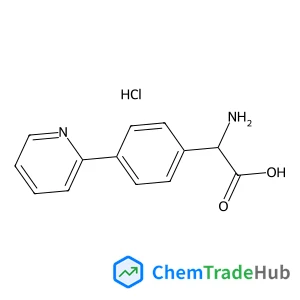
2-Amino-2-(4-(pyridin-2-YL)phenyl)acetic acid hydrochloride
CAS Number:
1135818-89-1
Molecular Formula:
C13H13ClN2O2
Recommended Suppliers





Disclaimer
This page provides academic journal information for reference and research purposes only. We are not affiliated with any journal publishers and do not handle publication submissions. For publication-related inquiries, please contact the respective journal publishers directly.
If you notice any inaccuracies in the information displayed, please contact us at support@chemtradehub.com. We will promptly review and address your concerns.