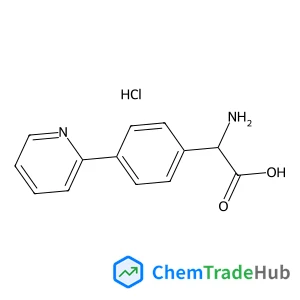
2-Amino-2-(4-(pyridin-2-YL)phenyl)acetic acid hydrochloride
CAS Number:
1135818-89-1
Molecular Formula:
C13H13ClN2O2
Chang Lu, Aaron E. Smith, Harold G. Craighead
Denatured proteins were separated in free solution on a microfluidic chip without any sieving matrix after carrying out the denaturation with a mixture of alkyl sulfates with different carbon chain lengths.
R. Devanathan, S. Thevuthasan, J. D. Gale
DOI: 10.1039/B902764E
Sameh Tawfick, Xiaopei Deng, A. John Hart, Joerg Lahann
DOI: 10.1039/C000304M
A. Stroppa, S. Picozzi
DOI: 10.1039/B927508H
Ahmet Taskiran, André Schirmeisen, Harald Fuchs, Hartmut Bracht, Bernhard Roling
DOI: 10.1039/B900175C
Sepideh Zamani, Vera Meynen, Myrjam Mertens, Eveline Popovici, Sabine Van Doorslaer, Pegie Cool
DOI: 10.1039/B819442B
Ron Siewertsen, Falk Renth, Friedrich Temps, Frank Sönnichsen
DOI: 10.1039/B821344E
I. N. Yakovkin
DOI: 10.1039/B903099A
Marta Łabuda, Jesús González-Vázquez, Leticia González
DOI: 10.1039/B926825A
Irene Conti, Piero Altoè, Marco Stenta, Marco Garavelli
DOI: 10.1039/B926608A
Daniel Hoersch, Harald Otto, Michael A. Cusanovich, Maarten P. Heyn
DOI: 10.1039/B821345C
(3.beta.)-3-Hydroxy-N,N-dimethyl-chol-5-en-24-amide (CAS: 79066-03-8) is primari...
5-(Aminomethyl)-2-methoxyphenol (CAS: 89702-89-6) is classified under GHS as a s...
Thieno[2,3-c]pyridin-7(6H)-one (CAS: 28981-13-7) is a heterocyclic organic compo...
1-[(6-Methoxy-3-pyridinyl)methyl]-4-piperidinamine dihydrochloride is generally ...
[(2E)-3-Phenyl-2-propen-1-yl]phosphonic acid (CAS: 146404-58-2) is regulated und...
6-Bromo-7-methoxyquinoline (CAS: 1620515-86-7) falls under the scope of the Glob...
This compound is primarily used in the pharmaceutical industry for the developme...
1-Ethyl-7-[2-methyl-6-(4H-1,2,4-triazol-3-yl)-3-pyridinyl]-3,5-dihydropyrazino[2...
Alternative reagents such as 2-[(dimethylamino)methyl]phenylboronic acid or rela...
3-(Piperidin-4-yloxy)pyridine (CAS: 310881-48-2) is an organic compound with the...

ChemComm publishes urgent research which is of outstanding significance and interest to experts in the field, while also appealing to the journal’s broad chemistry readership. Our communication format is ideally suited to short, urgent studies that are of such importance that they require accelerated publication. Our scope covers all topics in chemistry, and research at the interface of chemistry and other disciplines (such as materials science, nanoscience, physics, engineering and biology) where there is a significant novelty in the chemistry aspects. Major topic areas covered include: Analytical Chemistry Catalysis Chemical Biology and medicinal chemistry Computational Chemistry and Machine Learning Energy and sustainable chemistry Environmental Chemistry Green Chemistry Inorganic Chemistry Materials Chemistry Nanoscience Organic Chemistry Physical Chemistry Polymer Chemistry Supramolecular Chemistry
![Ethanone, 1-[4-chloro-2-(methylthio)-5-pyrimidinyl]- structure](https://static.chemtradehub.com/structs/661/66116-82-3-863e.webp "Ethanone, 1-[4-chloro-2-(methylthio)-5-pyrimidinyl]- structure")
![7-Bromo-5-chloro-1H-pyrazolo[4,3-b]pyridine structure](https://static.chemtradehub.com/structs/135/1351813-70-1-a716.webp "7-Bromo-5-chloro-1H-pyrazolo[4,3-b]pyridine structure")