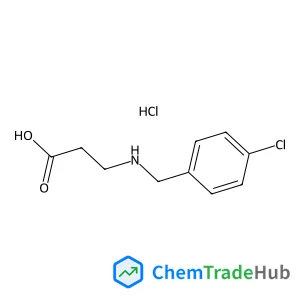
N-(4-Chlorobenzyl)-beta-alanine hydrochloride (1:1)
CAS Number:
1172479-10-5
Molecular Formula:
C10H13Cl2NO2
Jayakrupakar Nallala, Gavin Rhys Lloyd, Nicholas Stone
In infrared spectral histopathology, paraffin embedded tissues are often de-paraffinized using chemical agents such as xylene and hexane. These chemicals are known to be toxic and the routine de-waxing procedure is time consuming. A comparative study was carried out to identify alternate de-paraffinization methods by using paraffin oil and electronic de-paraffinization (using a mathematical computer algorithm) and their effectiveness was compared to xylene and hexane. Sixteen adjacent tissue sections obtained from a single block of a normal colon tissue were de-paraffinized using xylene, hexane and paraffin oil (+ hexane wash) at five different time points each for comparison. One section was reserved unprocessed for electronic de-paraffinization based on a modified extended multiplicative signal correction (EMSC). IR imaging was carried out on these tissue sections. Coefficients based on the fit of a pure paraffin model to the IR images were then calculated to estimate the amount of paraffin remaining after processing. Results indicate that on average xylene removes more paraffin in comparison to hexane and paraffin oil although the differences were small. This makes paraffin oil, followed by a hexane wash, an interesting and less toxic alternative method of de-paraffinization. However, none of the chemical methods removed paraffin completely from the tissues at any given time point. Moreover, paraffin was removed more easily from the glandular regions than the connective tissue regions indicating a form of differential paraffin retention based on the histology. In such cases, the use of electronic de-paraffinization to neutralize such variances across different tissue regions might be considered. Moreover it is faster, reduces scatter artefacts by index matching and enables samples to be easily stored for further analysis if required.
Jeane Bordini, Peter C. Ford, Elia Tfouni
DOI: 10.1039/B507407J
Gaku Fukuhara, Tadashi Mori
DOI: 10.1039/B504948B
Andrea Deák, Gábor Tárkányi
DOI: 10.1039/B506728F
Hui Hong, Tim Stinear, Paul Skelton, Jonathan B. Spencer, Peter F. Leadlay
DOI: 10.1039/B506835E
Isamu Shiina, Yo-ichi Kawakita, Ryoutarou Ibuka, Kazutoshi Yokoyama, Yu-suke Yamai
DOI: 10.1039/B507401K
Shaofeng Yang, Roel Prins
DOI: 10.1039/B507940C
John H. Thurston, Dale C. Swenson, Louis Messerle
DOI: 10.1039/B504864H
Motoichi Kurisawa, Joo Eun Chung, Yi Yan Yang, Shu Jun Gao, Hiroshi Uyama
DOI: 10.1039/B506989K
Jing Yang, Daniel Lévy, Wei Deng, Patrick Keller, Min-Hui Li
DOI: 10.1039/B508034G
Waste containing N-Methoxy-N-methyl-1,3-thiazole-5-carboxamide (CAS: 898825-89-3...
N-(4-Biphenylyl)dibenzo[b,d]furan-4-amine should be stored in a tightly sealed c...
The market for 3-Acetamido-5-amino-2,4,6-triiodobenzoic acid (CAS: 1713-07-1) is...
Benzyl 2-O-acetyl-3,4,6-tri-O-benzyl-beta-D-galactopyranoside (CAS: 61820-03-9) ...
2-Ethylpiperazine dihydrochloride (CAS: 438050-52-3) is regulated under the Glob...
1,1'-[1,3-Phenylenebis(methylene)]bis(3-methyl-1H-pyrrole-2,5-dione) (CAS: 11946...
Several alternatives can be used in the synthesis of 5-Fluoro-2-(1-pyrrolidinyl)...
Proper personal protective equipment (PPE) must be worn when handling this compo...
When handling 6-Bromoimidazo[1,2-a]pyridin-8-amine, it is important to wear appr...
Alternatives to (2S,4R)-4-(4-Nitrobenzyl)pyrrolidine-2-carboxylic acid hydrochlo...

Analyst publishes analytical and bioanalytical research that reports premier fundamental discoveries and inventions, and the applications of those discoveries, unconfined by traditional discipline barriers.