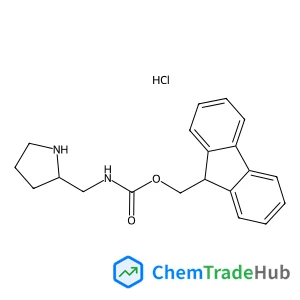
(S)-(9H-Fluoren-9-yl)methyl (pyrrolidin-2-ylmethyl)carbamate hydrochloride
CAS Number:
1217813-15-4
Molecular Formula:
C20H23ClN2O2
Motoichi Kurisawa, Joo Eun Chung, Yi Yan Yang, Shu Jun Gao, Hiroshi Uyama
The sequential injection of hyaluronic acid–tyramine conjugates and enzymes forms biodegradable hydrogels in vivo by enzyme-induced oxidative coupling, offering high potential as a promising biomaterial for drug delivery and tissue engineering.
Zhiqiang Wang, Gen Li
DOI: 10.1039/D3NJ05280J
Iván Sánchez-García, Richard J. M. Egberink, Willem Verboom, Hitos Galán
DOI: 10.1039/D3NJ04265K
Lei Zhao, Tingting Yang, Pei Xiong, Xiaobin Niu, Jinxia Jiang, Qian Xue, Le Yu, Rui Wu
DOI: 10.1039/D3TA04591A
DOI: 10.1039/D3NP00025G
DOI: 10.1039/D3NJ03991A
Rui Zhang, Xishang Song, Han Wu, Yunqi Zhai, Yina Qiao, Zhihao Yu, Jian Xiong, Xuebin Lu
DOI: 10.1039/D3NJ04771G
Xiao-Yu Liu, Yong Qin
DOI: 10.1039/D3NP00020F
Nasim Amiralian, Sandya S. A. Athukoralalage
DOI: 10.1039/D3TA04917E
P. Rosaiah, S. Vadivel, Kalaivani Dayanidhi, Mohammad Rezaul Karim, Ibrahim A. Alnaser, Sambasivam Sangaraju, M. Dhananjaya, Sang Woo Joo
DOI: 10.1039/D3NJ05321K
Waste containing N-Methoxy-N-methyl-1,3-thiazole-5-carboxamide (CAS: 898825-89-3...
N-(4-Biphenylyl)dibenzo[b,d]furan-4-amine should be stored in a tightly sealed c...
The market for 3-Acetamido-5-amino-2,4,6-triiodobenzoic acid (CAS: 1713-07-1) is...
Benzyl 2-O-acetyl-3,4,6-tri-O-benzyl-beta-D-galactopyranoside (CAS: 61820-03-9) ...
2-Ethylpiperazine dihydrochloride (CAS: 438050-52-3) is regulated under the Glob...
1,1'-[1,3-Phenylenebis(methylene)]bis(3-methyl-1H-pyrrole-2,5-dione) (CAS: 11946...
Several alternatives can be used in the synthesis of 5-Fluoro-2-(1-pyrrolidinyl)...
Proper personal protective equipment (PPE) must be worn when handling this compo...
When handling 6-Bromoimidazo[1,2-a]pyridin-8-amine, it is important to wear appr...
Alternatives to (2S,4R)-4-(4-Nitrobenzyl)pyrrolidine-2-carboxylic acid hydrochlo...

ChemComm publishes urgent research which is of outstanding significance and interest to experts in the field, while also appealing to the journal’s broad chemistry readership. Our communication format is ideally suited to short, urgent studies that are of such importance that they require accelerated publication. Our scope covers all topics in chemistry, and research at the interface of chemistry and other disciplines (such as materials science, nanoscience, physics, engineering and biology) where there is a significant novelty in the chemistry aspects. Major topic areas covered include: Analytical Chemistry Catalysis Chemical Biology and medicinal chemistry Computational Chemistry and Machine Learning Energy and sustainable chemistry Environmental Chemistry Green Chemistry Inorganic Chemistry Materials Chemistry Nanoscience Organic Chemistry Physical Chemistry Polymer Chemistry Supramolecular Chemistry