












![5-Bromoimidazo[1,2-a]pyridine structure](https://static.chemtradehub.com/structs/692/69214-09-1-d8e2.webp "5-Bromoimidazo[1,2-a]pyridine structure")
Polymer–graphite composite: a versatile use and throw plastic chip electrode
Literature Information
Publication Date
2014-09-04
DOI
10.1039/C4AN01405G
Impact Factor
4.616
Authors
Dilip B. Parmar, Gopala Ram Bhadu
View Original
Abstract
We report an efficient plastic chip electrode (PCE) fabricated from a composite of graphite and poly(methyl methacrylate) by a simple solution casting method and promoted as an economically inexpensive, multipurpose disposable electrode for various applications. The TEM images of the filler (graphite) show that the material consists of single, as well as multi-layers. Thus, the self-standing and arid electrodes prepared were characterized for their material properties such as, microscopy (SEM and AFM), as well as thermal properties (TGA), mechanical (tensile strength) and electrical properties. A set of physical parameters were derived from these characterizations for sustainability of these electrodes in harsh off-laboratory conditions. The utility of these mechanically stable, bulk-conducting and high surface area electrodes were demonstrated in various well understood electrochemical protocols, such as cyclic voltammetry, stripping voltammetry, electropolymerization, electrowinning and amperometric sensing. The voltammetry data were compared with the data recorded on a conventional glassy carbon electrode.
Related Literature
Spectral properties of a fluorescing molecule within a spherical metallic nanocavity
Jörg Enderlein
2002-05-07
Paper
DOI: 10.1039/B200502F
Coupling between dipole-bound and valence states: the nitromethane anion
2002-05-13
Paper
DOI: 10.1039/B202143A
High pressure investigations of (n-alkanes + ether) mixtures‡
Urszula Domańska, Piotr Morawski
2002-04-30
Paper
DOI: 10.1039/B200711H
Phase behaviour of room temperature ionic liquid solutions: an unusually large co-solvent effect in (water + ethanol)
Vesna Najdanovic-Visak, José M. S. S. Esperança, Luís P. N. Rebelo, Manuel Nunes da Ponte, Henrique J. R. Guedes, Kenneth R. Seddon, Jerzy Szydlowski
2002-04-02
Communication
DOI: 10.1039/B201723G
Two-step mechanism in cationic lipoplex formation as observed by dynamic light scattering, dielectric relaxation and circular dichroism methods
2002-05-13
Paper
DOI: 10.1039/B110503E
Interaction between probe molecules and zeolites. Part II:Interpretation of the IR spectra of CO and N2 adsorbed in NaY and NaRbY
A. V. Larin, D. P. Vercauteren, C. Lamberti, S. Bordiga, A. Zecchina
2002-04-29
Paper
DOI: 10.1039/B107242K
Ablation of noble metals in liquids: a method to obtain nanoparticles in a thin polymeric film
Giuseppe Compagnini, Alessandro A. Scalisi, Orazio Puglisi
2002-05-14
Paper
DOI: 10.1039/B109490D
A spectroscopic study of the fluorination and defluorination reactions on single-walled carbon nanotubes
Pierre R. Marcoux, Joachim Schreiber, Patrick Batail, Serge Lefrant, Joël Renouard, Guy Jacob, David Albertini, Jean-Yves Mevellec
2002-05-02
Paper
DOI: 10.1039/B109770A
EPR spectrum and formation properties of a cubic Rh+ centre in NaCl
H. Vrielinck, F. Callens, P. Matthys
2002-04-26
Paper
DOI: 10.1039/B110906P
Low-frequency depolarized Raman-spectral density of liquid water from femtosecond optical Kerr-effect measurements: Lineshape analysis of restricted translational modes
Kathrin Winkler, Jörg Lindner, Peter Vöhringer
2002-05-01
Paper
DOI: 10.1039/B200299J
You might also like
Compound Q&A
How should waste containing (6-Bromo-2-naphthyl)oxy](dimethyl)(2-methyl-2-propanyl)silane be handled?
Waste containing (6-Bromo-2-naphthyl)oxy](dimethyl)(2-methyl-2-propanyl)silane (...
100751-65-3[(6-Bromo-2-naphthyl...
Compound Q&A
How is 7-Fluoro-4-isoquinolinecarboxylic acid (CAS: 1841081-40-0) typically synthesized?
7-Fluoro-4-isoquinolinecarboxylic acid can be synthesized via a multi-step proce...
1841081-40-07-Fluoro-4-isoquinol...
Compound Q&A
What are the physical and chemical properties of 2,3,5,6-Tetrabromothieno[3,2-b]thiophene (CAS: 124638-53-5)?
2,3,5,6-Tetrabromothieno[3,2-b]thiophene is a crystalline compound with a high m...
124638-53-52,3,5,6-Tetrabromoth...
Compound Q&A
Is 1-[4-(Benzylamino)-7,8-dihydro-5H-pyrano[4,3-d]pyrimidin-2-yl]-2-methyl-1H-indole-4-carboxamide (CAS: 1542705-92-9) safe?
1-[4-(Benzylamino)-7,8-dihydro-5H-pyrano[4,3-d]pyrimidin-2-yl]-2-methyl-1H-indol...
1542705-92-91-[4-(Benzylamino)-7...
Compound Q&A
What is the market or research trend for imidazo[5,1-d]-1,2,3,5-tetrazine-8-carboxylic acid, 3,4-dihydro-3-methyl-4-oxo- (CAS: 113942-30-6)?
The market for imidazo[5,1-d]-1,2,3,5-tetrazine-8-carboxylic acid, 3,4-dihydro-3...
113942-30-6Imidazo[5,1-d]-1,2,3...
Compound Q&A
What is 3-(Triisopropylsilyl)propiolaldehyde (CAS: 163271-80-5)?
3-(Triisopropylsilyl)propiolaldehyde is a synthetic organic compound with the CA...
163271-80-53-(Triisopropylsilyl...
Compound Q&A
What regulatory guidelines apply to 6-Nitro-2H-1,4-benzoxazin-3(4H)-one (CAS: 81721-87-1)?
6-Nitro-2H-1,4-benzoxazin-3(4H)-one (CAS: 81721-87-1) is subject to various regu...
81721-87-16-Nitro-2H-1,4-benzo...
Compound Q&A
How should waste containing (3-Fluorophenyl)(4-{[(2-methyl-2-propanyl)oxy]carbonyl}-1-piperazinyl)acetic acid (CAS: 885272-91-3) be handled?
Waste containing (3-Fluorophenyl)(4-{[(2-methyl-2-propanyl)oxy]carbonyl}-1-piper...
885272-91-3(3-Fluorophenyl)(4-{...
Compound Q&A
What are the physical and chemical properties of N,N'-4,4'-Biphenyldiyldiisonicotinamide (CAS: 55119-40-9)?
N,N'-4,4'-Biphenyldiyldiisonicotinamide is a white crystalline solid with a mole...
55119-40-9N,N'-4,4'-Biphenyldi...
Compound Q&A
What industries use 6-Bromo-8-fluoro-2-quinazolinol (CAS: 1036756-15-6)?
6-Bromo-8-fluoro-2-quinazolinol is primarily used in the pharmaceutical industry...
1036756-15-66-Bromo-8-fluoro-2-q...
Source Journal
Analyst

CiteScore:
7.8
Self-citation Rate:
5.6%
Articles per Year:
653
Analyst publishes analytical and bioanalytical research that reports premier fundamental discoveries and inventions, and the applications of those discoveries, unconfined by traditional discipline barriers.
Recommended Compounds
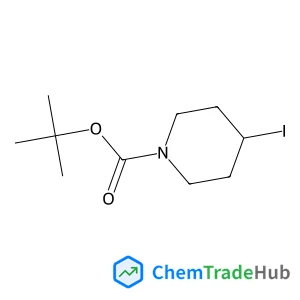
2-Methyl-2-propanyl 4-iodo-1-piperidinecarboxylate
CAS Number:
301673-14-3
Molecular Formula:
C10H18INO2


Recommended Suppliers






Disclaimer
This page provides academic journal information for reference and research purposes only. We are not affiliated with any journal publishers and do not handle publication submissions. For publication-related inquiries, please contact the respective journal publishers directly.
If you notice any inaccuracies in the information displayed, please contact us at support@chemtradehub.com. We will promptly review and address your concerns.