












Functionalized lanthanide coordination polymer nanoparticles for selective sensing of hydrogen peroxide in biological fluids
Literature Information
Publication Date
2014-08-18
DOI
10.1039/C4AN01152J
Impact Factor
4.616
Authors
Hongliang Tan, Chanjiao Ma, Qian Li, Li Wang, Fugang Xu, Shouhui Chen, Yonghai Song
View Original
Abstract
Lanthanide coordination polymers have recently emerged as very fascinating sensing materials due to their tunable structures and unique optical properties. However, a major problem concerning the applications of lanthanide coordination polymers for fluorescent sensing is their unselective recognition to analytes. In this work, a direct post-modification strategy was employed to prepare functionalized lanthanide coordination polymer nanoparticles (Phe/Tb-CPBA CPNPs) with specific response ability to hydrogen peroxide (H2O2) by using phenylalanine (Phe) as bridging ligands, terbium ions (Tb3+) as metal nodes and carboxyphenylboronic acids (CPBAs) as guest ligands. Phe/Tb-CPBA CPNPs emit a strong green fluorescence due to the removal of coordinated water molecules and the sensitization effect of CPBA. Upon the addition of H2O2, however, the quenched fluorescence of Phe/Tb-CPBA CPNPs can be observed owing to an intramolecular charge transfer effect. This finding led to a method for the quantitation of H2O2 in the 6 μM to 1 mM concentration range and with a detection limit at 2 μM. Because of the chemoselective H2O2-mediated oxidative deboronation, Phe/Tb-CPBA CPNPs as fluorescent sensors exhibit excellent selectivity to H2O2. Furthermore, Phe/Tb-CPBA CPNPs were successfully used to measure the level of H2O2 in urine samples and showed satisfactory results. We envision that the presented strategy could be extended to design other functionalized coordination polymers with desired functions for various biomedical applications.
Related Literature
Phase behaviour of room temperature ionic liquid solutions: an unusually large co-solvent effect in (water + ethanol)
Vesna Najdanovic-Visak, José M. S. S. Esperança, Luís P. N. Rebelo, Manuel Nunes da Ponte, Henrique J. R. Guedes, Kenneth R. Seddon, Jerzy Szydlowski
2002-04-02
Communication
DOI: 10.1039/B201723G
Scanning tunneling microscopy study of WS2nanotubes
Luana Scheffer, R. Rosentzveig, A. Margolin, G. Seifert, S. R. Cohen, R. Tenne
2002-05-01
Communication
DOI: 10.1039/B201244H
Black body radiation induced hydrogen formation in hydrated vanadium cations V+(H2O)n
Brigitte S. Fox, Iulia Balteanu, O. Petru Balaj, Haichuan Liu, Martin K. Beyer, Vladimir E. Bondybey
2002-05-01
Paper
DOI: 10.1039/B110849B
Determination of adsorption energies and kinetic parameters by isosteric methods
Wolfgang Ranke, Yvonne Joseph
2002-05-13
Invited Article
DOI: 10.1039/B200363E
Development of kinetic models for the formation and degradation of unsaturated hydrocarbons at high temperature
2002-05-02
Paper
DOI: 10.1039/B110563A
Reactions of chemically activated C9H9 species. Part I. The product distribution of the reaction of phenyl radicals with propyne
Luc Vereecken, Holger F. Bettinger, Jozef Peeters
2002-04-22
Paper
DOI: 10.1039/B109452A
Thermal decomposition of a hydrotalcite-containing Cu–Zn–Al precursor: thermal methods combined with an in situDRIFT study
I. Melián-Cabrera, M. López Granados, J. L. G. Fierro
2002-05-28
Paper
DOI: 10.1039/B201996E
Solubilization of organic compounds into as-synthesized spherical mesoporous silica
Yoshikazu Miyake, Toshimi Yumoto, Hajime Kitamura, Taichi Sugimoto
2002-05-10
Paper
DOI: 10.1039/B200074C
On the kinetics of hydrocarbons oxidation from natural gas to kerosene and diesel fuel
2002-05-03
Paper
DOI: 10.1039/B110787A
Theoretical analysis of the oxocarbons: The role played by the solvent and counter-ions in the electronic spectrum of the deltate ion
Willian R. Rocha, Wagner B. De Almeida, Hélio F. Dos Santos
2002-05-09
Paper
DOI: 10.1039/B109738E
You might also like
Compound Q&A
How should waste containing (6-Bromo-2-naphthyl)oxy](dimethyl)(2-methyl-2-propanyl)silane be handled?
Waste containing (6-Bromo-2-naphthyl)oxy](dimethyl)(2-methyl-2-propanyl)silane (...
100751-65-3[(6-Bromo-2-naphthyl...
Compound Q&A
How is 7-Fluoro-4-isoquinolinecarboxylic acid (CAS: 1841081-40-0) typically synthesized?
7-Fluoro-4-isoquinolinecarboxylic acid can be synthesized via a multi-step proce...
1841081-40-07-Fluoro-4-isoquinol...
Compound Q&A
What are the physical and chemical properties of 2,3,5,6-Tetrabromothieno[3,2-b]thiophene (CAS: 124638-53-5)?
2,3,5,6-Tetrabromothieno[3,2-b]thiophene is a crystalline compound with a high m...
124638-53-52,3,5,6-Tetrabromoth...
Compound Q&A
Is 1-[4-(Benzylamino)-7,8-dihydro-5H-pyrano[4,3-d]pyrimidin-2-yl]-2-methyl-1H-indole-4-carboxamide (CAS: 1542705-92-9) safe?
1-[4-(Benzylamino)-7,8-dihydro-5H-pyrano[4,3-d]pyrimidin-2-yl]-2-methyl-1H-indol...
1542705-92-91-[4-(Benzylamino)-7...
Compound Q&A
What is the market or research trend for imidazo[5,1-d]-1,2,3,5-tetrazine-8-carboxylic acid, 3,4-dihydro-3-methyl-4-oxo- (CAS: 113942-30-6)?
The market for imidazo[5,1-d]-1,2,3,5-tetrazine-8-carboxylic acid, 3,4-dihydro-3...
113942-30-6Imidazo[5,1-d]-1,2,3...
Compound Q&A
What is 3-(Triisopropylsilyl)propiolaldehyde (CAS: 163271-80-5)?
3-(Triisopropylsilyl)propiolaldehyde is a synthetic organic compound with the CA...
163271-80-53-(Triisopropylsilyl...
Compound Q&A
What regulatory guidelines apply to 6-Nitro-2H-1,4-benzoxazin-3(4H)-one (CAS: 81721-87-1)?
6-Nitro-2H-1,4-benzoxazin-3(4H)-one (CAS: 81721-87-1) is subject to various regu...
81721-87-16-Nitro-2H-1,4-benzo...
Compound Q&A
How should waste containing (3-Fluorophenyl)(4-{[(2-methyl-2-propanyl)oxy]carbonyl}-1-piperazinyl)acetic acid (CAS: 885272-91-3) be handled?
Waste containing (3-Fluorophenyl)(4-{[(2-methyl-2-propanyl)oxy]carbonyl}-1-piper...
885272-91-3(3-Fluorophenyl)(4-{...
Compound Q&A
What are the physical and chemical properties of N,N'-4,4'-Biphenyldiyldiisonicotinamide (CAS: 55119-40-9)?
N,N'-4,4'-Biphenyldiyldiisonicotinamide is a white crystalline solid with a mole...
55119-40-9N,N'-4,4'-Biphenyldi...
Compound Q&A
What industries use 6-Bromo-8-fluoro-2-quinazolinol (CAS: 1036756-15-6)?
6-Bromo-8-fluoro-2-quinazolinol is primarily used in the pharmaceutical industry...
1036756-15-66-Bromo-8-fluoro-2-q...
Source Journal
Analyst

CiteScore:
7.8
Self-citation Rate:
5.6%
Articles per Year:
653
Analyst publishes analytical and bioanalytical research that reports premier fundamental discoveries and inventions, and the applications of those discoveries, unconfined by traditional discipline barriers.
Recommended Compounds
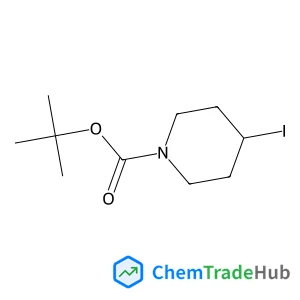
2-Methyl-2-propanyl 4-iodo-1-piperidinecarboxylate
CAS Number:
301673-14-3
Molecular Formula:
C10H18INO2
Recommended Suppliers





Disclaimer
This page provides academic journal information for reference and research purposes only. We are not affiliated with any journal publishers and do not handle publication submissions. For publication-related inquiries, please contact the respective journal publishers directly.
If you notice any inaccuracies in the information displayed, please contact us at support@chemtradehub.com. We will promptly review and address your concerns.