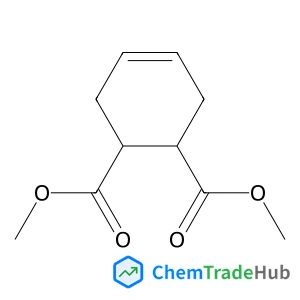
4-Cyclohexene-1,2-dicarboxylic acid, 1,2-dimethyl ester, (1R,2R)-rel-
CAS Number:
17673-68-6
Molecular Formula:
C10H14O4
Ruiwen Hao, Jinming Zhang, Tao Xu, Lei Huang, Jinrong Yao, Xin Chen, Zhengzhong Shao
To obtain the peptides with various functions, the “bottom-up” methods including chem- or bio-synthesis are historically emphasized, in which the sequences of peptide are designed on purpose. In this paper, we present the reverse way, i.e. a “top-down” approach, to harvest the peptides by enzyme hydrolysis of Bombyx mori silkworm silk fibroin (SF), a kind of natural fibrous protein with relatively simple motifs. It is found that the elastase attacks the peptide bond between alanine (A) and glycine (G) in the edges of SF fibril (turning points of the SF chain which folds cross β-sheet) prior to the one in the regular (crystalline) region during the enzymolysis. Therefore, a dodecapeptide GAGSGAGAGSGA in the final product with a relatively high yield confirmed the cross β-sheet structure model for the SF fibrils we proposed in previous work. Moreover, the obtained dodecapeptide is able to form β-sheet, and further assemble into nanofibers with a temperature-responsive behavior. Based on these results, a model is proposed to interpret the structure of the self-assembled dodecapeptide.
Taizo Mori, Waka Nakanishi, Jonathan P. Hill
DOI: 10.1039/C7CP02280H
Ronghua Ma, Xiaotong Chen, Xvsheng Qiao, Xianping Fan, Jincheng Du, Xianghua Zhang
DOI: 10.1039/C7CP02531A
Jorge L. Cholula-Díaz, José Barzola-Quiquia, Marcelo Videa, Chunhai Yin, Pablo Esquinazi
DOI: 10.1039/C7CP04052K
Weimeng Kong, Xilin Zhang, Jianjun Mao, Xiaopei Xu, Yanxing Zhang
DOI: 10.1039/C7CP04718E
Eric R. Kennehan, Christopher Grieco, Alyssa N. Brigeman, Adam Rimshaw, Kayla Bisgaier, Noel C. Giebink
DOI: 10.1039/C7CP04819J
Yingjie Zhang, Yang Li
DOI: 10.1039/C7CP04591C
Jing Kong, Zheng Bo, Huachao Yang, Jinyuan Yang, Xiaorui Shuai, Jianhua Yan, Kefa Cen
DOI: 10.1039/C6CP08752C
DOI: 10.1039/C7CP04759B
Martin Hangaard Hansen, Anders Nilsson, Jan Rossmeisl
DOI: 10.1039/C7CP03576D
DOI: 10.1039/C6CP08265C
6-(3-Fluorophenyl)picolinic acid is generally considered safe for laboratory use...
(3R)-3-Pyrrolidinol is used in the pharmaceutical industry as a precursor for dr...
When handling (4R,5R)-4,5-Diethoxycarbonyl-2,2-dimethyldioxolane (CAS: 59779-75-...
1-(6-Chloroimidazo[1,2-b]pyridazin-3-yl)ethanone is often synthesized via a mult...
The market for N-Ethyl-3,4-dimethylbenzylamine (CAS: 39180-83-1) remains steady,...
Tert-butyl 3-(pyrrolidin-1-yl)azetidine-1-carboxylate is a chemical compound wit...
1-Bromo-3-chloro-2,4-dimethoxybenzene (CAS: 1228956-93-1) falls under the classi...
The safety of 8-Bromo-2-methyl-3,4-dihydroisoquinolin-1(2H)-one (CAS: 1368622-07...
Benzyl [(3S)-2,6-dioxo-3-piperidinyl]carbamate is generally safe when handled wi...
1-{[4-(4,4,5,5-Tetramethyl-1,3,2-dioxaborolan-2-yl)phenyl]sulfonyl}pyrrolidine s...

Polymer Chemistry welcomes submissions in all areas of polymer science that have a strong focus on macromolecular chemistry. Manuscripts may cover a broad range of fields, yet no direct application focus is required.
![4-[(2,4-Dihydroxyphenyl)diazenyl]-5-hydroxy-2,7-naphthalenedisulfonic acid structure](https://static.chemtradehub.com/structs/362/3627-01-8-79ac.webp "4-[(2,4-Dihydroxyphenyl)diazenyl]-5-hydroxy-2,7-naphthalenedisulfonic acid structure")