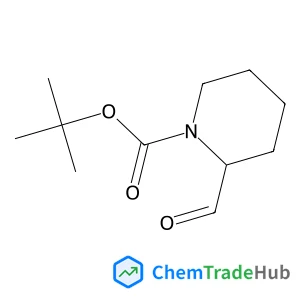
2-Methyl-2-propanyl (2R)-2-formyl-1-piperidinecarboxylate
CAS Number:
134526-69-5
Molecular Formula:
C11H19NO3
Taizo Mori, Waka Nakanishi, Jonathan P. Hill
The investigation of molecules and materials at interfaces is critical for the accumulation of new scientific insights and technological advances in the chemical and physical sciences. Immobilization on solid surfaces permits the investigation of different properties of functional molecules or materials with high sensitivity and high spatial resolution. Liquid surfaces also present important media for physicochemical innovation and insight based on their great flexibility and dynamicity, rapid diffusion of molecular components for mixing and rearrangements, as well as drastic spatial variation in the prevailing dielectric environment. Therefore, a comparative discussion of the relative merits of the properties of materials when positioned at solid or liquid surfaces would be informative regarding present-to-future developments of surface-based technologies. In this perspective article, recent research examples of nanoarchitectonics, molecular machines, DNA nanotechnology, and DNA origami are compared with respect to the type of surface used, i.e. solid surfaces vs. liquid surfaces, for future perspectives of interfacial physics and chemistry.
Joseph S. Carlson, Megan R. Hill, Taiga Young, Philip J. Costanzo
DOI: 10.1039/C0PY00191K
Shengang Xu, Tao Chen, Hongwu Guo, Qiongyan Liu, Baoxian Ye, Zhi Zhang, Zhiqun He, Shaokui Cao
DOI: 10.1039/C0PY00096E
Marc A. Gauthier, Harm-Anton Klok
DOI: 10.1039/C0PY90001J
Johan P. A. Heuts, Stephanie Hoeppener
DOI: 10.1039/C0PY00052C
M. Baklar, S. Barard, D. Sparrowe, R. M. Wilson, T. Kreouzis
DOI: 10.1039/C0PY00056F
Rungsima Chollakup, Wirasak Smitthipong, Arkadiusz Chworos
DOI: 10.1039/B9PY00290A
Stefan Theiler, Michael Teske, Helmut Keul, Katrin Sternberg, Martin Möller
DOI: 10.1039/C0PY00097C
Taina Matos, Rui Li, Jason E. Lewis, Jian Zhang, Xiaomei Jiang
DOI: 10.1039/B9PY00324J
6-(3-Fluorophenyl)picolinic acid is generally considered safe for laboratory use...
(3R)-3-Pyrrolidinol is used in the pharmaceutical industry as a precursor for dr...
When handling (4R,5R)-4,5-Diethoxycarbonyl-2,2-dimethyldioxolane (CAS: 59779-75-...
1-(6-Chloroimidazo[1,2-b]pyridazin-3-yl)ethanone is often synthesized via a mult...
The market for N-Ethyl-3,4-dimethylbenzylamine (CAS: 39180-83-1) remains steady,...
Tert-butyl 3-(pyrrolidin-1-yl)azetidine-1-carboxylate is a chemical compound wit...
1-Bromo-3-chloro-2,4-dimethoxybenzene (CAS: 1228956-93-1) falls under the classi...
The safety of 8-Bromo-2-methyl-3,4-dihydroisoquinolin-1(2H)-one (CAS: 1368622-07...
Benzyl [(3S)-2,6-dioxo-3-piperidinyl]carbamate is generally safe when handled wi...
1-{[4-(4,4,5,5-Tetramethyl-1,3,2-dioxaborolan-2-yl)phenyl]sulfonyl}pyrrolidine s...

Physical Chemistry Chemical Physics (PCCP) is an international journal co-owned by 19 physical chemistry and physics societies from around the world. This journal publishes original, cutting-edge research in physical chemistry, chemical physics and biophysical chemistry. To be suitable for publication in PCCP, articles must include significant innovation and/or insight into physical chemistry; this is the most important criterion that reviewers and Editors will judge against when evaluating submissions. The journal has a broad scope and welcomes contributions spanning experiment, theory, computation and data science. Topical coverage includes spectroscopy, dynamics, kinetics, statistical mechanics, thermodynamics, electrochemistry, catalysis, surface science, quantum mechanics, quantum computing and machine learning. Interdisciplinary research areas such as polymers and soft matter, materials, nanoscience, energy, surfaces/interfaces, and biophysical chemistry are welcomed if they demonstrate significant innovation and/or insight into physical chemistry. Joined experimental/theoretical studies are particularly appreciated when complementary and based on up-to-date approaches.