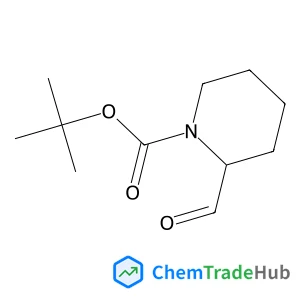
2-Methyl-2-propanyl (2R)-2-formyl-1-piperidinecarboxylate
CAS Number:
134526-69-5
Molecular Formula:
C11H19NO3
Jitka Škodová, Dušan Kopecký, Martin Vrňata, Martin Varga, Jan Prokeš, Miroslav Cieslar, Patrycja Bober, Jaroslav Stejskal
Polypyrrole nanotubes were prepared by the oxidation of pyrrole with iron(III) chloride in the presence of methyl orange. They were subsequently used for the reduction of silver ions to silver nanoparticles. The nanotubular form of polypyrrole is compared with the classical globular morphology in its ability to reduce silver ions. Both polypyrrole salts and bases were used in the experiments. The content of metallic silver in the resulting composite, determined by thermogravimetric analysis, was 21–31 wt%. Elemental composition is also discussed on the basis of energy-dispersive X-ray spectroscopy. Contrary to the expectation, the conductivity of polypyrrole nanotubes in salt form, 35.7 S cm−1, was reduced to 20.9 S cm−1 after the incorporation of silver. The presence of silver had generally little effect on the conductivity. The temperature dependence of conductivity reveals that the composites maintain the semiconducting character of polypyrrole and their conductivity increased with increasing temperature. The conductivity of the composites surprisingly increased when the samples were placed in vacuo.
DOI: 10.1039/C7CP04759B
Gilles Frapper
DOI: 10.1039/C6CP08708F
Nathalie Minko Ito, Waldemir Moura Carvalho, Jr, Dereck Nills Ferreira Muche, Ricardo Hauch Ribeiro Castro, Gustavo Martini Dalpian
DOI: 10.1039/C7CP04827K
I. León, E. R. Alonso, S. Mata, C. Cabezas, M. A. Rodríguez, J.-U. Grabow, J. L. Alonso
DOI: 10.1039/C7CP03924G
Noriyuki Isobe, James H. Clark, Seishi Shimizu
DOI: 10.1039/C7CP04647B
DOI: 10.1039/C7CP90191G
Sarah D. Hann, Daeyeon Lee, Kathleen J. Stebe
DOI: 10.1039/C7CP02809A
Jing Kong, Zheng Bo, Huachao Yang, Jinyuan Yang, Xiaorui Shuai, Jianhua Yan, Kefa Cen
DOI: 10.1039/C6CP08752C
Dominik Lindorfer, Frank Müh, Thomas Renger
DOI: 10.1039/C6CP08778G
6-(3-Fluorophenyl)picolinic acid is generally considered safe for laboratory use...
(3R)-3-Pyrrolidinol is used in the pharmaceutical industry as a precursor for dr...
When handling (4R,5R)-4,5-Diethoxycarbonyl-2,2-dimethyldioxolane (CAS: 59779-75-...
1-(6-Chloroimidazo[1,2-b]pyridazin-3-yl)ethanone is often synthesized via a mult...
The market for N-Ethyl-3,4-dimethylbenzylamine (CAS: 39180-83-1) remains steady,...
Tert-butyl 3-(pyrrolidin-1-yl)azetidine-1-carboxylate is a chemical compound wit...
1-Bromo-3-chloro-2,4-dimethoxybenzene (CAS: 1228956-93-1) falls under the classi...
The safety of 8-Bromo-2-methyl-3,4-dihydroisoquinolin-1(2H)-one (CAS: 1368622-07...
Benzyl [(3S)-2,6-dioxo-3-piperidinyl]carbamate is generally safe when handled wi...
1-{[4-(4,4,5,5-Tetramethyl-1,3,2-dioxaborolan-2-yl)phenyl]sulfonyl}pyrrolidine s...

Polymer Chemistry welcomes submissions in all areas of polymer science that have a strong focus on macromolecular chemistry. Manuscripts may cover a broad range of fields, yet no direct application focus is required.