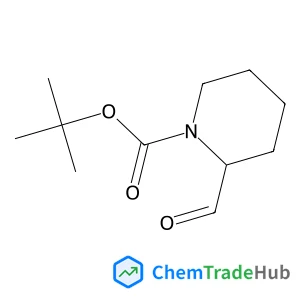
2-Methyl-2-propanyl (2R)-2-formyl-1-piperidinecarboxylate
CAS Number:
134526-69-5
Molecular Formula:
C11H19NO3
Sarah D. Hann, Daeyeon Lee, Kathleen J. Stebe
Interfacial complexation between two oppositely charged polymers in aqueous two phase systems (ATPSs) leads to the formation of mechanically robust microcapsules that can be stressed without losing their structural integrity. When a polyelectrolyte (PE) is replaced with a charged nanoparticle (NP), microcapsules with internal compartments can be generated within an encapsulated shell comprising NPs and PEs, named AWE-somes. These shells, made by interfacial complexation between PEs and NPs, are, however, very brittle and can lose their integrity under mechanical stress, potentially limiting their applications. Improved control over the properties and structure of microcapsules over a wide range is needed to enable their broad utilization. In this work, we show that interfacial complexation of a polycation with a mixture of a polyanion and a negatively charged NP in ATPS presents a simple yet versatile method of tuning the structure and properties of microcapsules. We show that internal structure, along with the mechanical robustness and stimuli-responsive properties of microcapsules, can be varied by changing the concentrations of polyanion and NP present in one of the two aqueous phases. Interfacial complexation of PE with mixtures of PE and NP provides a new strategy for controlling and imparting the properties and functionality of AWE-some interfacial membranes for applications in encapsulation and release of active agents and recapitulation of basic functions of living cells.
Johannes Pall Magnusson, Aram Omer Saeed, Francisco Fernández-Trillo, Cameron Alexander
DOI: 10.1039/C0PY00210K
Andrew J. Inglis, Christopher Barner-Kowollik
DOI: 10.1039/C0PY00189A
Xiang Ma, Ruyi Sun, Weifeng Li, He Tian
DOI: 10.1039/C0PY00419G
Hiromasa Goto, Kohsuke Kawabata
DOI: 10.1039/C0PY00396D
Miaojun Ding, Hongyuan Hu
DOI: 10.1039/C0PY00170H
Stefan Theiler, Michael Teske, Helmut Keul, Katrin Sternberg, Martin Möller
DOI: 10.1039/C0PY00097C
Tanay Kesharwani, Justin S. Valenstein, Brian G. Trewyn, Fengkui Li, Victor S.-Y. Lin, Richard C. Larock
DOI: 10.1039/C0PY00145G
Christian Porsch, Susanne Hansson, Niklas Nordgren, Eva Malmström
DOI: 10.1039/C0PY00417K
Zhenhua Zhang, Bo Liu, Chunyue Pan, Yongfang Li, Yuehui He, Kechao Zhou, Yingping Zou
DOI: 10.1039/C0PY00136H
6-(3-Fluorophenyl)picolinic acid is generally considered safe for laboratory use...
(3R)-3-Pyrrolidinol is used in the pharmaceutical industry as a precursor for dr...
When handling (4R,5R)-4,5-Diethoxycarbonyl-2,2-dimethyldioxolane (CAS: 59779-75-...
1-(6-Chloroimidazo[1,2-b]pyridazin-3-yl)ethanone is often synthesized via a mult...
The market for N-Ethyl-3,4-dimethylbenzylamine (CAS: 39180-83-1) remains steady,...
Tert-butyl 3-(pyrrolidin-1-yl)azetidine-1-carboxylate is a chemical compound wit...
1-Bromo-3-chloro-2,4-dimethoxybenzene (CAS: 1228956-93-1) falls under the classi...
The safety of 8-Bromo-2-methyl-3,4-dihydroisoquinolin-1(2H)-one (CAS: 1368622-07...
Benzyl [(3S)-2,6-dioxo-3-piperidinyl]carbamate is generally safe when handled wi...
1-{[4-(4,4,5,5-Tetramethyl-1,3,2-dioxaborolan-2-yl)phenyl]sulfonyl}pyrrolidine s...

Physical Chemistry Chemical Physics (PCCP) is an international journal co-owned by 19 physical chemistry and physics societies from around the world. This journal publishes original, cutting-edge research in physical chemistry, chemical physics and biophysical chemistry. To be suitable for publication in PCCP, articles must include significant innovation and/or insight into physical chemistry; this is the most important criterion that reviewers and Editors will judge against when evaluating submissions. The journal has a broad scope and welcomes contributions spanning experiment, theory, computation and data science. Topical coverage includes spectroscopy, dynamics, kinetics, statistical mechanics, thermodynamics, electrochemistry, catalysis, surface science, quantum mechanics, quantum computing and machine learning. Interdisciplinary research areas such as polymers and soft matter, materials, nanoscience, energy, surfaces/interfaces, and biophysical chemistry are welcomed if they demonstrate significant innovation and/or insight into physical chemistry. Joined experimental/theoretical studies are particularly appreciated when complementary and based on up-to-date approaches.