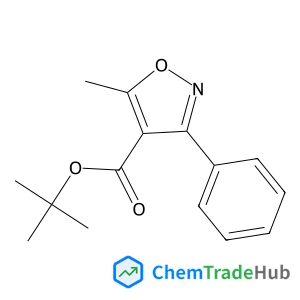
2-Methyl-2-propanyl 5-methyl-3-phenyl-1,2-oxazole-4-carboxylate
CAS Number:
211429-79-7
Molecular Formula:
C15H17NO3
Binbin Zhang, Jinliang Song, Huizhen Liu, Jinghua Shi, Jun Ma, Honglei Fan, Weitao Wang, Peng Zhang, Buxing Han
Enhancement of reaction efficiency using non-toxic, abundant, and cheap additives is an interesting topic in green chemistry. In this paper, we report the first work to study the effect of salt particles on organic reactions in different solvents, in which the salts were not soluble, and it was discovered that NaCl, KCl, Na2SO4 and K2SO4 particles could considerably accelerate Suzuki coupling reactions catalyzed by the Pd nanocatalysts. X-ray photoelectron spectroscopy (XPS) and Fourier transform infrared spectroscopy (FT-IR) studies indicated that there exist strong interactions between the salts and the catalyst (Pd) and between the salts and the reactants, which are important reasons for the synergistic effect of the catalyst and the salts. The application of salt particles suspended in organic reaction systems may become a useful strategy to develop new and green reaction routes.
Rafał Szabla, Robert W. Góra
DOI: 10.1039/C6CP01391K
DOI: 10.1039/C5CP03924J
Jan Chalabala, Petr Slavíček
DOI: 10.1039/C6CP02714H
Claudio Bulloni, Amador García-Fuente, Werner Urland, Claude Daul
DOI: 10.1039/C5CP02915E
Djemel Hamdane, Christophe Velours, David Cornu, Magali Nicaise, Murielle Lombard, Marc Fontecave
DOI: 10.1039/C6CP03635J
Niloy Kundu, Debasis Banik, Arpita Roy, Jagannath Kuchlyan, Nilmoni Sarkar
DOI: 10.1039/C5CP03906A
Yajun Zhang
DOI: 10.1039/C6CP03056D
Shahin Sowlati-Hashjin, Stacey D. Wetmore
DOI: 10.1039/C5CP04250J
Camila S. Monteiro, Daniele C. Ferreira, Gustavo A. M. Sáfar, Rafael N. Gontijo, Cristiano Fantini, Dayse C. S. Martins, Ynara M. Idemori, Maurício V. B. Pinheiro, Klaus Krambrock
DOI: 10.1039/C6CP03366K
M. H. Ghatee, S. Namvar, A. R. Zolghadr, F. Moosavi
DOI: 10.1039/C5CP02683K
When handling 4-Methyl-6-(trifluoromethyl)quinoline (CAS: 40716-16-3), safety go...
4-(3,5-Difluorophenyl)aniline is an aromatic organic compound with the CAS numbe...
5-{[4-(Trifluoromethyl)phenyl]sulfanyl}-1,2,3-thiadiazole-4-carboxylic acid can ...
The market for 4-Benzylaniline hydrochloride (CAS: 6317-57-3) is steadily growin...
[3-(Diethylsulfamoyl)phenyl]boronic acid is generally considered safe when handl...
3-Bromo-2,5-dimethoxyaniline is mainly used in the pharmaceutical and chemical i...
N-Methyl-1-(5-methyl-1H-indol-3-yl)methanamine (CAS: 915922-67-7) is subject to ...
This compound is primarily used in the pharmaceutical industry for the synthesis...
2-Methyl-2-propanyl [(1S,3R)-3-aminocyclohexyl]carbamate (CAS: 1298101-47-9) sho...
Ethyl 2-bromo-4,4,4-trifluorobutanoate (CAS: 367-33-9) is utilized in the pharma...

Green Chemistry provides a unique forum for the publication of innovative research on the development of alternative green and sustainable technologies. The scope of Green Chemistry is based on, but not limited to, the definition proposed by Anastas and Warner (Green Chemistry: Theory and Practice, P T Anastas and J C Warner, Oxford University Press, Oxford, 1998). Green chemistry is the utilisation of a set of principles that reduces or eliminates the use or generation of hazardous substances in the design, manufacture and application of chemical products. Green Chemistry is at the frontiers of this continuously-evolving interdisciplinary science and publishes research that attempts to reduce the environmental impact of the chemical enterprise by developing a technology base that is inherently non-toxic to living things and the environment. Submissions on all aspects of research relating to the endeavour are welcome. The journal publishes original and significant cutting-edge research that is likely to be of wide general appeal. To be published, work must present a significant advance in green chemistry. Papers must contain a comparison with existing methods and demonstrate advantages over those methods before publication can be considered. For more information please see this Editorial. Coverage includes the following, but is not limited to: Design (e.g. biomimicry, design for degradation/recycling/reduced toxicity…) Reagents & Feedstocks (e.g. renewables, CO2, solvents, auxiliary agents, waste utilization…) Synthesis (e.g. organic, inorganic, synthetic biology…) Catalysis (e.g. homogeneous, heterogeneous, enzyme, whole cell…) Process (e.g. process design, intensification, separations, recycling, efficiency…) Energy (e.g. renewable energy, fuels, photovoltaics, fuel cells, energy storage, energy carriers…) Applications (e.g. electronics, dyes, consumer products, coatings, pharmaceuticals, preservatives, building materials, chemicals for industry/agriculture/mining…) Impact (e.g. safety, metrics, LCA, sustainability, (eco)toxicology…) Green chemistry is, by definition, a continuously-evolving frontier. Therefore, the inclusion of a particular material or technology does not, of itself, guarantee that a paper is suitable for the journal. To be suitable, the novel advance should have the potential for reduced environmental impact relative to the state of the art. Green Chemistry does not normally deal with research associated with 'end-of-pipe' or remediation issues.