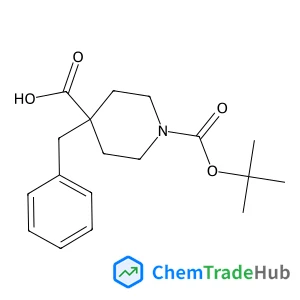
4-Benzyl-1-(tert-butoxycarbonyl)piperidine-4-carboxylic acid
CAS Number:
170838-87-6
Molecular Formula:
C18H25NO4
Rémi Auvergne, Sylvain Caillol
Rosin acid oligomers were modified and utilized in order to prepare thermosets based on epoxy resins. Epoxide groups were incorporated into this acidic precursor by various synthetic strategies and the corresponding thermosets were obtained thanks to an amino curing agent. Endocyclic epoxidized materials were firstly prepared and used as an additive to diglycidyl ether of bisphenol A (DGEBA) in the presence of isophorone diamine. In a second approach, glycidyl esters of rosin acid oligomers were synthesized and thus utilized for the preparation of DGEBA-free thermosets. Some thermo-mechanical properties of the resulting epoxy resins were explored by DSC and DMA analytical techniques.

Colloid Journal

Bioorganic & Medicinal Chemistry

Electroanalysis

Journal of Chemical Sciences

Herald of the Russian Academy of Sciences

Acta Metallurgica Sinica-English Letters

Critical Reviews in Solid State and Materials Sciences

Main Group Chemistry

Polycyclic Aromatic Compounds

Journal of the Indian Institute of Science
Yong Qiao, Jincui An
DOI: 10.1039/C5AN02564H
Lu Zhou, Jun Zhou, Zhao Feng, Fuyan Wang, Shushen Xie, Shizhong Bu
DOI: 10.1039/C6AN00003G
Jing Wu, Hua Tang, Minghui He, Guangxue Chen, Junfei Tian
DOI: 10.1039/C9AN01131E
J. Sarkar, A. Kumar
DOI: 10.1039/C6AN00356G
Chenguang Wang, Tianxiao Guo
DOI: 10.1039/C6AN00145A
Yuhua Zhu, Jianying Wang, Xiang Zhu, Jun Wang, Lijie Zhou, Jinhua Li, Tao Mei, Jingwen Qian, Lai Wei, Xianbao Wang
DOI: 10.1039/C9AN01287G
Khairunnisa Amreen, Annamalai Senthil Kumar
DOI: 10.1039/C5AN02646F
Vanessa G. Santos, Marcos A. Pudenzi, Clécio F. Klitzke, Heliara L. Nascimento, Rosana C. L. Pereira, Wagner L. Bastos, Marcos N. Eberlin
DOI: 10.1039/C5AN02333E
When handling 4-(2-Furylmethyl)thiomorpholine 1,1-dioxide (CAS: 79206-94-3), it ...
When handling 4-Chloro-N-[2-(4-morpholinyl)ethyl]benzamide (CAS: 71320-77-9), it...
Waste containing this compound (CAS: 62921-74-8) should be handled according to ...
Waste containing (S)-Methyl 2-amino-3-cyclohexylpropanoate should be collected i...
This compound can be synthesized using a multi-step process involving the conjug...
There are several alternatives to (2E)-3-(3,4-Dichlorophenyl)acrylic acid in syn...
Ethyl 6-(2-nitrophenyl)imidazo[2,1-b][1,3]thiazole-3-carboxylate (CAS: 925437-84...
Waste containing 2-(1,3-Thiazol-2-yl)ethanamine (CAS: 18453-07-1) should be coll...
Methyl 5-iodo-2-methylbenzoate can be synthesized through the iodination of meth...
5-Chloro[1,2,4]triazolo[1,5-a]pyridine is commonly synthesized via the condensat...

Green Chemistry provides a unique forum for the publication of innovative research on the development of alternative green and sustainable technologies. The scope of Green Chemistry is based on, but not limited to, the definition proposed by Anastas and Warner (Green Chemistry: Theory and Practice, P T Anastas and J C Warner, Oxford University Press, Oxford, 1998). Green chemistry is the utilisation of a set of principles that reduces or eliminates the use or generation of hazardous substances in the design, manufacture and application of chemical products. Green Chemistry is at the frontiers of this continuously-evolving interdisciplinary science and publishes research that attempts to reduce the environmental impact of the chemical enterprise by developing a technology base that is inherently non-toxic to living things and the environment. Submissions on all aspects of research relating to the endeavour are welcome. The journal publishes original and significant cutting-edge research that is likely to be of wide general appeal. To be published, work must present a significant advance in green chemistry. Papers must contain a comparison with existing methods and demonstrate advantages over those methods before publication can be considered. For more information please see this Editorial. Coverage includes the following, but is not limited to: Design (e.g. biomimicry, design for degradation/recycling/reduced toxicity…) Reagents & Feedstocks (e.g. renewables, CO2, solvents, auxiliary agents, waste utilization…) Synthesis (e.g. organic, inorganic, synthetic biology…) Catalysis (e.g. homogeneous, heterogeneous, enzyme, whole cell…) Process (e.g. process design, intensification, separations, recycling, efficiency…) Energy (e.g. renewable energy, fuels, photovoltaics, fuel cells, energy storage, energy carriers…) Applications (e.g. electronics, dyes, consumer products, coatings, pharmaceuticals, preservatives, building materials, chemicals for industry/agriculture/mining…) Impact (e.g. safety, metrics, LCA, sustainability, (eco)toxicology…) Green chemistry is, by definition, a continuously-evolving frontier. Therefore, the inclusion of a particular material or technology does not, of itself, guarantee that a paper is suitable for the journal. To be suitable, the novel advance should have the potential for reduced environmental impact relative to the state of the art. Green Chemistry does not normally deal with research associated with 'end-of-pipe' or remediation issues.